Koohestani Hamid Reza, Baghcheghi Nayereh
Department of Medical Education, Social Determinants of Health Research Center, Saveh University of Medical Sciences, Saveh, Iran.
Department of Nursing, Saveh University of Medical Sciences, Saveh, Iran.
J Educ Health Promot. 2020 Aug 31;9:208. doi: 10.4103/jehp.jehp_224_20. eCollection 2020.
There is a growing interest in learning styles of undergraduate health-care professional students; however, the evidences about learning styles over time during undergraduate programs are rare. In this study, the learning styles of undergraduate health-care professional students from the beginning to the completion of the program were examined to determine changes in learning style over time.
This is a longitudinal descriptive study from 2015 to 2018. A total of 101 health-care professional students were selected by census method. Learning styles were evaluated using the Perceptual Learning-Style Preference Questionnaire three times in the study at the beginning (T1), the middle (T2), and the end of the educational course (T3). The data were analyzed using repeated measures ANOVA.
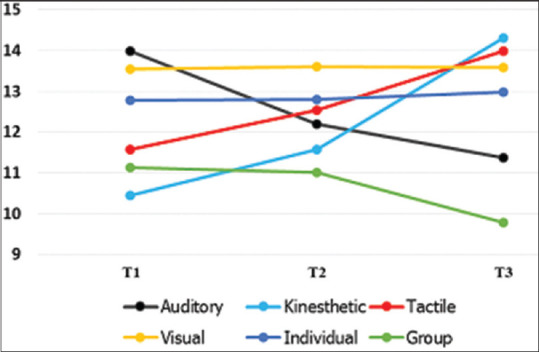
In T1, auditory (mean = 13.99) and visual (mean = 13.54) styles were preferred as major learning styles, whereas at T2, visual style (mean = 13.6) was the only preferred major learning style. At T3, the major learning styles were kinesthetic (mean = 14.32), tactile (mean = 13.98), and visual (mean = 13.58). There were statistically significant differences in auditory, kinesthetic, tactile and group scale scores between the three time points ( < 0.05). Group learning style was in the negative type at all three time points.
Learning styles can change depending on the context, environment, teaching method, and the subject of learning material and are probably a flexible changing feature rather than a fixed inherent feature a student possesses.
本科医护专业学生的学习风格越来越受到关注;然而,关于本科课程期间学习风格随时间变化的证据却很少。在本研究中,对本科医护专业学生从课程开始到结束的学习风格进行了考察,以确定学习风格随时间的变化。
这是一项2015年至2018年的纵向描述性研究。采用普查法共选取了101名医护专业学生。在研究开始时(T1)、中期(T2)和课程结束时(T3),使用感知学习风格偏好问卷对学习风格进行了三次评估。数据采用重复测量方差分析进行分析。
在T1时,听觉(均值 = 13.99)和视觉(均值 = 13.54)风格是主要的学习风格,而在T2时,视觉风格(均值 = 13.6)是唯一主要的偏好学习风格。在T3时,主要的学习风格是动觉(均值 = 14.32)、触觉(均值 = 13.98)和视觉(均值 = 13.58)。三个时间点在听觉、动觉、触觉和小组量表得分上存在统计学显著差异(<0.05)。小组学习风格在所有三个时间点均为负向类型。
学习风格可能会根据情境、环境、教学方法以及学习材料的主题而发生变化,并且可能是一种灵活变化的特征,而非学生所拥有的固定内在特征。