Department of Neuroscience, Rehabilitation, Ophthalmology, Genetics and Mother and Child Sciences (DINOGMI), University of Genoa, Genoa, Italy.
IRCCS Ospedale Policlinico San Martino, Genoa, Italy.
Intern Emerg Med. 2021 Apr;16(3):735-739. doi: 10.1007/s11739-020-02522-w. Epub 2020 Oct 15.
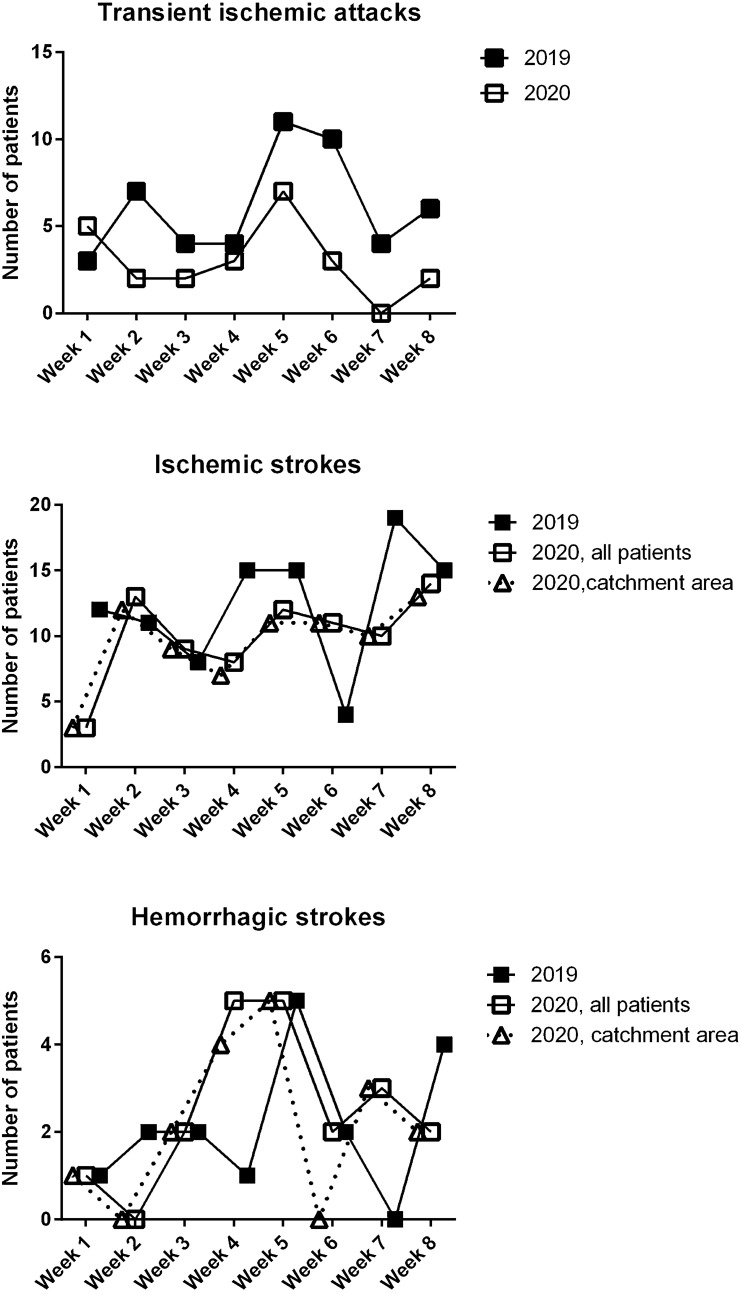
Reduced incidence of stroke during COVID-19 pandemic was sometimes reported. While decrease in stroke incidence and fear of patients to go to the hospitals were sometimes invoked to explain this decrease, reduction in urban pollution was also hypothesized as a possible cause. We investigated statistically the incidence of ischemic and hemorrhagic stroke, and of transient ischemic attacks, at a large Italian tertiary stroke center during the pandemic. We analyzed statistically the number of transient ischemic attacks (TIA), ischemic strokes (IS) and hemorrhagic strokes (HS) between March 8 and May 2, 2020, the peak of the COVID-19 epidemic in Italy, and compared them with the identical period of 2019. We also analyzed the concentration of small particulate matter (PM) in 2019 and 2020, to see if it could account for modified incidence of strokes or TIA. We found a large, significant drop in TIA (- 51%) during the pandemic compared to the same period of 2019. By contrast, the number of HS was identical, and IS showed a not significant - 24% decrease. PM concentration, already low in 2019, did not further decrease in 2020. Patients kept seeking hospital care when experiencing permanent neurological symptoms (stroke), but they tended not go to the hospital when their symptoms were transient (TIA). The fact that we did not observe a significant decrease in strokes may be explained by the fact that in our city the concentration of small particulate matter did not change compared to 2019.
有时报道称 COVID-19 大流行期间中风的发病率降低。虽然有时会减少中风的发病率和患者对去医院的恐惧来解释这种减少,但也假设城市污染减少是可能的原因。我们在一家大型意大利三级卒中中心统计调查了大流行期间缺血性和出血性中风以及短暂性脑缺血发作的发病率。我们统计分析了 2020 年 3 月 8 日至 5 月 2 日(意大利 COVID-19 疫情高峰期)期间短暂性脑缺血发作(TIA)、缺血性中风(IS)和出血性中风(HS)的数量,并将其与 2019 年同期进行了比较。我们还分析了 2019 年和 2020 年小颗粒物(PM)的浓度,以了解其是否可以解释中风或 TIA 发病率的变化。我们发现,与 2019 年同期相比,大流行期间 TIA 大幅显著下降(-51%)。相比之下,HS 的数量相同,IS 则下降了不显著的-24%。2020 年 PM 浓度已经较低,并未进一步降低。当出现永久性神经症状(中风)时,患者仍会寻求医院治疗,但当症状短暂(TIA)时,他们往往不会去医院。我们没有观察到中风明显减少,可能是因为与 2019 年相比,我们城市的小颗粒物浓度没有变化。