Peters Sanne A E, Carcel Cheryl, Millett Elizabeth R C, Woodward Mark
From The George Institute for Global Health (S.A.E.P., E.R.C.M., M.W.), University of Oxford, UK; Julius Center for Health Sciences and Primary Care (S.A.E.P.), University Medical Center Utrecht, Utrecht University, the Netherlands; The George Institute for Global Health (C.C., M.W.), University of New South Wales; The University of Sydney (C.C.), Sydney School of Public Health, Sydney Medical School, New South Wales, Australia; and Department of Epidemiology (M.W.), Johns Hopkins University, Baltimore, MD.
Neurology. 2020 Nov 17;95(20):e2715-e2726. doi: 10.1212/WNL.0000000000010982. Epub 2020 Oct 16.
To determine whether there are sex differences in the association between risk factors and incident stroke, including stroke subtypes.
A total of 471,971 (56% women) UK Biobank participants without a history of cardiovascular disease were included. During 9 years of follow-up, 4,662 (44% women) cases of stroke were recorded. Cox models yielded adjusted hazard ratios (HRs) and women-to-men ratios of HRs (RHRs) for stroke associated with 7 risk factors.
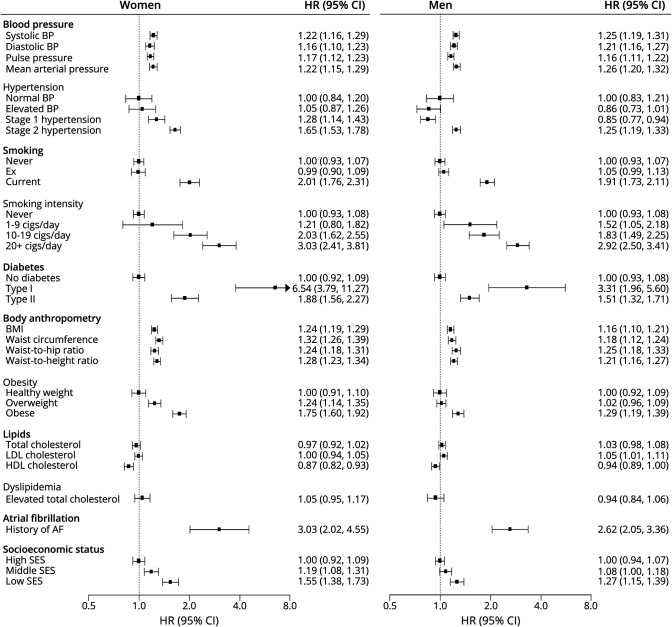
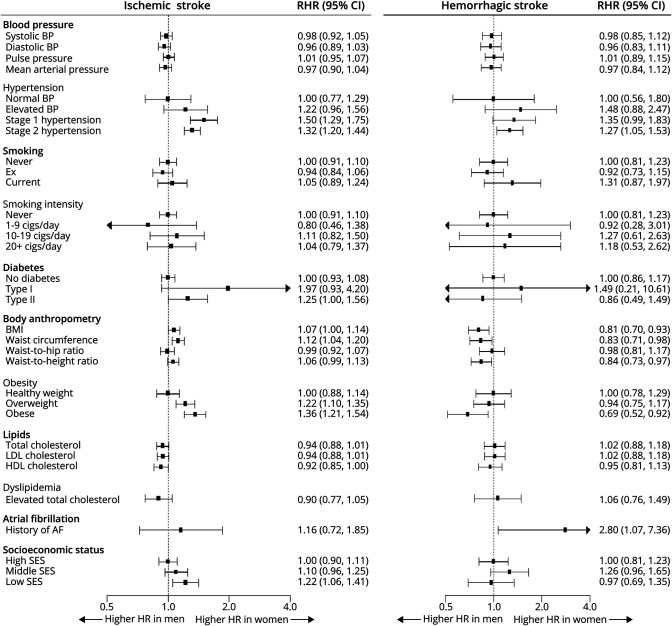
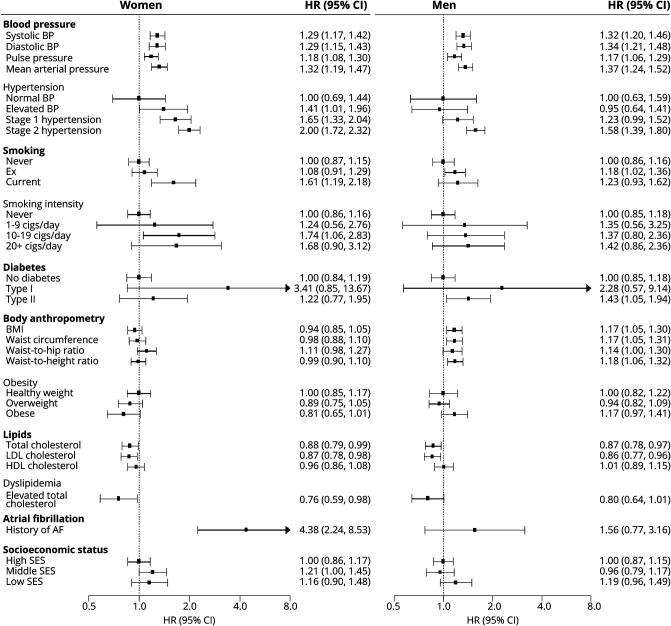
The incidence rate per 10,000 person-years was 8.66 (8.29-9.04) in women and 13.96 (13.44-14.50) in men for any stroke, 6.06 (5.75-6.38) in women and 11.35 (10.88; 11.84) in men for ischemic stroke, and 1.56 (1.41-1.73) in women and 2.23 (2.02-2.45) in men for hemorrhagic stroke. The association between increases in blood pressure, body anthropometry, and lipids, diabetes, and atrial fibrillation and any stroke was similar between men and women. Hypertension, smoking, and a low socioeconomic status were associated with a greater HR of any stroke in women than men; the RHRs were 1.36 (1.26-1.47), 1.18 (1.02-1.36), and 1.17 (1.03-1.33), respectively. Diabetes was associated with a higher HR of ischemic stroke in women than men (RHR 1.25 [1.00-1.56]). Atrial fibrillation was associated with a higher HR of hemorrhagic stroke in women than men (RHR 2.80 [1.07-7.36]).
Several risk factors are more strongly associated with the risk of any stroke or stroke subtypes in women compared with men. Despite this, the incidence of stroke remains higher among men than women.
确定危险因素与新发卒中(包括卒中亚型)之间的关联是否存在性别差异。
纳入英国生物银行中471,971名无心血管疾病史的参与者(女性占56%)。在9年的随访期间,记录了4,662例卒中病例(女性占44%)。Cox模型得出与7种危险因素相关的卒中的校正风险比(HR)以及女性与男性的HR比值(RHR)。
任何卒中的每10,000人年发病率在女性中为8.66(8.29 - 9.04),在男性中为13.96(13.44 - 14.50);缺血性卒中在女性中为6.06(5.75 - 6.38),在男性中为11.35(10.88;11.84);出血性卒中在女性中为1.56(1.41 - 1.73),在男性中为2.23(2.02 - 2.45)。血压升高、身体测量指标、血脂、糖尿病和心房颤动与任何卒中之间的关联在男性和女性中相似。高血压、吸烟和低社会经济地位与女性任何卒中的HR升高相关,高于男性;RHR分别为1.36(1.26 - 1.47)、1.18(1.02 - 1.36)和1.17(1.03 - 1.33)。糖尿病与女性缺血性卒中的HR升高相关,高于男性(RHR 1.25 [1.00 - 1.56])。心房颤动与女性出血性卒中的HR升高相关,高于男性(RHR 2.80 [1.07 - 7.36])。
与男性相比,几种危险因素与女性任何卒中或卒中亚型风险的关联更强。尽管如此,男性卒中的发病率仍高于女性。