Martens Marieke Annie Gerdine, Kaltenboeck Alexander, Halahakoon Don Chamith, Browning Michael, Cowen Philip J, Harmer Catherine J
Department of Psychiatry, University of Oxford, Warneford Hospital, Oxford OX3 7JX, UK.
Wellcome Centre for Integrative Neuroimaging, University of Oxford, Oxford OX3 7JX, UK.
Pharmaceuticals (Basel). 2021 Aug 14;14(8):800. doi: 10.3390/ph14080800.
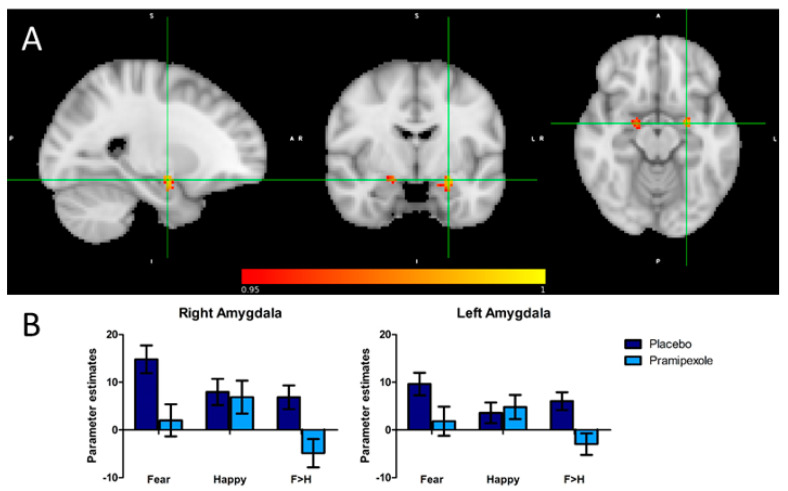
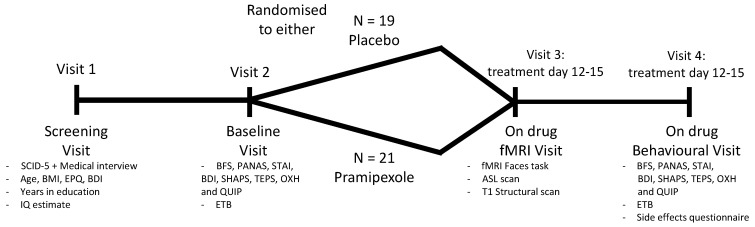
Treatment with the dopamine D2/D3 receptor agonist pramipexole has demonstrated promising clinical effects in patients with depression. However, the mechanisms through which pramipexole might alleviate depressive symptoms are currently not well understood. Conventional antidepressant drugs are thought to work by biasing the processing of emotional information in favour of positive relative to negative appraisal. In this study, we used an established experimental medicine assay to explore whether pramipexole treatment might have a similar effect. Employing a double-blind, parallel-group design, 40 healthy volunteers (aged 18 to 43 years, 50% female) were randomly allocated to 12 to 15 days of treatment with either pramipexole (at a peak daily dose of 1.0 mg pramipexole salt) or placebo. After treatment was established, emotional information processing was assessed on the neural level by measuring amygdala activity in response to positive and negative facial emotional expressions, using functional magnetic resonance imaging (MRI). In addition, behavioural measures of emotional information processing were collected at baseline and on drug, using an established computerized task battery, tapping into different cognitive domains. As predicted, pramipexole-treated participants, compared to those receiving placebo, showed decreased neural activity in response to negative (fearful) vs. positive (happy) facial expressions in bilateral amygdala. Contrary to our predictions, however, pramipexole treatment had no significant antidepressant-like effect on behavioural measures of emotional processing. This study provides the first experimental evidence that subacute pramipexole treatment in healthy volunteers modifies neural responses to emotional information in a manner that resembles the effects of conventional antidepressant drugs.
使用多巴胺D2/D3受体激动剂普拉克索进行治疗已在抑郁症患者中显示出有前景的临床效果。然而,目前对于普拉克索减轻抑郁症状的机制尚不清楚。传统抗抑郁药物被认为是通过偏向于积极而非消极评估来处理情绪信息而起作用的。在本研究中,我们使用一种既定的实验医学检测方法来探究普拉克索治疗是否可能有类似的效果。采用双盲、平行组设计,40名健康志愿者(年龄在18至43岁之间,50%为女性)被随机分配接受12至15天的普拉克索(每日最大剂量为1.0毫克普拉克索盐)或安慰剂治疗。在确定治疗方案后,通过功能磁共振成像(MRI)测量杏仁核在对正面和负面面部情绪表达做出反应时的活动,在神经层面评估情绪信息处理情况。此外,在基线和用药时,使用一套既定的计算机化任务组收集情绪信息处理的行为测量数据,这些任务涉及不同的认知领域。正如预期的那样,与接受安慰剂的参与者相比,接受普拉克索治疗的参与者在双侧杏仁核中对负面(恐惧)与正面(快乐)面部表情的反应中,神经活动有所减少。然而,与我们的预测相反,普拉克索治疗在情绪处理的行为测量方面没有显著的抗抑郁样效果。本研究提供了首个实验证据,表明在健康志愿者中进行亚急性普拉克索治疗会以类似于传统抗抑郁药物的方式改变对情绪信息的神经反应。