Yu Guangyuan, Li Xuefei, He Ting-Fang, Gruosso Tina, Zuo Dongmei, Souleimanova Margarita, Ramos Valentina Muñoz, Omeroglu Atilla, Meterissian Sarkis, Guiot Marie-Christine, Yang Li, Yuan Yuan, Park Morag, Lee Peter P, Levine Herbert
Department of Physics and Astronomy, Rice University, Houston, TX, United States.
Center for Theoretical Biological Physics, Rice University, Houston, TX, United States.
Front Physiol. 2020 Sep 23;11:511071. doi: 10.3389/fphys.2020.511071. eCollection 2020.
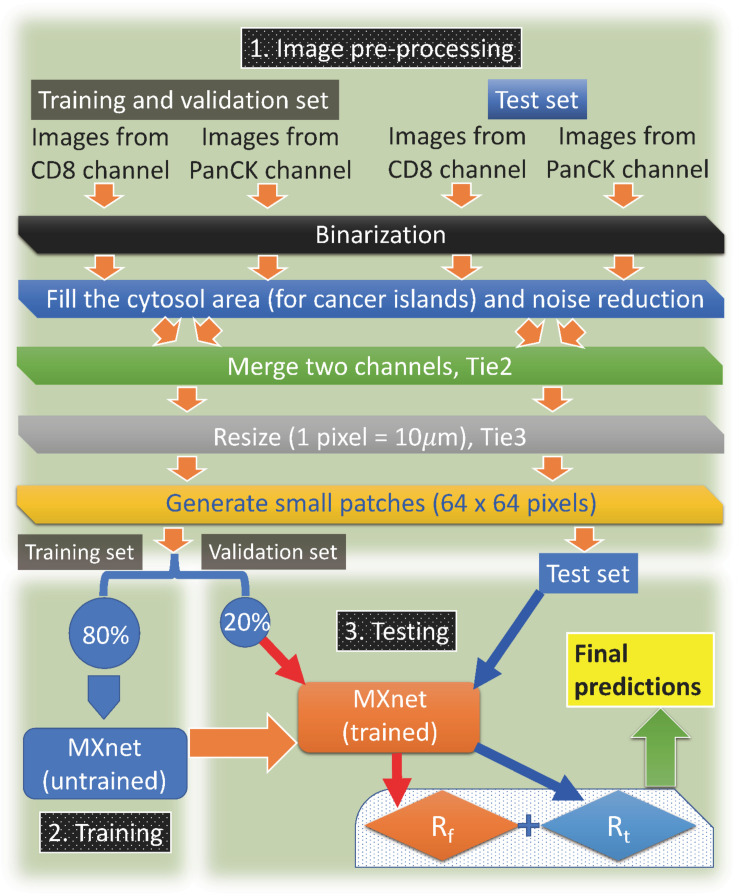
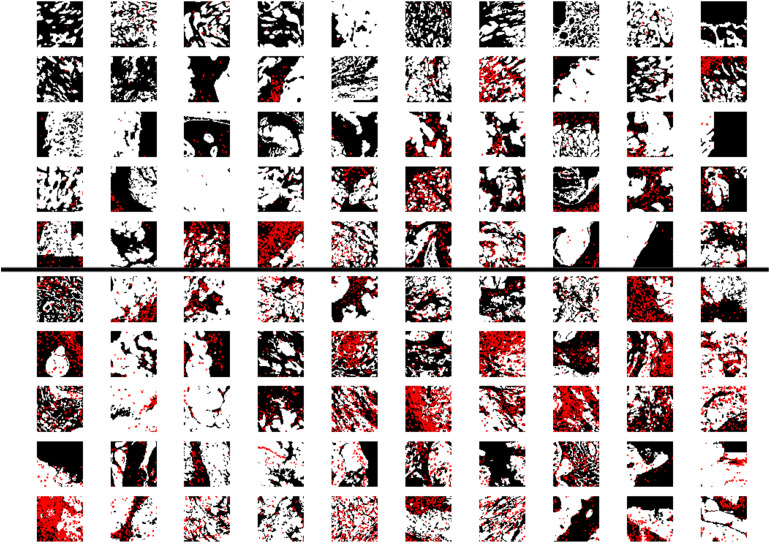
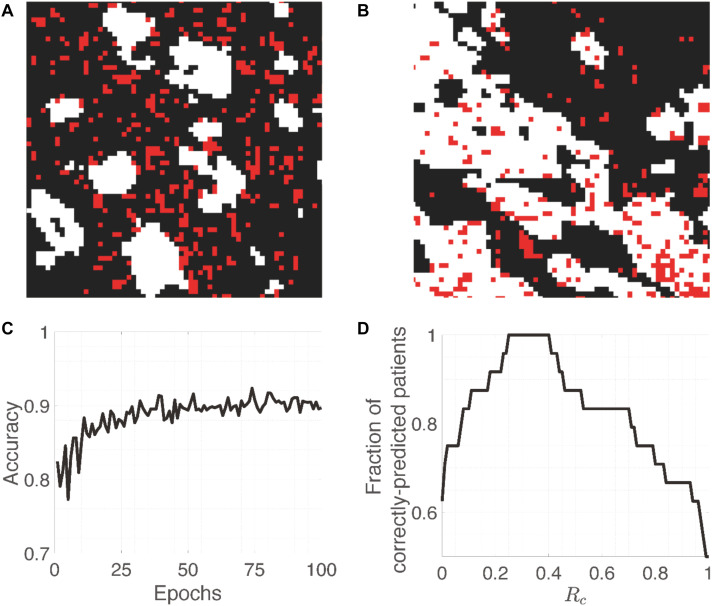
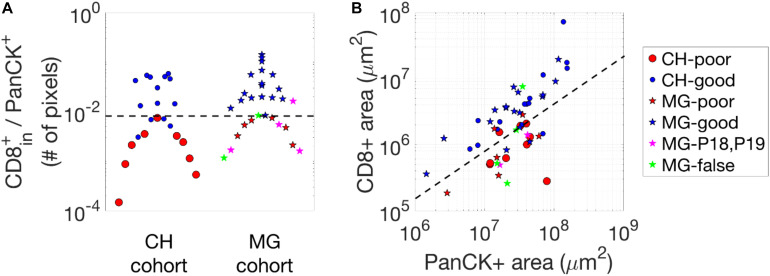
The abundance and/or location of tumor infiltrating lymphocytes (TILs), especially CD8 T cells, in solid tumors can serve as a prognostic indicator in various types of cancer. However, it is often difficult to select an appropriate threshold value in order to stratify patients into well-defined risk groups. It is also important to select appropriate tumor regions to quantify the abundance of TILs. On the other hand, machine-learning approaches can stratify patients in an unbiased and automatic fashion. Based on immunofluorescence (IF) images of CD8 T lymphocytes and cancer cells, we develop a machine-learning approach which can predict the risk of relapse for patients with Triple Negative Breast Cancer (TNBC). Tumor-section images from 9 patients with poor outcome and 15 patients with good outcome were used as a training set. Tumor-section images of 29 patients in an independent cohort were used to test the predictive power of our algorithm. In the test cohort, 6 (out of 29) patients who belong to the poor-outcome group were all correctly identified by our algorithm; for the 23 (out of 29) patients who belong to the good-outcome group, 17 were correctly predicted with some evidence that improvement is possible if other measures, such as the grade of tumors, are factored in. Our approach does not involve arbitrarily defined metrics and can be applied to other types of cancer in which the abundance/location of CD8 T lymphocytes/other types of cells is an indicator of prognosis.
实体瘤中肿瘤浸润淋巴细胞(TILs),尤其是CD8 T细胞的数量和/或位置,可作为多种癌症的预后指标。然而,为了将患者分层到明确的风险组中,通常很难选择合适的阈值。选择合适的肿瘤区域来量化TILs的数量也很重要。另一方面,机器学习方法可以以无偏且自动的方式对患者进行分层。基于CD8 T淋巴细胞和癌细胞的免疫荧光(IF)图像,我们开发了一种机器学习方法,该方法可以预测三阴性乳腺癌(TNBC)患者的复发风险。来自9例预后不良患者和15例预后良好患者的肿瘤切片图像用作训练集。独立队列中29例患者的肿瘤切片图像用于测试我们算法的预测能力。在测试队列中,我们的算法正确识别出了29例中属于预后不良组的6例患者;对于29例中属于预后良好组的23例患者,正确预测了17例,并且有证据表明,如果考虑其他因素,如肿瘤分级,预测可能会有所改善。我们的方法不涉及任意定义的指标,可应用于CD8 T淋巴细胞/其他类型细胞的数量/位置是预后指标的其他类型癌症。