Zheng Qingyuan, Yang Rui, Ni Xinmiao, Yang Song, Jiao Panpan, Wu Jiejun, Xiong Lin, Wang Jingsong, Jian Jun, Jiang Zhengyu, Wang Lei, Chen Zhiyuan, Liu Xiuheng
Department of Urology, Renmin Hospital of Wuhan University, Wuhan 430060, China.
Institute of Urologic Disease, Renmin Hospital of Wuhan University, Wuhan 430060, China.
J Clin Med. 2022 Nov 29;11(23):7081. doi: 10.3390/jcm11237081.
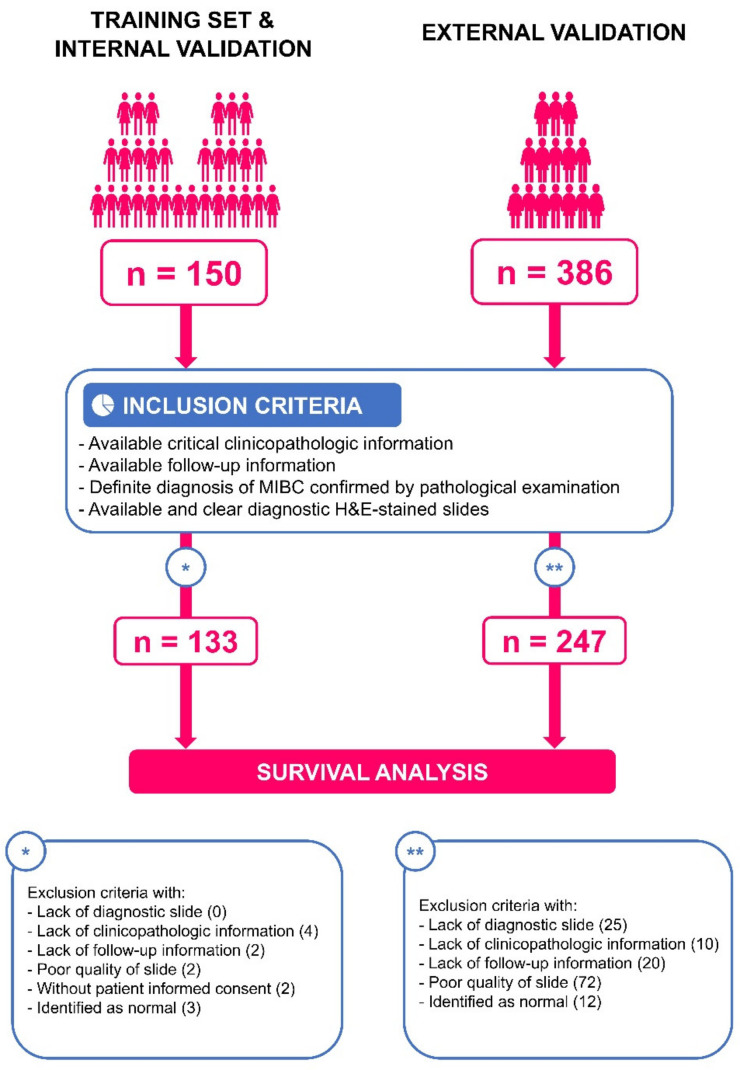
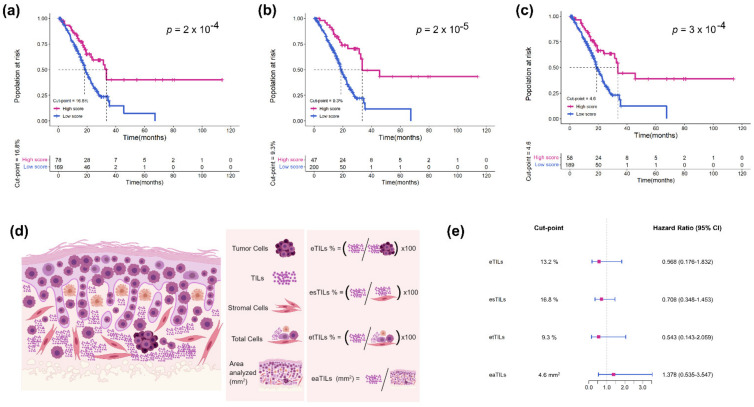
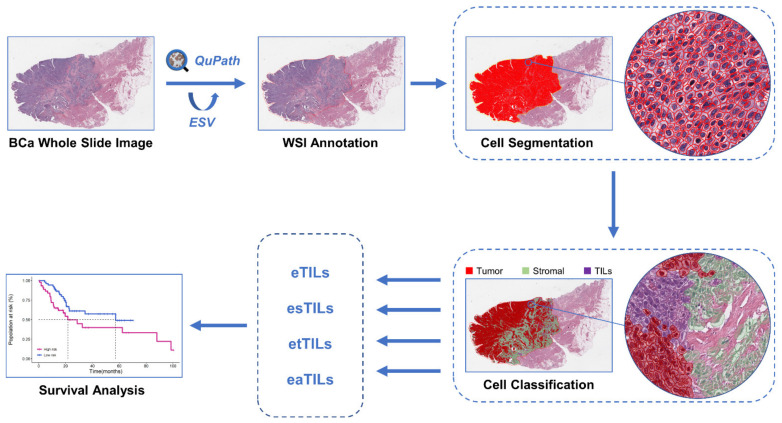
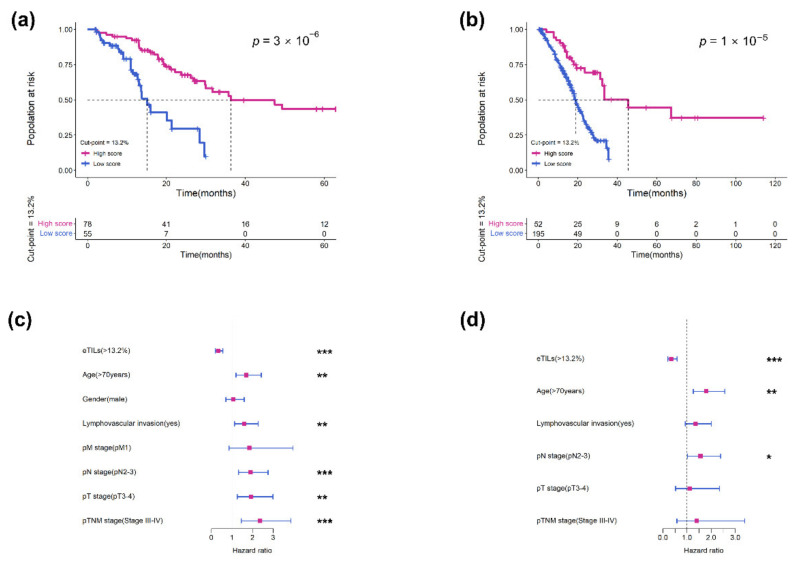
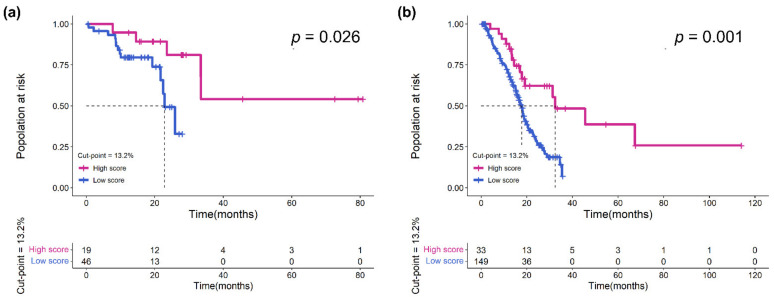
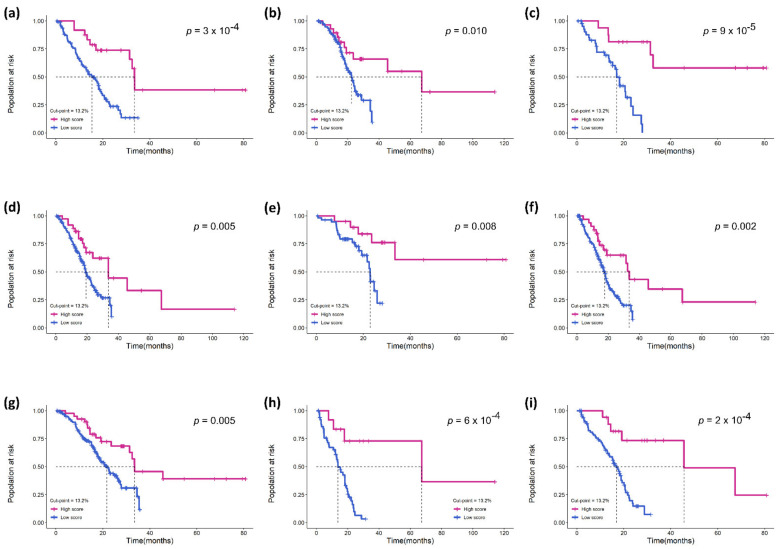
(1) Purpose: Although assessment of tumor-infiltrating lymphocytes (TILs) has been acknowledged to have important predictive prognostic value in muscle-invasive bladder cancer (MIBC), it is limited by inter- and intra-observer variability, hampering widespread clinical application. We aimed to evaluate the prognostic value of quantitative TILs score based on a machine learning (ML) algorithm to identify MIBC patients who might benefit from immunotherapy or the de-escalation of therapy. (2) Methods: We constructed an artificial neural network classifier for tumor cells, lymphocytes, stromal cells, and “ignore” cells from hematoxylin-and-eosin-stained slide images using the QuPath open source software. We defined four unique TILs variables based on ML to analyze TILs measurements. Pathological slide images from 133 MIBC patients were retrospectively collected as the discovery set to determine the optimal association of ML-read TILs variables with patient survival outcomes. For validation, we evaluated an independent external validation set consisting of 247 MIBC patients. (3) Results: We found that all four TILs variables had significant prognostic associations with survival outcomes in MIBC patients (p < 0.001 for all comparisons), with higher TILs score being associated with better prognosis. Univariate and multivariate Cox regression analyses demonstrated that electronic TILs (eTILs) variables were independently associated with overall survival after adjustment for clinicopathological factors including age, sex, and pathological stage (p < 0.001 for all analyses). Results analyzed in different subgroups showed that the eTILs variable was a strong prognostic factor that was not redundant with pre-existing clinicopathological features (p < 0.05 for all analyses). (4) Conclusion: ML-driven cell classifier-defined TILs variables were robust and independent prognostic factors in two independent cohorts of MIBC patients. eTILs have the potential to identify a subset of high-risk stage II or stage III-IV MIBC patients who might benefit from adjuvant immunotherapy.
(1) 目的:尽管肿瘤浸润淋巴细胞(TILs)评估在肌肉浸润性膀胱癌(MIBC)中具有重要的预测预后价值,但它受观察者间和观察者内变异性的限制,阻碍了其在临床的广泛应用。我们旨在评估基于机器学习(ML)算法的定量TILs评分的预后价值,以识别可能从免疫治疗或降阶梯治疗中获益的MIBC患者。(2) 方法:我们使用QuPath开源软件从苏木精-伊红染色的玻片图像中构建了一个用于肿瘤细胞、淋巴细胞、基质细胞和“忽略”细胞的人工神经网络分类器。我们基于ML定义了四个独特的TILs变量来分析TILs测量值。回顾性收集133例MIBC患者的病理玻片图像作为发现集,以确定ML读取的TILs变量与患者生存结果的最佳关联。为了进行验证,我们评估了一个由247例MIBC患者组成的独立外部验证集。(3) 结果:我们发现所有四个TILs变量与MIBC患者的生存结果均有显著的预后关联(所有比较p<0.001),TILs评分越高,预后越好。单因素和多因素Cox回归分析表明,在调整年龄、性别和病理分期等临床病理因素后,电子TILs(eTILs)变量与总生存独立相关(所有分析p<0.001)。在不同亚组中的分析结果表明,eTILs变量是一个强大的预后因素,与现有的临床病理特征不冗余(所有分析p<0.05)。(4) 结论:ML驱动的细胞分类器定义的TILs变量在两个独立的MIBC患者队列中是强大且独立的预后因素。eTILs有可能识别出可能从辅助免疫治疗中获益的高危II期或III-IV期MIBC患者亚组。