Samuel Roy David, Tenenbaum Gershon, Galily Yair
Interdisciplinary Center Herzliya, Herzliya, Israel.
Front Psychol. 2020 Sep 23;11:567966. doi: 10.3389/fpsyg.2020.567966. eCollection 2020.
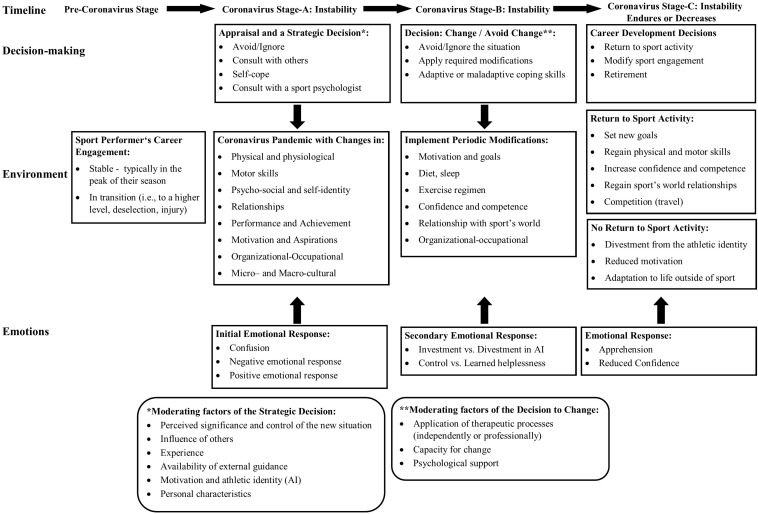
The Coronavirus experience (CE) presents a highly challenging period for sport performers (e.g., athletes, coaches, referees), with potential effects on their lives and career trajectories. In this article, we initially conceptualize the CE using the scheme of change for sport psychology practice (Samuel and Tenenbaum, 2011a). Within this framework, the CE is understood as a longitudinal, multifaceted, unpredicted, non-controlled change-event, with four distinct stages: (a) a pre-Coronavirus stage with unique career contextual conditions (i.e., stable engagement or a transitional period), (b) Coronavirus stage-A accompanied by instability and confusion, emotional response, and cognitive appraisal, (c) Coronavirus stage-B characterized by active coping or regression, and (d) Coronavirus stage-C; instability endures or decreases, depending on career trajectory. The CE presents sport performers with modifications in various dimensions, including physical and physiological, motor skills, psycho-social and self-identity, relationships, performance and achievement, motivation and aspirations, organizational-occupational, and micro- and macro-cultural issues. Sport performers can exhibit several emotional responses (i.e., positive, negative, neutral), and consequential coping endeavors. The development of the change process is underlined by key decisions, manifested in sport performers' attempts to implement responsive change in these dimensions (e.g., adapt their diets, sleep routines, and exercise regimen). The second part of the article discusses applied practice considerations, presenting various techniques and methodologies which practitioners can apply while consulting from a change-based perspective. Ethical issues pertaining to the formation of effective therapeutic relationships during this period are also assessed. The conclusions offer future avenues for researchers and practitioners when attempting to evaluate and cope with this global phenomenon.
新冠疫情经历(CE)对体育从业者(如运动员、教练、裁判)而言是极具挑战性的时期,可能会对他们的生活和职业轨迹产生影响。在本文中,我们最初运用体育心理学实践的变革框架(塞缪尔和特南鲍姆,2011年a)对新冠疫情经历进行概念化。在此框架内,新冠疫情经历被理解为一个纵向的、多方面的、不可预测的、不受控制的变革事件,具有四个不同阶段:(a)新冠疫情前阶段,具有独特的职业背景条件(即稳定的参与状态或过渡时期);(b)新冠疫情阶段A,伴有不稳定和困惑、情绪反应及认知评估;(c)新冠疫情阶段B,其特征为积极应对或退行;(d)新冠疫情阶段C,不稳定持续或减轻,这取决于职业轨迹。新冠疫情经历在多个维度给体育从业者带来了变化,包括身体和生理、运动技能、心理社会和自我认同、人际关系、表现和成就、动机和抱负、组织职业以及微观和宏观文化问题。体育从业者可能会表现出多种情绪反应(即积极、消极、中性)以及相应的应对努力。变革过程的发展以关键决策为突出特点,这些决策体现在体育从业者试图在这些维度实施适应性变革(例如,调整饮食、睡眠习惯和锻炼计划)。文章的第二部分讨论了应用实践方面的考虑因素,介绍了从业者从基于变革的视角进行咨询时可以应用的各种技术和方法。还评估了在此期间形成有效治疗关系所涉及的伦理问题。结论为研究人员和从业者在试图评估和应对这一全球现象时提供了未来的方向。