
网络疑病症和焦虑敏感性在伊朗在线人群中问题性互联网使用、元认知信念与对COVID-19的恐惧之间关联中的中介作用。
The mediating effect of the cyberchondria and anxiety sensitivity in the association between problematic internet use, metacognition beliefs, and fear of COVID-19 among Iranian online population.
作者信息
Seyed Hashemi Seyed Ghasem, Hosseinnezhad Shalaleh, Dini Solmaz, Griffiths Mark D, Lin Chung-Ying, Pakpour Amir H
机构信息
Department of Psychology, Faculty of Psychology and Educational Sciences, Azarbaijan Shahid Madani University, Tabriz, Iran.
Department of Psychology, Urmia Branch, Islamic Azad University, Urmia, Iran.
出版信息
Heliyon. 2020 Oct;6(10):e05135. doi: 10.1016/j.heliyon.2020.e05135. Epub 2020 Oct 10.
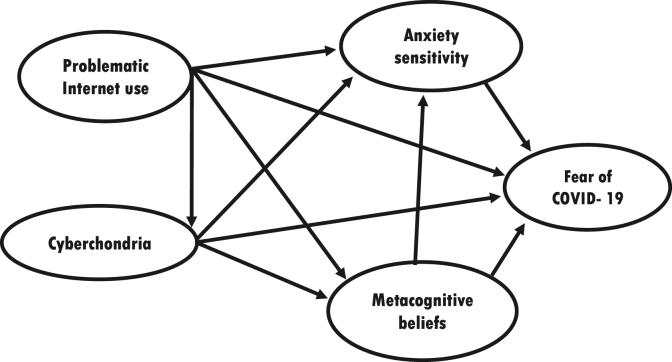
With the rapid growth of the novel coronavirus disease 2019 (COVID-19), individuals may try to find related medical information using the internet to overcome their fears. Under such circumstances, individuals with the features of cyberchondria, anxiety sensitivity, and metacognitive beliefs in negative thoughts may suffer more fears than those without these features. Therefore, the present study proposed a model to understand the associations between problematic internet use (PIU), cyberchondria, anxiety sensitivity, metacognition beliefs, and fear of COVID-19. Utilizing a cross-sectional online survey, 651 Iranians completed the following psychometric scales: Metacognition Questionnaire-30 (MCQ-30), Anxiety Sensitivity Questionnaire (ASI), Cyberchondria Severity Scale-Short Form (CSS-12), Fear of COVID-19 Scale (FCV-19S), and Generalized Problematic Internet Use Scale (GPIUS). Structural equation modeling (SEM) was used to assess the proposed model via several fit indices. The indices include Tucker-Lewis index (TLI), comparative fit index (CFI), standardized root mean square residual (SRMR), and root mean square error of approximation (RMSEA). The fit indices (CFI = 0.948, TLI = 0.938, RMSEA = 0.053, and SRMR = 0.001) indicated the good fit between the data and the proposed model. Moreover, fear of COVID-19 was significantly and directly predicted by cyberchondria (β = 0.479, < .001) and anxiety sensitivity (β = 0.286, < .001). The relationship between PIU and cyberchondria with fear of COVID-19 was mediated significantly by anxiety sensitivity and metacognitive beliefs. Because fear of COVID-19 was found to be significantly associated with cyberchondria and anxiety sensitivity, healthcare providers may want to provide additional support for those with cyberchondria and anxiety sensitivity tendencies.
随着2019年新型冠状病毒病(COVID-19)的迅速蔓延,人们可能会试图通过互联网查找相关医学信息来克服恐惧。在这种情况下,具有网络疑病症、焦虑敏感性和对负面想法的元认知信念等特征的人可能比没有这些特征的人更容易产生恐惧。因此,本研究提出了一个模型,以了解问题性互联网使用(PIU)、网络疑病症、焦虑敏感性、元认知信念与对COVID-19的恐惧之间的关联。通过横断面在线调查,651名伊朗人完成了以下心理测量量表:元认知问卷-30(MCQ-30)、焦虑敏感性问卷(ASI)、网络疑病症严重程度量表简版(CSS-12)、对COVID-19的恐惧量表(FCV-19S)和广义问题性互联网使用量表(GPIUS)。采用结构方程模型(SEM)通过几个拟合指数来评估所提出的模型。这些指数包括塔克-刘易斯指数(TLI)、比较拟合指数(CFI)、标准化根均方残差(SRMR)和近似根均方误差(RMSEA)。拟合指数(CFI = 0.948,TLI = 0.938,RMSEA = 0.053,SRMR = 0.001)表明数据与所提出的模型拟合良好。此外,网络疑病症(β = 0.479,p <.001)和焦虑敏感性(β = 0.286,p <.001)对COVID-19的恐惧有显著的直接预测作用。PIU和网络疑病症与对COVID-19的恐惧之间的关系通过焦虑敏感性和元认知信念显著中介。由于发现对COVID-19的恐惧与网络疑病症和焦虑敏感性显著相关,医疗保健提供者可能需要为有网络疑病症和焦虑敏感性倾向的人提供额外的支持。
 Zotero 插件