Faculty of Psychology, University of Warsaw, Warsaw, Poland.
PLoS One. 2021 Aug 5;16(8):e0255750. doi: 10.1371/journal.pone.0255750. eCollection 2021.
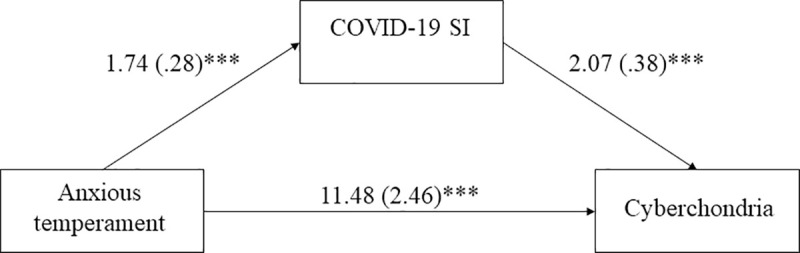
This study's main goal was to evaluate the association between anxious temperament and the fear of COVID-19-related self-infection and infection in loved ones (family members, friends, relatives) and cyberchondria. The sample consisted of 499 men and women aged between 18 and 72 who were gathered from the general population via an online recruitment platform. A numerical rating scale comprising 11 degrees of fear was used to assess participants' COVID-19-related fear, and affective temperaments were evaluated using Akiskal's Temperament Evaluation of the Memphis, Pisa, Paris and San Diego Autoquestionnaire (TEMPS-A) scales. Cyberchondria was assessed using McElroy and Shevlin's Cyberchondria Severity Scale (CSS). Small to medium positive correlations were found between depressive, cyclothymic, irritable and anxious temperaments and cyberchondria and between depressive and anxious temperaments and COVID-19 fears. However, no correlation was observed between the hyperthymic temperament and cyberchondria. Cyberchondria positively correlated with both COVID-19 fears scales, though the correlation coefficients were medium. Based on the results of linear regression analysis, only anxious temperament and COVID-19 fear of self-infection were significant predictors of cyberchondria. The analysis also revealed a significant indirect effect of anxious temperament on cyberchondria through fear of COVID-19 self-infection as a mediator between anxious temperament and cyberchondria.
这项研究的主要目的是评估焦虑气质与对 COVID-19 相关自我感染和感染亲人(家庭成员、朋友、亲戚)以及网络疑病症的恐惧之间的关联。样本由 499 名年龄在 18 至 72 岁之间的男性和女性组成,他们通过在线招聘平台从普通人群中招募而来。使用 11 级恐惧程度的数字评分量表评估参与者的 COVID-19 相关恐惧,使用 Akiskal 的孟菲斯、比萨、巴黎和圣地亚哥自动问卷(TEMPS-A)量表评估情感气质。使用 McElroy 和 Shevlin 的网络疑病症严重程度量表(CSS)评估网络疑病症。抑郁、环性、易激惹和焦虑气质与网络疑病症以及抑郁和焦虑气质与 COVID-19 恐惧之间存在小到中等程度的正相关。然而,高反应性气质与网络疑病症之间没有相关性。网络疑病症与 COVID-19 恐惧的两个量表均呈正相关,尽管相关系数为中等。基于线性回归分析的结果,只有焦虑气质和 COVID-19 自我感染恐惧是网络疑病症的显著预测因子。分析还揭示了焦虑气质通过 COVID-19 自我感染恐惧对网络疑病症的显著间接影响,焦虑气质和网络疑病症之间的中介变量。