
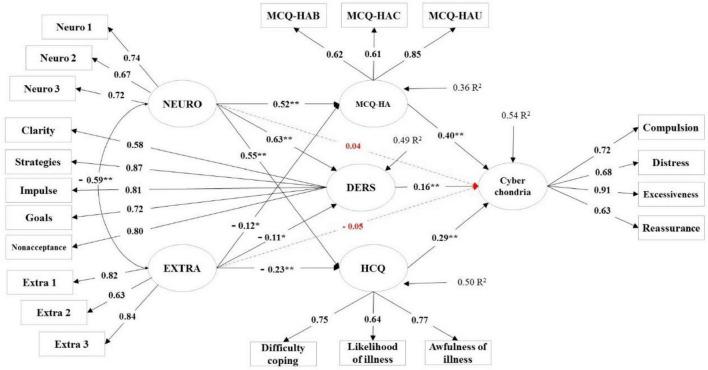
基于人格特质、健康相关元认知、认知偏差和情绪失调的网络chondria结构模型。 (注:这里“chondria”不太明确准确含义,可能是个特定术语或拼写有误,按照原文直接翻译)
The structural model of cyberchondria based on personality traits, health-related metacognition, cognitive bias, and emotion dysregulation.
作者信息
Nasiri Mohammad, Mohammadkhani Shahram, Akbari Mehdi, Alilou Majid Mahmoud
机构信息
Department of Clinical Psychology, Faculty of Psychology and Education, Kharazmi University, Tehran, Iran.
Department of Psychology, Faculty of Psychology and Educational Sciences, University of Tabriz, Tabriz, Iran.
出版信息
Front Psychiatry. 2023 Jan 9;13:960055. doi: 10.3389/fpsyt.2022.960055. eCollection 2022.
INTRODUCTION
Cyberchondria is excessive seeking for online health-related information related to increasing health anxiety and distress levels. The current study investigated the mediating role of health-related metacognition, cognitive bias, and emotion dysregulation in the relationship between personality traits and cyberchondria.
METHODS
Participants were 703 individuals 18+ years old who had access to the internet (males = 43.8%, mean age = 33.82 ± 10.09 years and females = 56.2%, mean age = 34.37 ± 11.16 years). They voluntarily completed a questionnaire package that included the Cyberchondria Severity Scale (CSS), the revised NEO Personality Inventory (NEO-PI-R), the Difficulties in Emotion Regulation Scale (DERS), the Meta-Cognitions about Health Questionnaire (MCQ-HA), and the Health Cognitions Questionnaire (HCQ).
RESULTS
The initial evaluation of the model demonstrated that the personality traits of openness to experience, agreeableness, and conscientiousness had no significant relationship with other variables in the structural model, and the effects of neuroticism and extroversion were the only significant results. Rerunning the model with the removal of non-significant variables revealed a full mediation of health-related metacognition, cognitive bias, and emotion dysregulation in the relation between personality traits (neuroticism and extraversion) and cyberchondria. Fit indices demonstrated the acceptable fit of the model with the collected data (χ = 979.24, <.001; NFI = 0.92, CFI = 0.93, GFI = 0.90, IFI = 0.93, RMSEA = 0.071, and SRMR = 0.063). The results indicated that the present model could explain = 54% of cyberchondria variance.
DISCUSSION
These findings suggest that health-related metacognition, cognitive bias, and emotion dysregulation could demonstrate a full mediating role in the correlation between personality traits and cyberchondria.
引言
网络疑病症是指过度搜索与健康焦虑和痛苦水平增加相关的在线健康信息。本研究调查了与健康相关的元认知、认知偏差和情绪调节障碍在人格特质与网络疑病症关系中的中介作用。
方法
参与者为703名18岁及以上可上网的个体(男性占43.8%,平均年龄=33.82±10.09岁;女性占56.2%,平均年龄=34.37±11.16岁)。他们自愿完成了一套问卷,包括网络疑病症严重程度量表(CSS)、修订后的大五人格量表(NEO-PI-R)、情绪调节困难量表(DERS)、健康元认知问卷(MCQ-HA)和健康认知问卷(HCQ)。
结果
对模型的初步评估表明,经验开放性、宜人性和尽责性等人格特质与结构模型中的其他变量无显著关系,神经质和外向性的影响是唯一显著的结果。去除不显著变量后重新运行模型,结果显示与健康相关的元认知、认知偏差和情绪调节障碍在人格特质(神经质和外向性)与网络疑病症的关系中起到完全中介作用。拟合指数表明该模型与收集的数据拟合良好(χ=979.24,p<.001;NFI=0.92,CFI=0.93,GFI=0.90,IFI=0.93,RMSEA=0.071,SRMR=0.063)。结果表明,本模型可以解释54%的网络疑病症变异。
讨论
这些发现表明,与健康相关的元认知、认知偏差和情绪调节障碍在人格特质与网络疑病症的相关性中可能起到完全中介作用。

 Zotero 插件