Department of Cardiothoracic Surgery, Ningbo Medical Centre Lihuili Hospital, Ningbo University, Ningbo, Zhejiang 315041, China.
Institute of Pharmaceutics, College of Pharmaceutical Sciences, Zhejiang University, Hangzhou, China.
Biosci Rep. 2020 Nov 27;40(11). doi: 10.1042/BSR20201573.
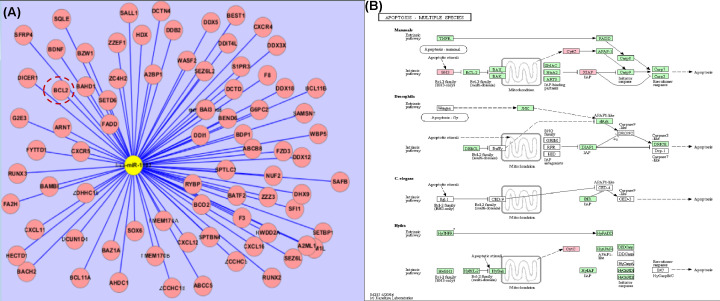
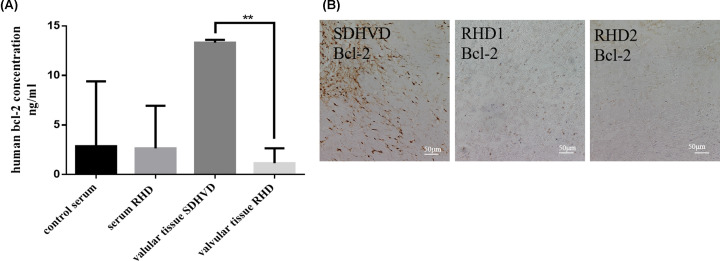
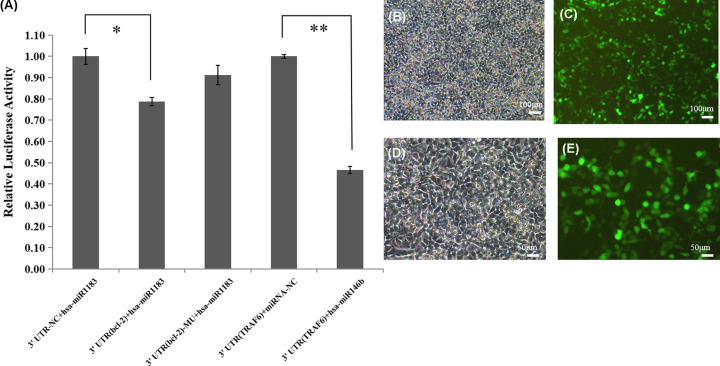
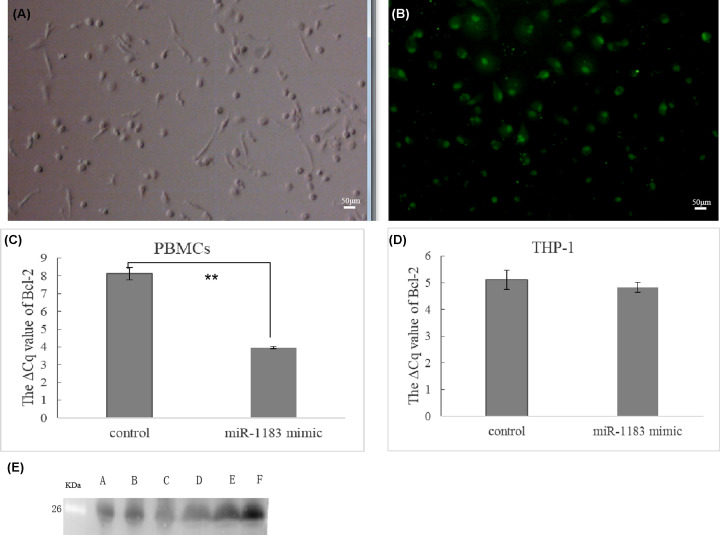
To determine whether up-regulation of miR-1183 targeting the gene for anti-apoptotic factor, B-cell lymphoma 2 (BCL-2) contributes to apoptosis in patients with rheumatic heart disease (RHD). Peripheral blood samples were isolated for miR-1183 characterization. The function of miRNA-1183 in RHD using miRNA mimic on PBMCs and THP-1 cell models. The binding of miR-1183 and Bcl-2 gene was confirmed by luciferase activity test. We also measured expression levels of BCL-2 in heart valve tissue from patients with RHD using ELISA and immunohistochemistry. In silico analysis and reporter gene assays indicated that miR-1183 directly targets the mRNA encoding BCL-2. It is found that miR-1183 binds directly to the 3'UTR of the BCL-2 mRNA and down-regulates the mRNA and protein levels of BCL-2. Overexpression of miR-1183 in RHD patients and cell lines down-regulated BCL-2 expression and induced apoptosis. With the progression of the disease, the expression of BCL-2 in the heart valve tissue of patients with RHD decreased. MiRNA-1183 is up-regulated in RHD and induces cardiac myocyte apoptosis through direct targeting and suppression of BCL-2, both of which might play important roles in RHD pathogenesis. During the compensatory period of RHD, up-regulated miR-1183 destroyed the balance of apoptosis proteins (Bax and BAK) in Bcl-2 family, enhance the apoptosis cascade reaction and reduce the anti apoptosis effect. The significantly higher expression levels of miR-1183 appear to play distinct roles in RHD pathogenesis by regulation BCL-2, possibly affecting myocardial apoptosis and remodeling in the context of RHD.
为了确定 miR-1183 对凋亡抑制因子 B 细胞淋巴瘤 2(BCL-2)基因的上调是否导致风湿性心脏病(RHD)患者发生凋亡,我们分离了外周血样本进行 miR-1183 特征分析。利用 miRNA 模拟物在 PBMC 和 THP-1 细胞模型中研究了 miRNA-1183 在 RHD 中的作用。通过荧光素酶活性试验证实了 miR-1183 与 Bcl-2 基因的结合。我们还通过 ELISA 和免疫组织化学法测量了风湿性心脏病患者心脏瓣膜组织中 BCL-2 的表达水平。通过计算机分析和报告基因检测表明,miR-1183 可直接靶向 BCL-2 基因的 mRNA。研究发现,miR-1183 直接与 BCL-2 mRNA 的 3'UTR 结合,下调 BCL-2 的 mRNA 和蛋白水平。在 RHD 患者和细胞系中过表达 miR-1183 会下调 BCL-2 的表达并诱导细胞凋亡。随着疾病的进展,风湿性心脏病患者心脏瓣膜组织中 BCL-2 的表达减少。miR-1183 在 RHD 中上调,并通过直接靶向和抑制 BCL-2 诱导心肌细胞凋亡,这可能在 RHD 发病机制中发挥重要作用。在 RHD 的代偿期,上调的 miR-1183 破坏了 Bcl-2 家族中凋亡蛋白(Bax 和 BAK)的平衡,增强了凋亡级联反应,降低了抗凋亡作用。miR-1183 的表达水平显著升高,可能通过调节 BCL-2 在 RHD 发病机制中发挥独特作用,可能影响 RHD 背景下的心肌凋亡和重塑。