School of Tropical Medicine and Global Health, Nagasaki University, Nagasaki, Japan.
School of Tropical Medicine and Global Health, Nagasaki University, Nagasaki, Japan.
Int J Infect Dis. 2020 Dec;101:409-411. doi: 10.1016/j.ijid.2020.10.027. Epub 2020 Oct 17.
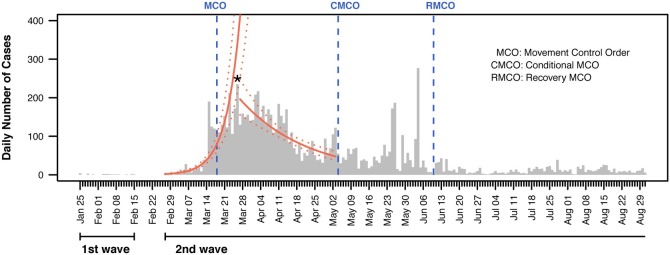
The first wave of COVID-19 epidemic began in late January in Malaysia and ended with a very small final size. The second wave of infections broke out in late February and grew rapidly in the first 3 weeks. Authorities in the country responded quickly with a series of control strategies collectively known as the Movement Control Order (MCO) with different levels of intensity matching the progression of the epidemic. We examined the characteristics of the second wave and discussed the key control strategies implemented in the country. In the second wave, the epidemic doubled in size every 3.8 days (95% confidence interval [CI]: 3.3, 4.5) in the first month and decayed slowly after that with a halving time of approximately 3 weeks. The time-varying reproduction number R peaked at 3.1 (95% credible interval: 2.7, 3.5) in the 3rd week, declined sharply thereafter and stayed below 1 in the last 3 weeks of April, indicating low transmissibility approximately 3 weeks after the MCO. Experience of the country suggests that adaptive triggering of distancing policies combined with a population-wide movement control measure can be effective in suppressing transmission and preventing a rebound.
马来西亚的 COVID-19 疫情于 1 月底进入第一波,规模很小,最终结束。第二波感染于 2 月底爆发,并在前 3 周迅速增长。该国当局迅速采取了一系列控制策略,统称为“行动管制令”(MCO),不同强度的措施与疫情的进展相匹配。我们研究了第二波疫情的特征,并讨论了该国实施的关键控制策略。在第二波疫情中,疫情在第一个月每 3.8 天(95%置信区间[CI]:3.3,4.5)翻一番,此后缓慢衰减,减半时间约为 3 周。时变繁殖数 R 在第 3 周达到 3.1(95%可信区间:2.7,3.5),此后急剧下降,4 月的最后 3 周一直低于 1,表明 MCO 后约 3 周传播率较低。该国的经验表明,适应性触发距离政策结合全民流动控制措施,可以有效抑制传播,防止反弹。