A.I. Virtanen Institute for Molecular Sciences, University of Eastern Finland, P.O. Box 1627, FI-70210 Kuopio, Finland.
School of Pharmacy, University of Eastern Finland, P.O. Box 1627, FI-70210 Kuopio, Finland.
Cells. 2020 Oct 15;9(10):2306. doi: 10.3390/cells9102306.
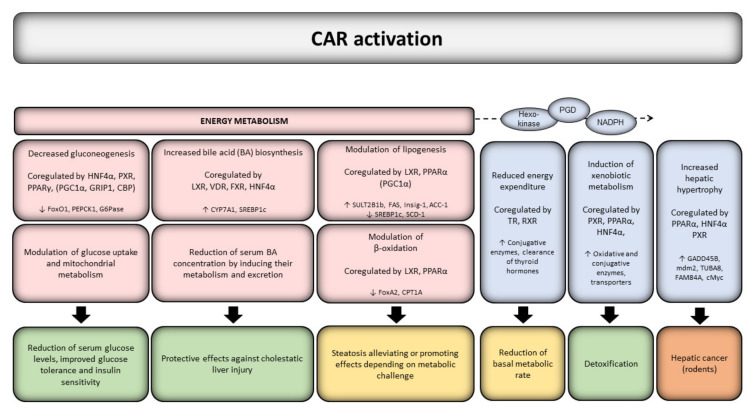
During the last two decades, the constitutive androstane receptor (CAR; NR1I3) has emerged as a master activator of drug- and xenobiotic-metabolizing enzymes and transporters that govern the clearance of both exogenous and endogenous small molecules. Recent studies indicate that CAR participates, together with other nuclear receptors (NRs) and transcription factors, in regulation of hepatic glucose and lipid metabolism, hepatocyte communication, proliferation and toxicity, and liver tumor development in rodents. Endocrine-disrupting chemicals (EDCs) constitute a wide range of persistent organic compounds that have been associated with aberrations of hormone-dependent physiological processes. Their adverse health effects include metabolic alterations such as diabetes, obesity, and fatty liver disease in animal models and humans exposed to EDCs. As numerous xenobiotics can activate CAR, its role in EDC-elicited adverse metabolic effects has gained much interest. Here, we review the key features and mechanisms of CAR as a xenobiotic-sensing receptor, species differences and selectivity of CAR ligands, contribution of CAR to regulation hepatic metabolism, and evidence for CAR-dependent EDC action therein.
在过去的二十年中,组成型雄烷受体 (CAR; NR1I3) 已成为药物和外源性代谢酶和转运蛋白的主要激活剂,这些酶和转运蛋白控制着外源性和内源性小分子的清除。最近的研究表明,CAR 与其他核受体 (NRs) 和转录因子一起参与调节肝葡萄糖和脂质代谢、肝细胞通讯、增殖和毒性以及啮齿动物的肝肿瘤发生。内分泌干扰化学物质 (EDCs) 是一大类持久性有机化合物,与激素依赖性生理过程的异常有关。它们对健康的不良影响包括代谢改变,如动物模型和接触 EDC 的人类中的糖尿病、肥胖和脂肪肝疾病。由于许多外源性化学物质可以激活 CAR,因此它在 EDC 引发的不良代谢作用中的作用引起了广泛关注。在这里,我们回顾了 CAR 作为外源性化学物质感应受体的关键特征和机制、CAR 配体的物种差异和选择性、CAR 对调节肝代谢的贡献以及 CAR 依赖性 EDC 作用的证据。