Department of Epidemiology, School of Public Health, University of Michigan, Ann Arbor, MI 48109, USA.
Department of Obstetrics and Gynecology, School of Medicine, University of Michigan, Ann Arbor, MI 48109, USA.
Hum Reprod Update. 2020 Sep 1;26(5):724-752. doi: 10.1093/humupd/dmaa018.
Perfluoroalkyl and polyfluoroalkyl substances (PFAS) are found widespread in drinking water, foods, food packaging materials and other consumer products. Several PFAS have been identified as endocrine-disrupting chemicals based on their ability to interfere with normal reproductive function and hormonal signalling. Experimental models and epidemiologic studies suggest that PFAS exposures target the ovary and represent major risks for women's health.
This review summarises human population and toxicological studies on the association between PFAS exposure and ovarian function.
A comprehensive review was performed by searching PubMed. Search terms included an extensive list of PFAS and health terms ranging from general keywords (e.g. ovarian, reproductive, follicle, oocyte) to specific keywords (including menarche, menstrual cycle, menopause, primary ovarian insufficiency/premature ovarian failure, steroid hormones), based on the authors' knowledge of the topic and key terms.
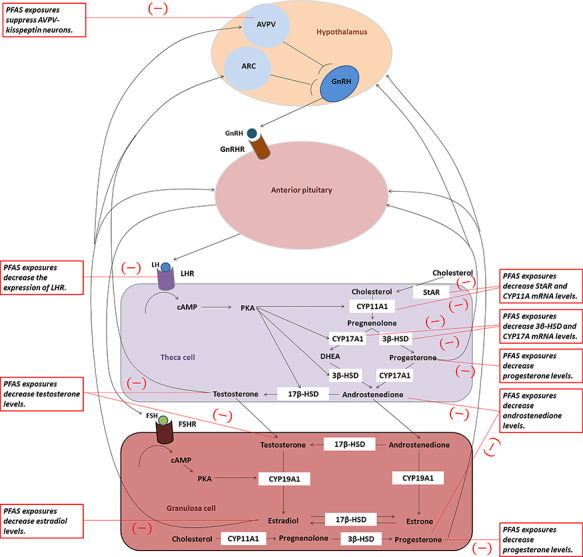
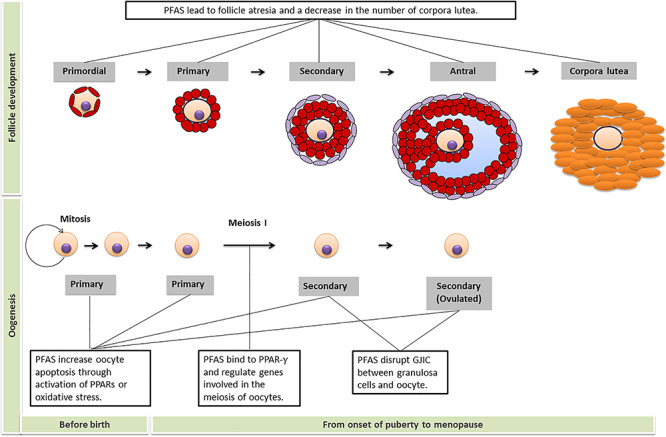
Clinical evidence demonstrates the presence of PFAS in follicular fluid and their ability to pass through the blood-follicle barrier. Although some studies found no evidence associating PFAS exposure with disruption in ovarian function, numerous epidemiologic studies, mostly with cross-sectional study designs, have identified associations of higher PFAS exposure with later menarche, irregular menstrual cycles, longer cycle length, earlier age of menopause and reduced levels of oestrogens and androgens. Adverse effects of PFAS on ovarian folliculogenesis and steroidogenesis have been confirmed in experimental models. Based on laboratory research findings, PFAS could diminish ovarian reserve and reduce endogenous hormone synthesis through activating peroxisome proliferator-activated receptors, disrupting gap junction intercellular communication between oocyte and granulosa cells, inducing thyroid hormone deficiency, antagonising ovarian enzyme activities involved in ovarian steroidogenesis or inhibiting kisspeptin signalling in the hypothalamus.
The published literature supports associations between PFAS exposure and adverse reproductive outcomes; however, the evidence remains insufficient to infer a causal relationship between PFAS exposure and ovarian disorders. Thus, more research is warranted. PFAS are of significant concern because these chemicals are ubiquitous and persistent in the environment and in humans. Moreover, susceptible groups, such as foetuses and pregnant women, may be exposed to harmful combinations of chemicals that include PFAS. However, the role environmental exposures play in reproductive disorders has received little attention by the medical community. To better understand the potential risk of PFAS on human ovarian function, additional experimental studies using PFAS doses equivalent to the exposure levels found in the general human population and mixtures of compounds are required. Prospective investigations in human populations are also warranted to ensure the temporality of PFAS exposure and health endpoints and to minimise the possibility of reverse causality.
全氟烷基和多氟烷基物质 (PFAS) 广泛存在于饮用水、食品、食品包装材料和其他消费品中。一些 PFAS 已被确定为内分泌干扰化学物质,因为它们能够干扰正常的生殖功能和激素信号。实验模型和流行病学研究表明,PFAS 暴露针对卵巢,是女性健康的主要风险因素。
本综述总结了人群和毒理学研究中关于 PFAS 暴露与卵巢功能之间关系的研究。
通过搜索 PubMed 进行了全面综述。搜索术语包括 PFAS 和健康术语的广泛列表,从一般关键字(例如卵巢、生殖、卵泡、卵母细胞)到特定关键字(包括初潮、月经周期、绝经期、原发性卵巢功能不全/卵巢早衰、类固醇激素),这基于作者对该主题和关键词的了解。
临床证据表明 PFAS 存在于卵泡液中,并且能够穿过血卵泡屏障。尽管一些研究没有发现 PFAS 暴露与卵巢功能障碍有关的证据,但许多流行病学研究,主要是横断面研究设计,已经确定了较高的 PFAS 暴露与较晚的初潮、不规则的月经周期、较长的周期长度、更早的绝经年龄以及雌激素和雄激素水平降低之间存在关联。实验模型证实了 PFAS 对卵巢卵泡发生和类固醇生成的不良影响。基于实验室研究结果,PFAS 可能通过激活过氧化物酶体增殖物激活受体、破坏卵母细胞和颗粒细胞之间的缝隙连接细胞通讯、诱导甲状腺激素缺乏、拮抗参与卵巢类固醇生成的卵巢酶活性或抑制下丘脑中的 kisspeptin 信号来减少卵巢储备并降低内源性激素合成。
已发表的文献支持 PFAS 暴露与不良生殖结局之间的关联;然而,证据仍然不足以推断 PFAS 暴露与卵巢疾病之间存在因果关系。因此,需要进行更多的研究。PFAS 是一个非常重要的关注点,因为这些化学物质在环境和人类中无处不在且持久存在。此外,胎儿和孕妇等易感群体可能会接触到包括 PFAS 在内的有害化学物质组合。然而,医学界对环境暴露在生殖障碍中的作用关注甚少。为了更好地了解 PFAS 对人类卵巢功能的潜在风险,需要使用相当于一般人群中发现的暴露水平的 PFAS 剂量和化合物混合物进行额外的实验研究。在人类群体中进行前瞻性研究也是必要的,以确保 PFAS 暴露和健康终点的时间顺序,并最大限度地减少反向因果关系的可能性。