Center of Innovation to Accelerate Discovery and Practice Transformation, Durham VA Health Care System, Durham, NC, USA.
Geriatrics Research, Education and Clinical Center, Durham VA Health Care System, Durham, NC, USA.
Trials. 2020 Oct 16;21(1):863. doi: 10.1186/s13063-020-04764-7.
Stepped wedge cluster randomized trials (SW-CRT) are increasingly used to evaluate new clinical programs, yet there is limited guidance on practical aspects of applying this design. We report our early experiences conducting a SW-CRT to examine an inpatient mobility program (STRIDE) in the Veterans Health Administration (VHA). We provide recommendations for future research using this design to evaluate clinical programs.
Based on data from study records and reflections from the investigator team, we describe and assess the design and initial stages of a SW-CRT, from site recruitment to program launch in 8 VHA hospitals.
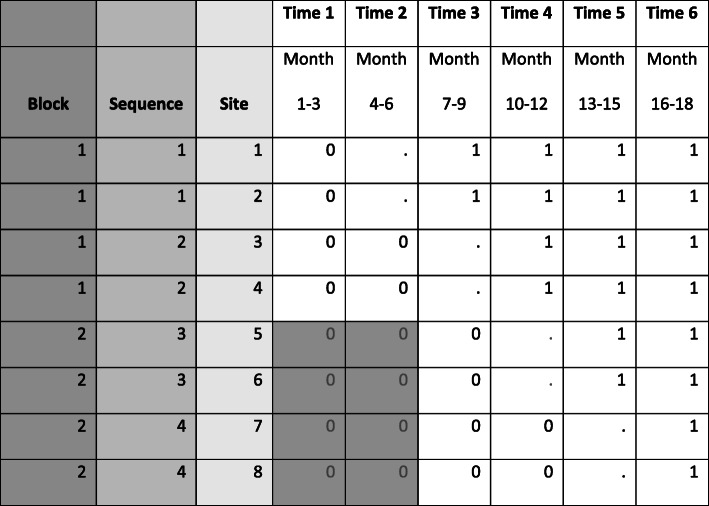
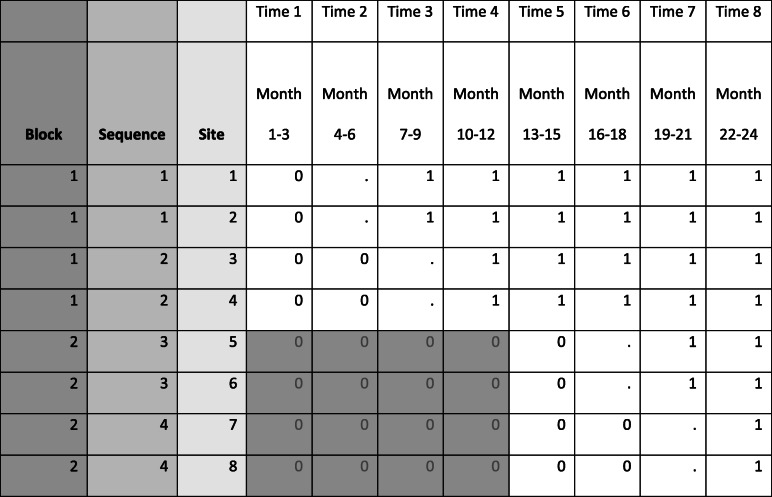
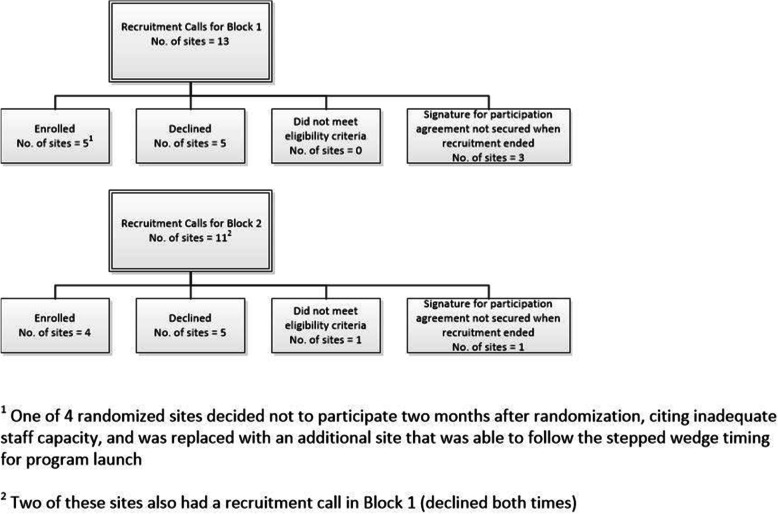
Site recruitment consisted of thirty 1-h conference calls with representatives from 22 individual VAs who expressed interest in implementing STRIDE. Of these, 8 hospitals were enrolled and randomly assigned in two stratified blocks (4 hospitals per block) to a STRIDE launch date. Block 1 randomization occurred in July 2017 with first STRIDE launch in December 2017; block 2 randomization occurred in April 2018 with first STRIDE launch in January 2019. The primary study outcome of discharge destination will be assessed using routinely collected data in the electronic health record (EHR). Within randomized blocks, two hospitals per sequence launched STRIDE approximately every 3 months with primary outcome assessment paused during the 3-month time period of program launch. All sites received 6-8 implementation support calls, according to a pre-specified schedule, from the time of recruitment to program launch, and all 8 sites successfully launched within their assigned 3-month window. Seven of the eight sites initially started with a limited roll out (for example on one ward) or modified version of STRIDE (for example, using existing staff to conduct walks until new positions were filled).
Future studies should incorporate sufficient time for site recruitment and carefully consider the following to inform design of SW-CRTs to evaluate rollout of a new clinical program: (1) whether a blocked randomization fits study needs, (2) the amount of time and implementation support sites will need to start their programs, and (3) whether clinical programs are likely to include a "ramp-up" period. Successful execution of SW-CRT designs requires both adherence to rigorous design principles and also careful consideration of logistical requirements for timing of program roll out.
ClinicalsTrials.gov NCT03300336 . Prospectively registered on 3 October 2017.
阶梯式楔形集群随机试验(SW-CRT)越来越多地用于评估新的临床方案,但在应用这种设计的实际方面,指导有限。我们报告了我们在退伍军人健康管理局(VHA)中进行 SW-CRT 以评估住院患者移动计划(STRIDE)的早期经验。我们为使用该设计评估临床方案的未来研究提供了建议。
基于研究记录中的数据和调查员团队的反思,我们描述并评估了从 8 家 VHA 医院的站点招募到计划启动的 SW-CRT 的设计和初始阶段。
站点招募包括 30 次 1 小时的电话会议,与 22 个对实施 STRIDE 感兴趣的个别 VA 代表进行了交流。其中,8 家医院被纳入并按 2 个分层块(每个块 4 家医院)随机分配 STRIDE 启动日期。第 1 块于 2017 年 7 月随机化,2017 年 12 月首次启动 STRIDE;第 2 块于 2018 年 4 月随机化,2019 年 1 月首次启动 STRIDE。使用电子健康记录(EHR)中常规收集的数据评估出院目的地的主要研究结果。在随机块内,每序列大约每 3 个月启动 2 家医院,在启动计划的 3 个月期间暂停主要结果评估。所有参与医院均按照预先规定的时间表,在招募至计划启动期间,共收到 6-8 次实施支持电话,并且所有 8 家医院均在其指定的 3 个月窗口内成功启动。8 家医院中的 7 家最初以有限的滚动方式(例如,在一个病房中)或 STRIDE 的修改版本(例如,在新职位填补之前,使用现有工作人员进行散步)启动。
未来的研究应纳入足够的时间进行站点招募,并仔细考虑以下因素,以告知评估新临床方案推出的 SW-CRT 设计:(1) 随机分组是否符合研究需求;(2) 各站点启动其计划所需的时间和实施支持;(3) 临床方案是否可能包括“启动”期。SW-CRT 设计的成功执行既需要严格遵循设计原则,也需要仔细考虑计划推出的时间安排的后勤要求。
ClinicalsTrials.gov NCT03300336。于 2017 年 10 月 3 日前瞻性注册。