Department of Psychosis Studies, Institute of Psychiatry, Psychology and Neuroscience, King's Health Partners, King's College London, London, UK.
Precision Psychiatry Cluster, National Institute for Health Research Biomedical Research Centre at South London and Maudsley NHS Foundation Trust and King's College London, London, UK.
Mol Psychiatry. 2021 Jun;26(6):2590-2604. doi: 10.1038/s41380-020-00899-w. Epub 2020 Oct 19.
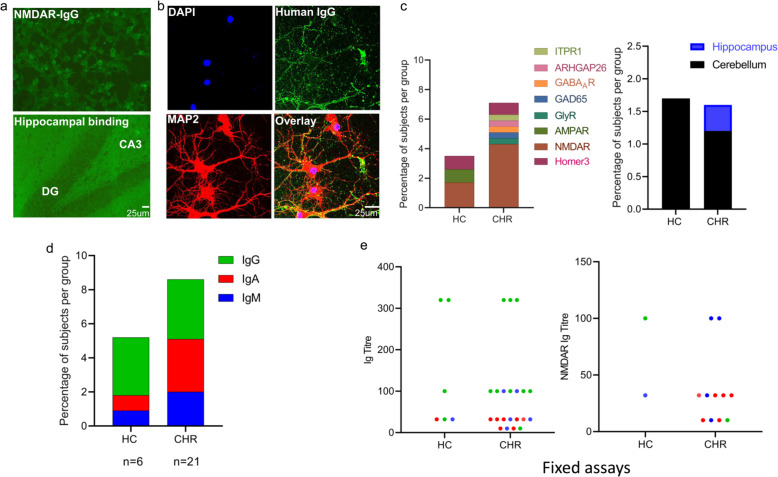
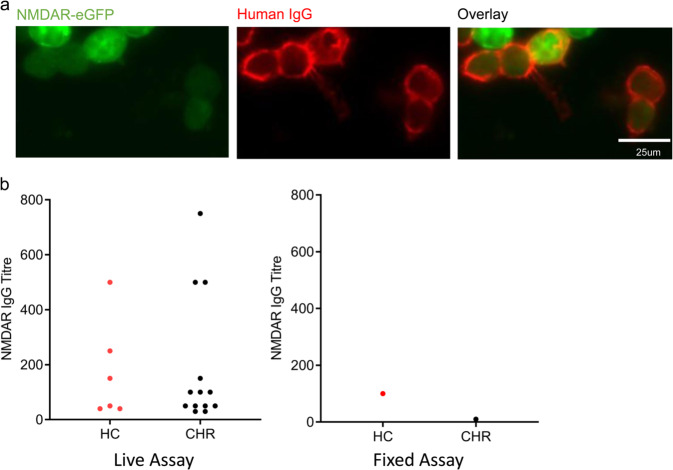
Serum neuronal autoantibodies, such as those to the NMDA receptor (NMDAR), are detectable in a subgroup of patients with psychotic disorders. It is not known if they are present before the onset of psychosis or whether they are associated with particular clinical features or outcomes. In a case-control study, sera from 254 subjects at clinical high risk (CHR) for psychosis and 116 healthy volunteers were tested for antibodies against multiple neuronal antigens implicated in CNS autoimmune disorders, using fixed and live cell-based assays (CBAs). Within the CHR group, the relationship between NMDAR antibodies and symptoms, cognitive function and clinical outcomes over 24 month follow-up was examined. CHR subjects were not more frequently seropositive for neuronal autoantibodies than controls (8.3% vs. 5.2%; OR = 1.50; 95% CI: 0.58-3.90). The NMDAR was the most common target antigen and NMDAR IgGs were more sensitively detected with live versus fixed CBAs (p < 0.001). Preliminary phenotypic analyses revealed that within the CHR sample, the NMDAR antibody seropositive subjects had higher levels of current depression, performed worse on the Rey Auditory Verbal Learning Task (p < 0.05), and had a markedly lower IQ (p < 0.01). NMDAR IgGs were not more frequent in subjects who later became psychotic than those who did not. NMDAR antibody serostatus and titre was associated with poorer levels of functioning at follow-up (p < 0.05) and the presence of a neuronal autoantibody was associated with larger amygdala volumes (p < 0.05). Altogether, these findings demonstrate that NMDAR autoantibodies are detectable in a subgroup of CHR subjects at equal rates to controls. In the CHR group, they are associated with affective psychopathology, impairments in verbal memory, and overall cognitive function: these findings are qualitatively and individually similar to core features of autoimmune encephalitis and/or animal models of NMDAR antibody-mediated CNS disease. Overall the current work supports further evaluation of NMDAR autoantibodies as a possible prognostic biomarker and aetiological factor in a subset of people already meeting CHR criteria.
血清神经元自身抗体,如 NMDA 受体(NMDAR)自身抗体,可在精神障碍患者亚群中检测到。目前尚不清楚它们是否在精神病发作前出现,或者它们是否与特定的临床特征或结局有关。在一项病例对照研究中,使用基于固定细胞和活细胞的检测(CBAs),对 254 名精神病高危(CHR)患者和 116 名健康志愿者的血清进行了针对多个与中枢神经系统自身免疫性疾病相关的神经元抗原的抗体检测。在 CHR 组中,检查了 NMDAR 抗体与 24 个月随访期间的症状、认知功能和临床结局之间的关系。CHR 受试者的神经元自身抗体阳性率并不高于对照组(8.3%比 5.2%;OR=1.50;95%CI:0.58-3.90)。NMDAR 是最常见的靶抗原,活 CBAs 比固定 CBAs 更敏感地检测到 NMDAR IgG(p<0.001)。初步表型分析显示,在 CHR 样本中,NMDAR 抗体阳性受试者当前抑郁水平较高,在 Rey 听觉言语学习任务中表现较差(p<0.05),智商明显较低(p<0.01)。后来出现精神病的受试者中 NMDAR 抗体的出现频率并不高于未出现精神病的受试者。NMDAR 抗体阳性状态和滴度与随访时功能水平较差相关(p<0.05),神经元自身抗体的存在与杏仁核体积增大相关(p<0.05)。总之,这些发现表明,在 CHR 受试者中,NMDAR 自身抗体的检出率与对照组相当。在 CHR 组中,它们与情感精神病学、言语记忆损伤和整体认知功能有关:这些发现与自身免疫性脑炎的核心特征和/或 NMDAR 抗体介导的中枢神经系统疾病的动物模型在性质和个体上相似。总的来说,目前的工作支持进一步评估 NMDAR 自身抗体作为可能的预后生物标志物和已经符合 CHR 标准的一部分人群的病因因素。