Department of Neurology, Kasr Alainy Hospital, Faculty of Medicine, Cairo University, Cairo, Egypt.
CNS Spectr. 2022 Apr;27(2):145-156. doi: 10.1017/S1092852920001935. Epub 2020 Oct 21.
The exact incidence of neurological complications from coronavirus disease 2019 (COVID-19) infection remains unknown. Neurological symptoms are more common with severe form of the disease. Through neuro-invasion, the virus can affect both neurons and glial cells and induce wide range of neurological pathologies.
To systematically assess the neurological manifestations in patients diagnosed with COVID-19.
A systematic literature search of the PubMed, Scopus, and Cochrane databases was performed. Randomized controlled trials, nonrandomized controlled trials, observational studies of neurological manifestations in patients diagnosed with COVID-19.
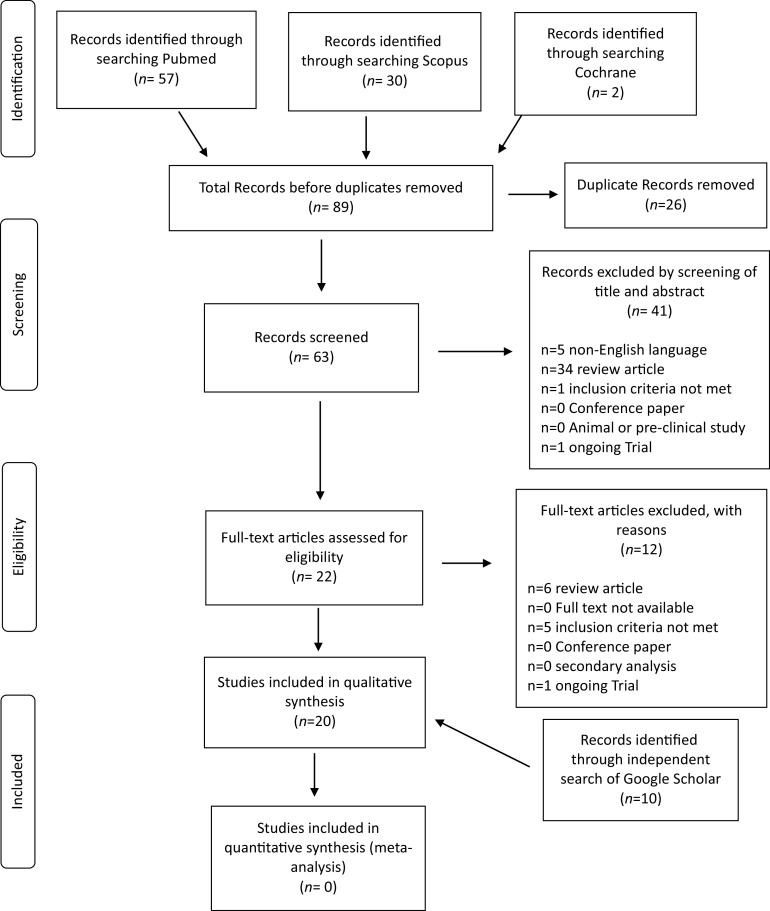
All three-database search identified 89 publications. A total of 22 full-text articles assessed for eligibility with 12 articles excluded. Altogether, the included studies reported 290 patients with neurological manifestations. Neurological manifestations were subdivided into central causes (CNS) and peripheral causes (PNS). CNS symptoms is commoner representing 91% of all neurological patients with 9% only with PNS. Headache represented the commonest neurological symptoms in regard to number of patients, meanwhile dizziness has the highest incidence with 11.9%. Neurological manifestations were divided according to COVID-19 severity into: (1) nonsevere and (2) severe; with all CNS manifestations were more in severe patients except headache were more in nonsevere patients. All included studies were on adult patients except one study in pediatric patients with limited number of participants.
From the descriptive analyses and available data of relatively small sample-sized studies, it can be concluded that in spite of the aforementioned limitations, that a wide spectrum of neurological manifestations including CNS and PNS can occur in COVID-19 patients.
新型冠状病毒疾病 2019(COVID-19)感染引起的神经系统并发症的确切发生率尚不清楚。神经系统症状在疾病的严重形式中更为常见。通过神经入侵,病毒可以影响神经元和神经胶质细胞,并引起广泛的神经病理学变化。
系统评估诊断为 COVID-19 的患者的神经系统表现。
对 PubMed、Scopus 和 Cochrane 数据库进行系统文献检索。纳入诊断为 COVID-19 的患者的神经系统表现的随机对照试验、非随机对照试验和观察性研究。
所有三个数据库的搜索共确定了 89 篇出版物。共有 22 篇全文文章评估合格,排除 12 篇文章。总共,纳入的研究报告了 290 例有神经系统表现的患者。神经系统表现分为中枢性(CNS)和周围性(PNS)。CNS 症状更为常见,占所有神经系统患者的 91%,仅有 9%为 PNS。头痛是最常见的神经系统症状,涉及的患者数量最多,而头晕的发病率最高,为 11.9%。根据 COVID-19 的严重程度将神经系统表现分为:(1)非严重和(2)严重;除头痛在非严重患者中更为常见外,所有 CNS 表现均在严重患者中更为常见。所有纳入的研究均为成人患者,只有一项研究为儿科患者,且参与者人数有限。
从描述性分析和相对较小样本量研究的现有数据可以得出结论,尽管存在上述局限性,但 COVID-19 患者可能会出现包括中枢神经系统和周围神经系统在内的广泛神经系统表现。