Department of Forestry and Environmental Conservation, Clemson University, 261 Lehotsky Hall, Clemson, SC, USA.
Department of Environmental Science, Policy, and Management, University of California Berkeley, 3 Mulford Hall, Berkeley, CA, 94720, USA.
Sci Rep. 2020 Oct 20;10(1):17841. doi: 10.1038/s41598-020-73318-3.
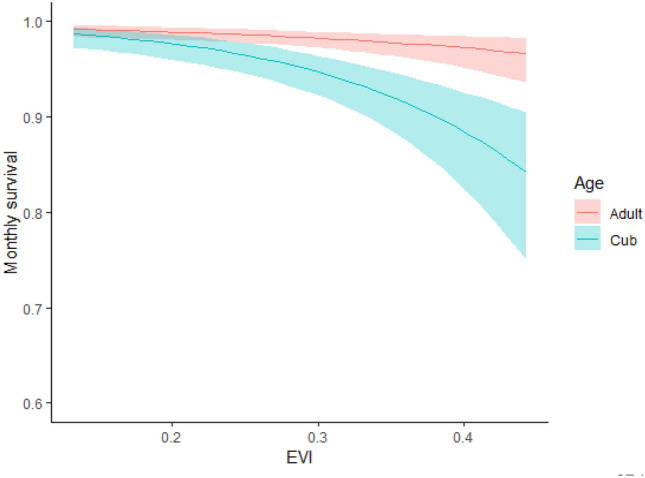
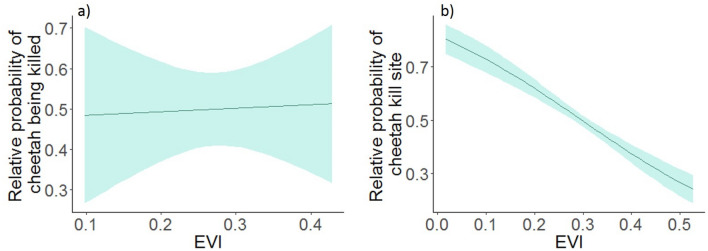
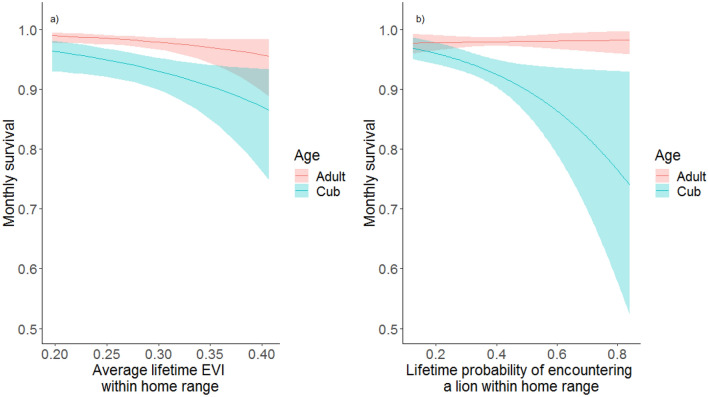
Variability in habitat selection can lead to differences in fitness; however limited research exists on how habitat selection of mid-ranking predators can influence population-level processes in multi-predator systems. For mid-ranking, or mesopredators, differences in habitat use might have strong demographic effects because mesopredators need to simultaneously avoid apex predators and acquire prey. We studied spatially-explicit survival of cheetahs (Acinonyx jubatus) in the Mun-Ya-Wana Conservancy, South Africa, to test hypotheses related to spatial influences of predation risk, prey availability, and vegetation complexity, on mesopredator survival. For each monitored cheetah, we estimated lion encounter risk, prey density, and vegetation complexity within their home range, on short-term (seasonal) and long-term (lifetime) scales and estimated survival based on these covariates. Survival was lowest for adult cheetahs and cubs in areas with high vegetation complexity on both seasonal and lifetime scales. Additionally, cub survival was negatively related to the long-term risk of encountering a lion. We suggest that complex habitats are only beneficial to mesopredators when they are able to effectively find and hunt prey, and show that spatial drivers of survival for mesopredators can vary temporally. Collectively, our research illustrates that individual variation in mesopredator habitat use can scale-up and have population-level effects.
生境选择的可变性可能导致适应度的差异;然而,关于中层捕食者的生境选择如何影响多捕食者系统中的种群水平过程的研究有限。对于中层捕食者,或中等级捕食者,生境利用的差异可能会产生强烈的人口统计学影响,因为中等级捕食者需要同时避免顶级捕食者并获得猎物。我们研究了南非 Mun-Ya-Wana 保护区猎豹(Acinonyx jubatus)的空间明确生存,以测试与捕食风险、猎物可用性和植被复杂性的空间影响相关的假设,这些都是对中等级捕食者生存的假设。对于每只监测到的猎豹,我们在短期(季节性)和长期(终身)尺度上估计了其栖息地范围内狮子遭遇的风险、猎物密度和植被复杂性,并根据这些协变量估计了生存。在季节性和终身尺度上,高植被复杂性地区的成年猎豹和幼崽的生存率最低。此外,幼崽的生存率与长期遭遇狮子的风险呈负相关。我们认为,只有当复杂的栖息地能够有效地寻找和捕猎猎物时,复杂的栖息地对中等级捕食者才是有益的,并表明中等级捕食者生存的空间驱动因素可能会随时间变化。总的来说,我们的研究表明,中等级捕食者生境利用的个体差异可以扩展并产生种群水平的影响。