State Key Laboratory of Animal Nutrition, Institute of Animal Science, Chinese Academy of Agricultural Sciences, Beijing, Peoples Republic of China.
Mucosal Immunology and Biology Research Center, Massachusetts General Hospital for Children, Harvard Medical School, Boston, Massachusetts.
Am J Physiol Gastrointest Liver Physiol. 2021 Apr 1;320(4):G521-G530. doi: 10.1152/ajpgi.00279.2020. Epub 2020 Oct 21.
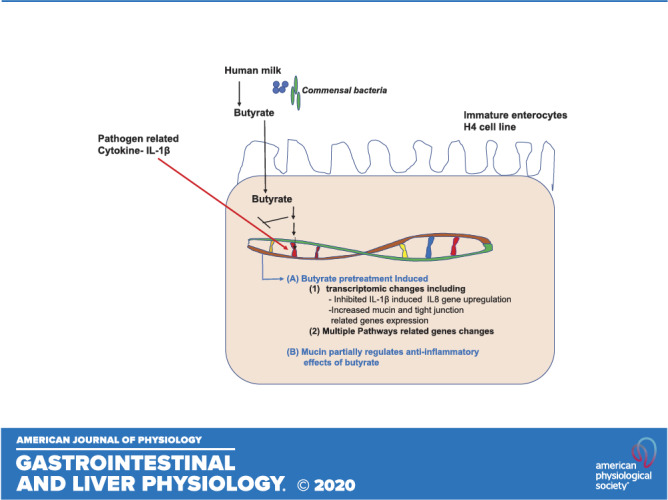
Infants born under 1,500 g have an increased incidence of necrotizing enterocolitis in the ileum and the colon, which is a life-threatening intestinal necrosis. This is in part due to excessive inflammation in the immature intestine to colonizing bacteria because of an immature innate immune response. Breastmilk complex carbohydrates create metabolites of colonizing bacteria in the form of short-chain fatty acids (SCFAs). We studied the effect of breastmilk metabolites, SCFAs, on immature intestine with regard to anti-inflammatory effects. This showed that acetate, propionate, and butyrate were all anti-inflammatory to an IL-1β inflammatory stimulus. In this study, to further define the mechanism of anti-inflammation, we created transcription profiles of RNA from immature human enterocytes after exposure to butyrate with and without an IL-1β inflammatory stimulus. We demonstrated that butyrate stimulates an increase in tight-junction and mucus genes and if we inhibit these genes, the anti-inflammatory effect is partially lost. SCFAs, products of microbial metabolism of complex carbohydrates of breastmilk oligosaccharides, have been found with this study to induce an anti-IL-1β response that is associated with an upregulation of tight junctions and mucus genes in epithelial cells (H4 cells). These studies suggest that breastmilk in conjunction with probiotics can reduce excessive inflammation with metabolites that are anti-inflammatory and stimulate an increase in the mucosal barrier. This study extends previous observations to define the anti-inflammatory properties of butyrate, a short-chain fatty acid produced by the metabolism of breastmilk oligosaccharides by colonizing bacteria. Using transcription profiling of immature enterocyte genes, after exposure to butyrate and an IL-1β stimulus, we showed that tight-junction genes and mucus genes were increased, which contributed to the anti-inflammatory effect.
出生体重低于 1500 克的婴儿患回肠和结肠坏死性小肠结肠炎的发病率增加,这是一种危及生命的肠道坏死。这在一定程度上是由于不成熟的先天免疫反应导致肠道中定植细菌的过度炎症。母乳中的复杂碳水化合物以短链脂肪酸(SCFA)的形式产生定植细菌的代谢物。我们研究了母乳代谢物 SCFA 对不成熟肠道的抗炎作用。结果表明,乙酸盐、丙酸盐和丁酸盐对 IL-1β 炎症刺激均具有抗炎作用。在这项研究中,为了进一步确定抗炎机制,我们在暴露于丁酸盐和没有 IL-1β 炎症刺激的情况下,创建了不成熟人肠细胞的 RNA 转录谱。我们证明丁酸盐刺激紧密连接和粘液基因的增加,如果我们抑制这些基因,抗炎作用就会部分丧失。SCFA 是母乳低聚糖复杂碳水化合物微生物代谢的产物,本研究发现,它能诱导抗 IL-1β 反应,与上皮细胞(H4 细胞)中紧密连接和粘液基因的上调有关。这些研究表明,母乳与益生菌结合可以减少代谢产物的过度炎症,这些代谢产物具有抗炎作用,并刺激粘膜屏障的增加。这项研究扩展了之前的观察结果,定义了短链脂肪酸丁酸的抗炎特性,丁酸是由定植细菌代谢母乳低聚糖产生的。通过对暴露于丁酸盐和 IL-1β 刺激后的不成熟肠细胞基因进行转录谱分析,我们发现紧密连接基因和粘液基因增加,这有助于抗炎作用。