Corrias Francesco, Atzei Alessandro, Lai Carla, Dedola Fabrizio, Ibba Enrico, Zedda Gianluca, Canu Francesca, Angioni Alberto
Department of Life and Environmental Science, Food Toxicology Unit, University of Cagliari, University Campus of Monserrato, SS 554, 09042 Cagliari, Italy.
Agricultural Research Agency of Sardinia (AGRIS), Service of Environmental Studies, Crop Protection and Production Quality, Bonassai SS 291 km 18,6, 07100 Sassari, Italy.
Foods. 2020 Oct 19;9(10):1497. doi: 10.3390/foods9101497.
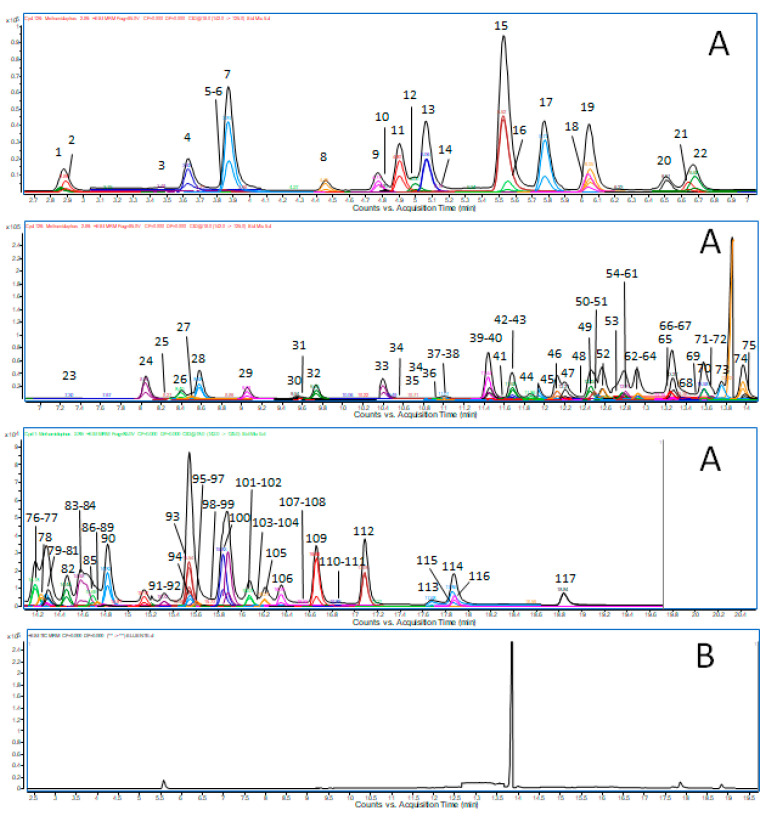
Pesticides are broadly used to improve food safety, although they can lead to adverse health effects on consumers. Various food processing approaches, at the industrial or domestic level, have been found to highly reduce the amount of pesticide residues in most food materials. In this work, samples of raw tomatoes were collected directly from the field and processed at the industrial level to produce purée, triple concentrated paste, fine pulp, and diced tomatoes. A multiresidue method based on a modified QuEChERS (Quick, Easy, Cheap, Effective, Rugged e Safe) sample preparation, followed by liquid chromatography-tandem mass spectrometry analysis (LC-MS/MS) for the assessment of 116 pesticides residues, was used. The analytical method has been validated according to SANTE indications. The recovery yields ranged from 75.5% to 115.3%, repeatability (RSDr) ranged from 3.4% to 18.3%, while reproducibility (RSD) ranged from 5.4% to 19.8%. The limit of quantifications (LOQs) ranged from 2.35 µg kg for benthiavalicarb to 6.49 µg kg for allethrin. A total of 159 raw tomato samples were collected from the field. The analysis showed the presence of 46 pesticides with azoxystrobin and chlorantraniliprole the most represented. On the other hand, all industrially processed samples showed values ≤ LOD, confirming that post-harvest processes can lead to a decrease in pesticide residues from agricultural commodities.
农药被广泛用于提高食品安全,尽管它们可能会对消费者的健康产生不利影响。人们发现,工业或家庭层面的各种食品加工方法能大幅减少大多数食品原料中的农药残留量。在这项研究中,生番茄样本直接从田间采集,并在工业层面进行加工,制成番茄泥、三倍浓缩番茄酱、细果肉和切块番茄。采用了一种基于改良QuEChERS(快速、简便、廉价、有效、耐用且安全)样品制备的多残留方法,随后进行液相色谱 - 串联质谱分析(LC-MS/MS)以评估116种农药残留。该分析方法已根据SANTE指南进行了验证。回收率在75.5%至115.3%之间,重复性(RSDr)在3.4%至18.3%之间,而再现性(RSD)在5.4%至19.8%之间。定量限(LOQ)范围从苯噻菌胺的2.35 μg/kg到烯丙菊酯的6.49 μg/kg。总共从田间采集了159个生番茄样本。分析表明存在46种农药,其中嘧菌酯和氯虫苯甲酰胺的含量最高。另一方面,所有工业加工后的样本显示值≤检测限,证实收获后的加工过程可导致农产品中农药残留量的降低。