Cancer Center, Union Hospital, Tongji Medical College, Huazhong University of Science and Technology, 1277 JieFang Avenue, Wuhan, 430022, People's Republic of China.
Mol Neurobiol. 2021 Mar;58(3):1074-1087. doi: 10.1007/s12035-020-02138-3. Epub 2020 Oct 22.
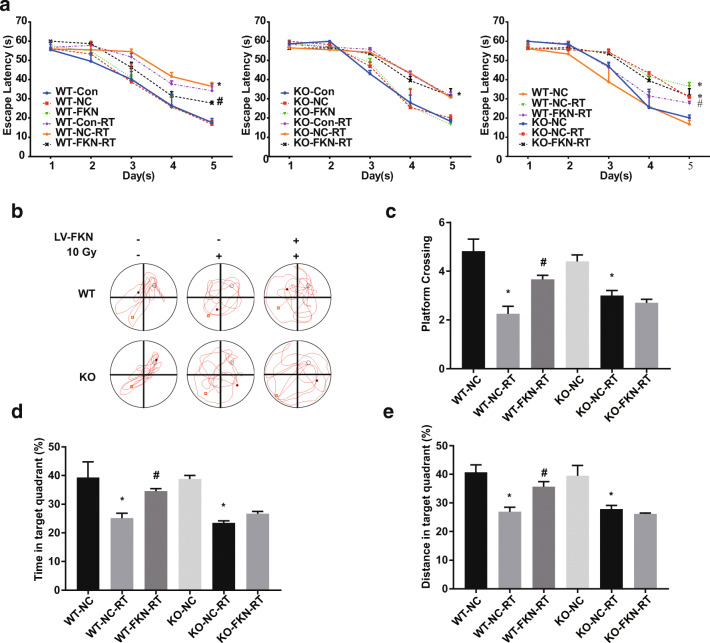
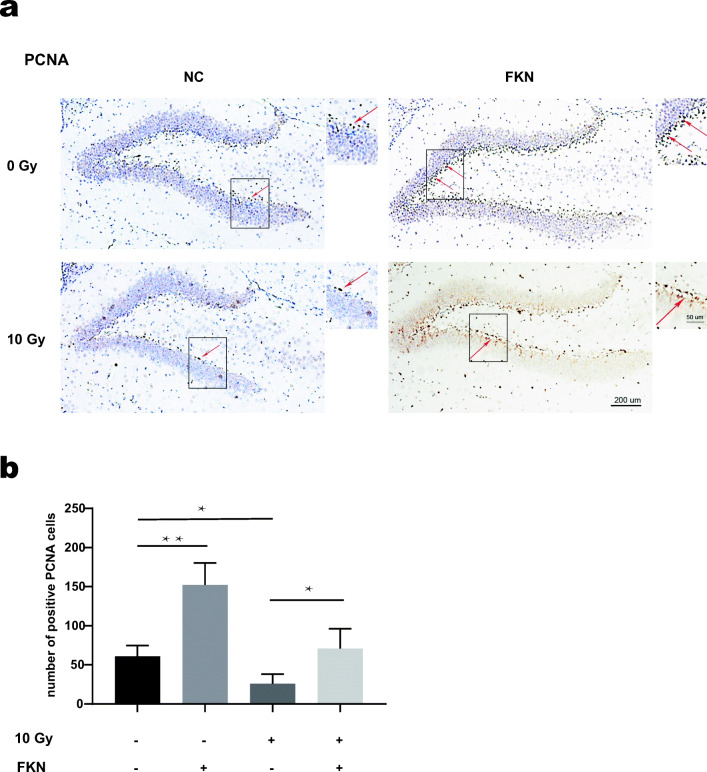
Radiation-induced brain injury (RIBI) is a serious complication in cancer patients receiving brain radiotherapy, and accumulating evidence suggests that microglial activation plays an important role in its pathogenesis. Fractalkine (FKN) is a crucial mediator responsible for the biological activity of microglia. In this study, the effect of FKN on activated microglial after irradiation and RIBI was explored and the underlying mechanisms were investigated. Our study demonstrated treatment with exogenous FKN diminished radiation-induced production of pro-inflammatory factors, such as IL1-β and TNFα, promoted transformation of microglial M1 phenotype to M2 phenotype after irradiation, and partially recovered the spatial memory of irradiated mice. Furthermore, upregulation of FKN/CX3CR1 via FKN lentivirus promoted radiation-induced microglial M2 transformation in the hippocampus and diminished the spatial memory injury of irradiated mice. Furthermore, while inhibiting the expression of CX3CR1, which exclusively expressed on microglia in the brain, the regulatory effect of FKN on microglia and cognitive ability of mice disappeared after radiation. In conclusion, the FKN could attenuate RIBI through the microglia polarization toward M2 phenotype by binding to CX3CR1 on microglia. Our study unveiled an important role of FKN/CX3CR1 in RIBI, indicating that promotion of FKN/CX3CR1 axis could be a promising strategy for the treatment of RIBI.
辐射诱导的脑损伤(RIBI)是癌症患者接受脑部放射治疗后的一种严重并发症,越来越多的证据表明小胶质细胞激活在其发病机制中起着重要作用。趋化因子(FKN)是负责小胶质细胞生物学活性的关键介质。在这项研究中,探讨了 FKN 对辐照后激活的小胶质细胞的影响及其潜在机制。我们的研究表明,外源性 FKN 治疗可减少辐照后促炎因子(如 IL1-β 和 TNFα)的产生,促进小胶质细胞 M1 表型向 M2 表型的转化,并部分恢复辐照小鼠的空间记忆。此外,通过 FKN 慢病毒上调 FKN/CX3CR1 可促进辐照后海马小胶质细胞 M2 转化,并减轻辐照小鼠的空间记忆损伤。此外,当抑制仅在大脑中小胶质细胞上表达的 CX3CR1 的表达时,FKN 对小胶质细胞的调节作用和小鼠的认知能力在辐射后消失。总之,FKN 通过与小胶质细胞上的 CX3CR1 结合,可减轻 RIBI,使小胶质细胞向 M2 表型极化。我们的研究揭示了 FKN/CX3CR1 在 RIBI 中的重要作用,表明促进 FKN/CX3CR1 轴可能是治疗 RIBI 的一种有前途的策略。