Key Lab of Genetics, Breeding and Multiple Utilization of Crops, Ministry of Education, State Key Laboratory of Ecological Pest Control for Fujian and Taiwan Crops, Fujian Provincial Key Laboratory of Haixia Applied Plant Systems Biology, Center for Genomics and Biotechnology, College of Plant Protection, College of Life Sciences, College of Crop Science, Fujian Agriculture and Forestry University, Fuzhou 350002, China.
State Key Laboratory for Conservation and Utilization of Subtropical Agro-Bioresources, Guangxi Key Lab of Sugarcane Biology, College of Agriculture, Guangxi University, Nanning 530004, China.
Int J Mol Sci. 2020 Oct 21;21(20):7778. doi: 10.3390/ijms21207778.
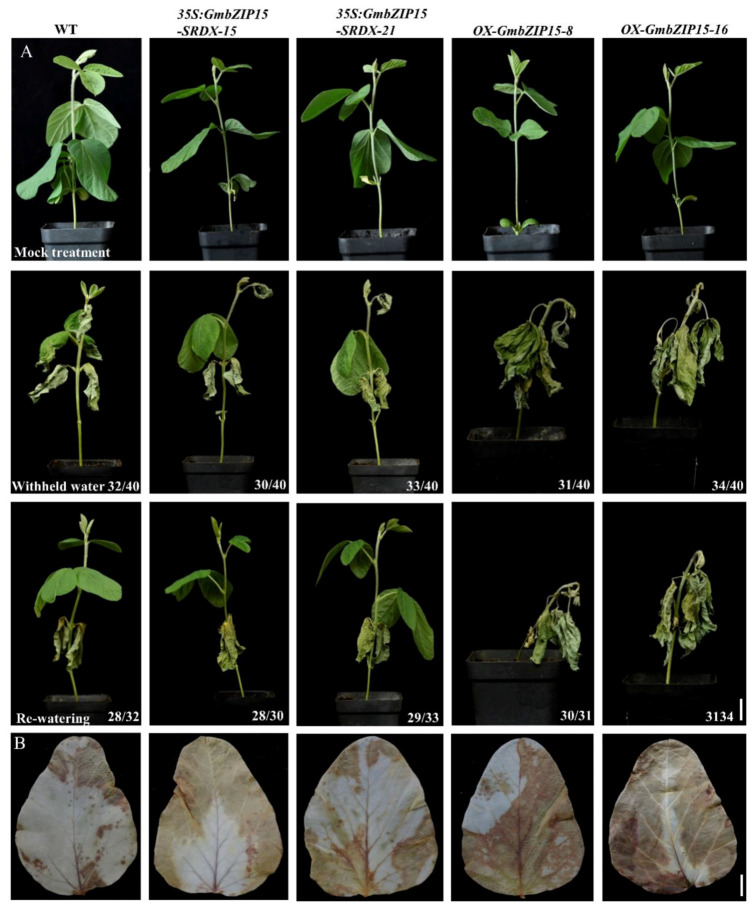
Soybean (), as an important oilseed crop, is constantly threatened by abiotic stress, including that caused by salinity and drought. bZIP transcription factors (TFs) are one of the largest TF families and have been shown to be associated with various environmental-stress tolerances among species; however, their function in abiotic-stress response in soybean remains poorly understood. Here, we characterized the roles of soybean transcription factor GmbZIP15 in response to abiotic stresses. The transcript level of was suppressed under salt- and drought-stress conditions. Overexpression of in soybean resulted in hypersensitivity to abiotic stress compared with wild-type (WT) plants, which was associated with lower transcript levels of stress-responsive genes involved in both abscisic acid (ABA)-dependent and ABA-independent pathways, defective stomatal aperture regulation, and reduced antioxidant enzyme activities. Furthermore, plants expressing a functional repressor form of exhibited drought-stress resistance similar to WT. RNA-seq and qRT-PCR analyses revealed that positively regulates expression and negatively regulates and expression in response to abiotic stress. Overall, these data indicate that GmbZIP15 functions as a negative regulator in response to salt and drought stresses.
大豆()作为一种重要的油料作物,不断受到非生物胁迫的威胁,包括盐胁迫和干旱胁迫。bZIP 转录因子(TFs)是最大的 TF 家族之一,已被证明与物种的各种环境胁迫耐受性有关;然而,它们在大豆非生物胁迫响应中的功能仍知之甚少。在这里,我们研究了大豆转录因子 GmbZIP15 在应对非生物胁迫中的作用。在盐胁迫和干旱胁迫条件下,的转录水平受到抑制。与野生型(WT)植株相比,大豆中 的过表达导致对非生物胁迫的超敏反应,这与涉及 ABA 依赖和 ABA 不依赖途径的应激反应基因的转录水平降低、气孔孔径调节缺陷以及抗氧化酶活性降低有关。此外,表达功能性抑制形式 的植株表现出与 WT 相似的抗旱性。RNA-seq 和 qRT-PCR 分析表明,在应对非生物胁迫时,GmbZIP15 正向调控 表达,负向调控 表达。总体而言,这些数据表明 GmbZIP15 作为一种负调控因子在盐胁迫和干旱胁迫中发挥作用。