Green Raquel, Delfabbro Paul H, King Daniel L
School of Psychology, The University of Adelaide, Australia.
School of Psychology, The University of Adelaide, Australia; College of Education, Psychology and Social Work, Flinders University, Australia.
Addict Behav. 2021 Feb;113:106694. doi: 10.1016/j.addbeh.2020.106694. Epub 2020 Oct 7.
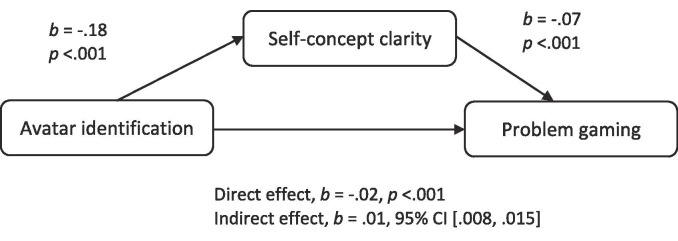
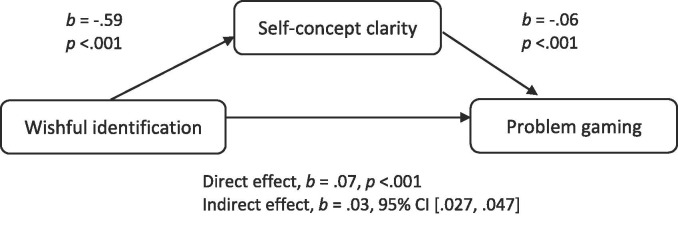
Some video-gaming activities feature customizable avatars that enable users to fulfil self-identity needs. Research evidence (e.g., fMRI and survey studies) has suggested that poorer self-concept and stronger avatar identification are associated with problematic gaming. Player-avatar relationships have thus been proposed to require attention in gaming disorder assessment and interventions. To examine the interplay of player-avatar interactions in problematic gaming, this study investigated whether avatar identification differed according to avatar characteristics and game types, and whether the association between avatar identification and problem gaming was mediated by self-concept clarity. A total of 993 adult respondents completed an online survey that assessed problematic gaming, avatar identification, and self-concept clarity. The results indicated that avatar identification scores were generally unrelated to avatar characteristics (e.g., human resemblance, degree of customizability, and in-game perspective). Avatar identification was significantly positively related to problematic gaming and significantly negatively related to self-concept clarity. There was a significant indirect relationship between avatar identification on problem gaming mediated through self-concept clarity. These findings suggest that poorer self-concept clarity may be one mechanism by which avatar identification affects problem gaming. Future research with clinical samples may help to gain a better understanding of avatar-related processes and psychological vulnerabilities related to problematic gaming.
一些电子游戏活动具有可定制的虚拟角色,这些虚拟角色能让玩家满足自我认同需求。研究证据(如功能磁共振成像和调查研究)表明,较差的自我概念和较强的虚拟角色认同与游戏问题行为相关。因此,玩家与虚拟角色的关系在游戏障碍评估和干预中需要引起关注。为了研究问题游戏中玩家与虚拟角色互动的相互作用,本研究调查了虚拟角色认同是否因虚拟角色特征和游戏类型而异,以及虚拟角色认同与问题游戏之间的关联是否由自我概念清晰度介导。共有993名成年受访者完成了一项在线调查,该调查评估了问题游戏、虚拟角色认同和自我概念清晰度。结果表明,虚拟角色认同得分通常与虚拟角色特征(如与人类的相似性、可定制程度和游戏视角)无关。虚拟角色认同与问题游戏显著正相关,与自我概念清晰度显著负相关。通过自我概念清晰度介导,虚拟角色认同与问题游戏之间存在显著的间接关系。这些发现表明,较差的自我概念清晰度可能是虚拟角色认同影响问题游戏的一种机制。未来对临床样本的研究可能有助于更好地理解与问题游戏相关的虚拟角色相关过程和心理脆弱性。