Zhang Shaozhen, Su Wenliang, Han Xiaoli, Potenza Marc N
Department of Applied Psychology, School of Humanities and Social Sciences, Fuzhou University, Fuzhou 350108, China.
Department of Psychiatry, Child Study Center, Department of Neuroscience, Yale University School of Medicine, New Haven, CT 06510, USA.
Behav Sci (Basel). 2022 Jun 16;12(6):193. doi: 10.3390/bs12060193.
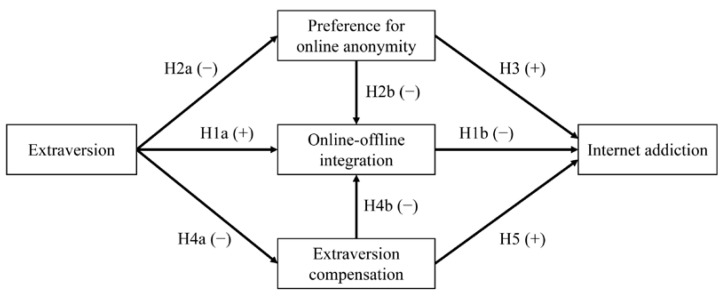
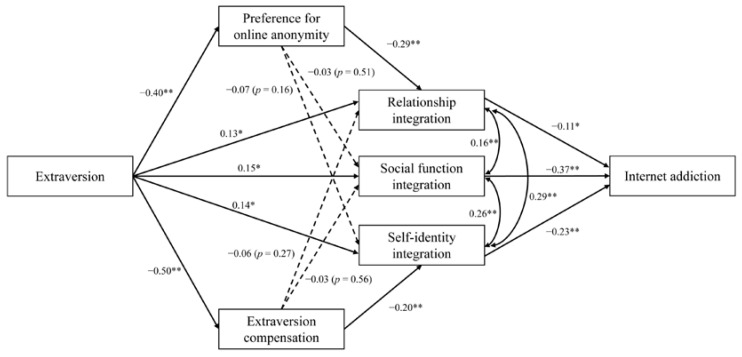
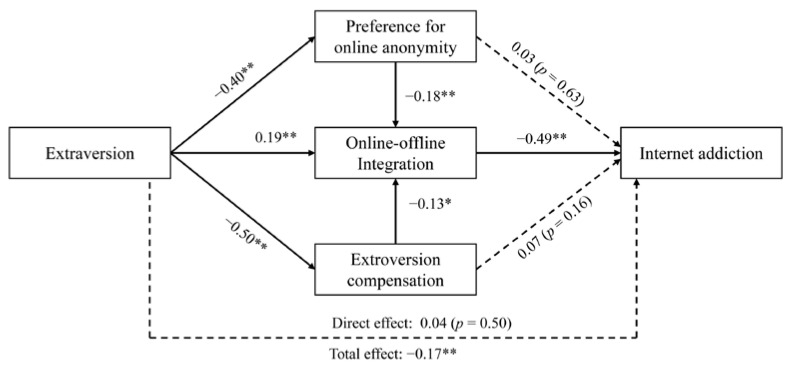
Internet addiction may arise from multiple factors and personality tendencies have been previously implicated. Prior studies have found that extraversion may be a protective factor mitigating against internet addiction, yielding a "rich-get-richer" effect. However, few studies have explored how extraversion may influence internet addiction from the perspective of online-offline integration. Drawing on a sample of 428 college students, the current study examined a serial mediation model exploring the underlying mechanisms of how extraversion may statistically predict internet addiction through online-offline integration and antecedent factors. The serial mediation model analyses indicated that extraverted internet users exhibited a weaker preference for online anonymity and less online extraversion compensation, thus formulating a higher level of online-offline integration than introverted individuals, which, in turn, appeared to reduce the risk of internet addiction. In contrast, with regard to specific components of online-offline integration, introverted internet users preferred online anonymity, which reduced their relationship integration and increased their likelihood of internet addiction; similarly, the introverted individuals were also more likely to exhibit an extraversion compensation effect. That is, they were more extraverted on the internet than in general; hence, they had a lower level of self-identity integration, resulting in a greater likelihood of experiencing internet addiction. These results highlight the importance of online-offline integration that may account for personality variations in social and psychological outcomes related to internet use, and suggest a role for online anonymity preference and extraversion compensation in influencing specific components of integration.
网络成瘾可能源于多种因素,先前已有研究表明人格倾向与之相关。此前的研究发现,外向性可能是减轻网络成瘾的一个保护因素,会产生一种“富者愈富”的效应。然而,很少有研究从线上线下融合的角度探讨外向性如何影响网络成瘾。本研究以428名大学生为样本,检验了一个中介模型,以探究外向性如何通过线上线下融合及先行因素在统计学上预测网络成瘾的潜在机制。中介模型分析表明,外向型网络用户对网络匿名性的偏好较弱,且较少有网络外向性补偿,因此与内向型个体相比,他们的线上线下融合水平更高,这反过来似乎降低了网络成瘾的风险。相比之下,就线上线下融合的具体组成部分而言,内向型网络用户更喜欢网络匿名性,这降低了他们的关系融合度,并增加了他们网络成瘾的可能性;同样,内向型个体也更有可能表现出外向性补偿效应。也就是说,他们在网络上比在现实中更外向;因此,他们的自我认同融合水平较低,导致网络成瘾的可能性更大。这些结果凸显了线上线下融合的重要性,它可能解释了与网络使用相关的社会和心理结果中的人格差异,并表明网络匿名性偏好和外向性补偿在影响融合的特定组成部分中发挥了作用。