Gopalkrishnan Manoj, Krishna Sandeep
IIT Bombay, Mumbai, India.
Simons Centre for the Study of Living Machines, National Centre for Biological Sciences, Tata Institute of Fundamental Research, Bangalore, India.
J Indian Inst Sci. 2020;100(4):787-792. doi: 10.1007/s41745-020-00204-2. Epub 2020 Oct 18.
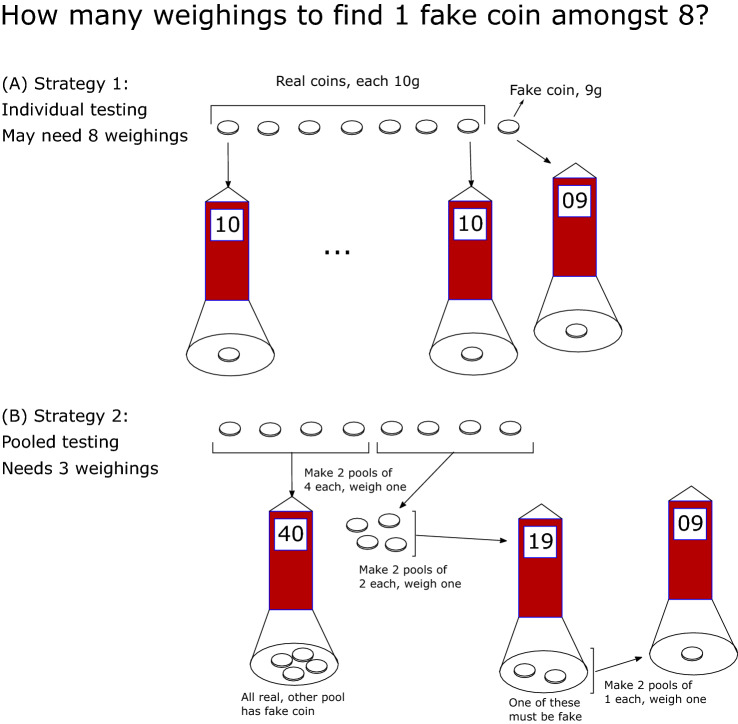
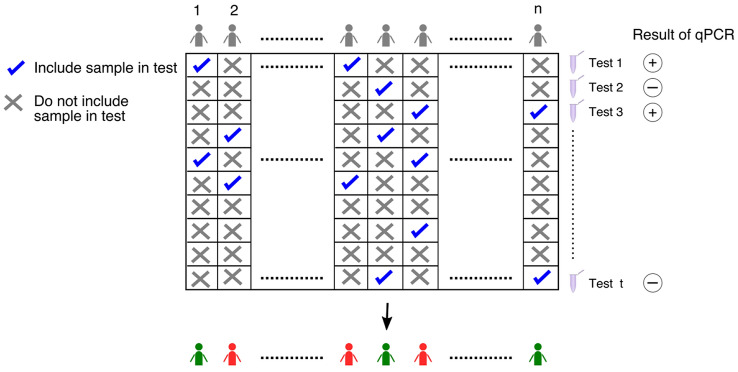
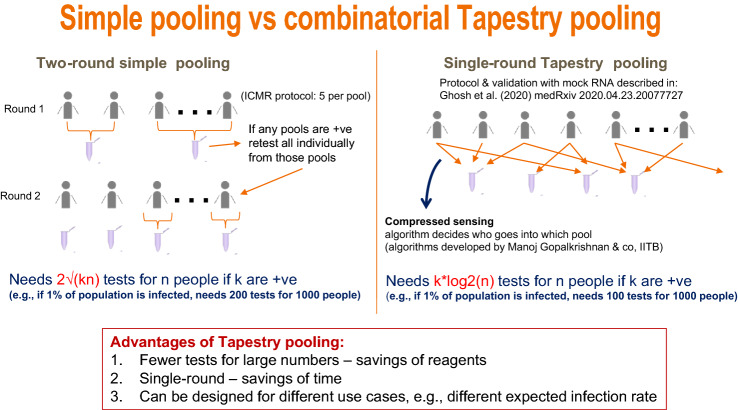
As SARS-CoV-2 continues to propagate around the world, it is becoming increasingly important to scale up testing. This is necessary both at the individual level, to inform diagnosis, treatment and contract tracing, as well as at the population level to inform policies to control spread of the infection. The gold-standard RT-qPCR test for the virus is relatively expensive and takes time, so combining multiple samples into "pools" that are tested together has emerged as a useful way to test many individuals with less than one test per person. Here, we describe the basic idea behind pooling of samples and different methods for reconstructing the result for each individual from the test of pooled samples. The methods range from simple pooling, where each pool is disjoint from the other, to more complex combinatorial pooling where each sample is split into multiple pools and each pool has a specified combination of samples. We describe efforts to validate these testing methods clinically and the potential advantages of the combinatorial pooling method named Tapestry Pooling that relies on compressed sensing techniques.
随着严重急性呼吸综合征冠状病毒2(SARS-CoV-2)在全球持续传播,扩大检测规模变得越来越重要。这在个体层面对于诊断、治疗和接触者追踪而言是必要的,在人群层面对于制定控制感染传播的政策也是必要的。针对该病毒的金标准逆转录定量聚合酶链反应(RT-qPCR)检测相对昂贵且耗时,因此将多个样本合并为“混合样本”一起进行检测,已成为一种有用的方法,能够以每人少于一次检测的方式对许多个体进行检测。在此,我们描述样本合并背后的基本理念,以及从混合样本检测结果重建每个个体结果的不同方法。这些方法范围从简单合并(每个混合样本相互不重叠)到更复杂的组合合并(每个样本被分割到多个混合样本中,且每个混合样本具有特定的样本组合)。我们描述了在临床上验证这些检测方法的努力,以及依赖压缩感知技术的名为“织锦合并”的组合合并方法的潜在优势。