Institute of Medical Microbiology and Hygiene, Saarland University, Homburg/Saar, DE.
Institute of Pneumology at the University of Cologne, Bethanien Hospital, Clinic for Pneumology and Allergology, Centre of Sleep Medicine and Respiratory Care, Solingen, DE.
Ann Glob Health. 2020 Nov 18;86(1):148. doi: 10.5334/aogh.3126.
Liberal PCR testing for severe acute respiratory syndrome coronavirus 2 (SARS-CoV-2) is key to contain the coronavirus disease 2019 (COVID-19) pandemic. Combined multi-sample testing in pools instead of single tests might enhance laboratory capacity and reduce costs, especially in low- and middle-income countries.
The purpose of our study was to assess the value of a simple questionnaire to guide and further improve pooling strategies for SARS-CoV-2 laboratory testing.
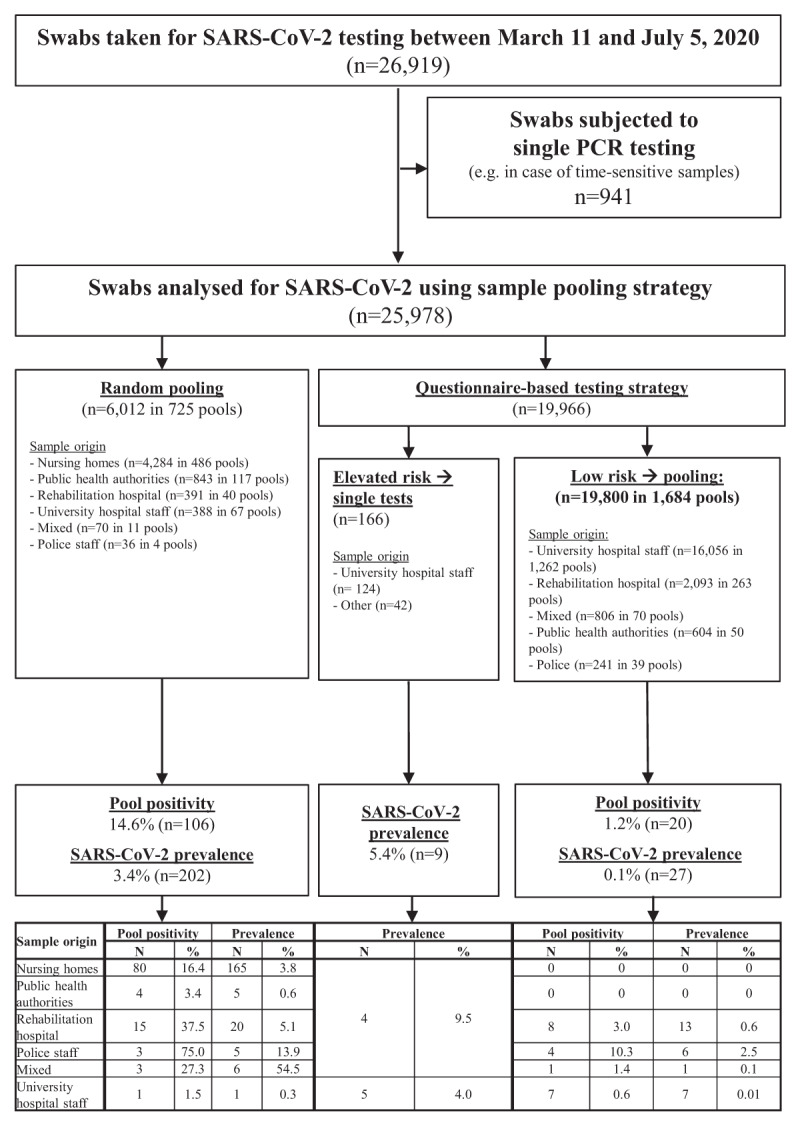
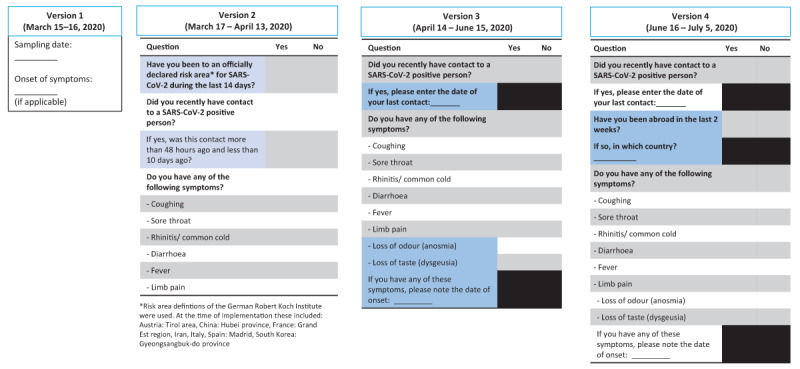
Pharyngeal swabs for SARS-CoV-2 testing were obtained from healthcare and police staff, hospital inpatients, and nursing home residents in the southwestern part of Germany. We designed a simple questionnaire, which included questions pertaining to a suggestive clinical symptomatology, recent travel history, and contact with confirmed cases to stratify an individual's pre-test probability of having contracted COVID-19. The questionnaire was adapted repeatedly in face of the unfolding pandemic in response to the evolving epidemiology and observed clinical symptomatology. Based on the response patterns, samples were either tested individually or in multi-sample pools. We compared the pool positivity rate and the number of total PCR tests required to obtain individual results between this questionnaire-based pooling strategy and randomly assembled pools.
Between March 11 and July 5, 2020, we processed 25,978 samples using random pooling (n = 6,012; 23.1%) or questionnaire-based pooling (n = 19,966; 76.9%). The overall prevalence of SARS-CoV-2 was 0.9% (n = 238). Pool positivity (14.6% vs. 1.2%) and individual SARS-CoV-2 prevalence (3.4% vs. 0.1%) were higher in the random pooling group than in the questionnaire group. The average number of PCR tests needed to obtain the individual result for one participant was 0.27 tests in the random pooling group, as compared to 0.09 in the questionnaire-based pooling group, leading to a laboratory capacity increase of 73% and 91%, respectively, as compared to single PCR testing.
Strategies that combine pool testing with a questionnaire-based risk stratification can increase laboratory testing capacities for COVID-19 and might be important tools, particularly in resource-constrained settings.
对严重急性呼吸综合征冠状病毒 2(SARS-CoV-2)进行宽松的聚合酶链反应(PCR)检测是控制 2019 年冠状病毒病(COVID-19)大流行的关键。将多个样本合并为一个池进行检测而不是单个检测,可能会提高实验室的检测能力并降低成本,特别是在中低收入国家。
本研究的目的是评估一个简单问卷在指导和进一步改进 SARS-CoV-2 实验室检测中的作用。
从德国西南部的医护人员和警察、住院患者和疗养院居民中采集咽拭子,用于 SARS-CoV-2 检测。我们设计了一个简单的问卷,其中包括有关提示性临床症状、近期旅行史和与确诊病例接触的问题,以对个体感染 COVID-19 的预先测试概率进行分层。该问卷根据不断发展的流行病学和观察到的临床症状进行了多次修改。根据反应模式,样本要么单独测试,要么在多样本池中进行测试。我们将基于问卷的分组策略与随机分组的池阳性率和获得个体结果所需的总 PCR 测试数量进行了比较。
2020 年 3 月 11 日至 7 月 5 日,我们使用随机分组(n = 6012;23.1%)或基于问卷的分组(n = 19966;76.9%)处理了 25978 个样本。SARS-CoV-2 的总体流行率为 0.9%(n = 238)。随机分组组的池阳性率(14.6%比 1.2%)和个体 SARS-CoV-2 患病率(3.4%比 0.1%)均高于问卷分组组。在随机分组组中,获得一个参与者的个体结果所需的平均 PCR 测试次数为 0.27 次,而在基于问卷的分组组中为 0.09 次,分别导致实验室检测能力提高了 73%和 91%,与单个 PCR 检测相比。
将池检测与基于问卷的风险分层相结合的策略可以提高 COVID-19 的实验室检测能力,并且可能是特别是在资源有限的环境中,是一种重要的工具。