Mensen Armand, Bodart Olivier, Thibaut Aurore, Wannez Sarah, Annen Jitka, Laureys Steven, Gosseries Olivia
Coma Science Group, GIGA Consciousness, University of Liège, Liège, Belgium.
Department of Neurology, University Hospital of Liège, Liège, Belgium.
Front Syst Neurosci. 2020 Sep 25;14:62. doi: 10.3389/fnsys.2020.00062. eCollection 2020.
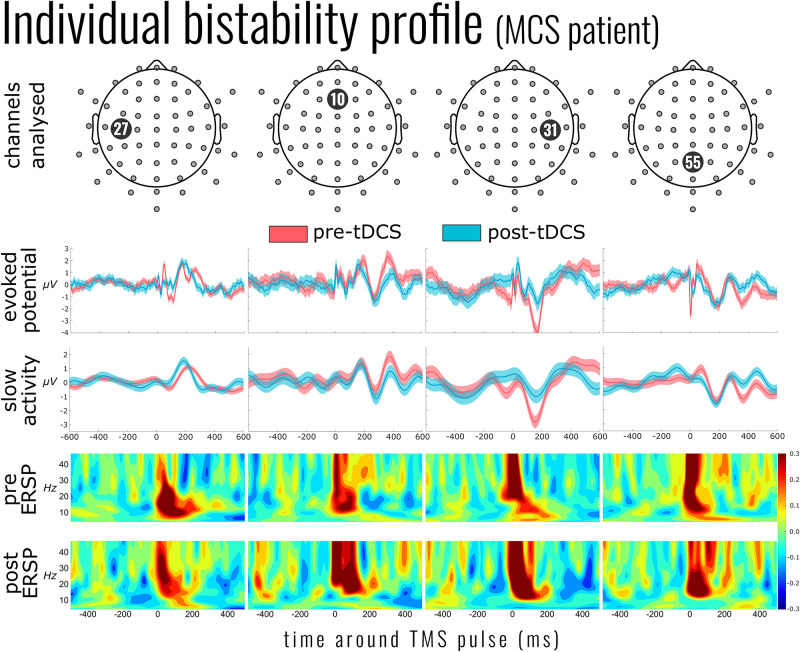
Due to life-saving medical advances, the diagnosis and treatment of disorders of consciousness (DOC) has become a more commonly occurring clinical issue. One recently developed intervention option has been non-invasive transcranial direct current stimulation. This dichotomy of patient responders may be better understood by investigating the mechanism behind the transcranial direct current stimulation (tDCS) intervention. The combination of transcranial magnetic stimulation and electroencephalography (TMS-EEG) has been an important diagnostic tool in DOC patients. We therefore examined the neural response using TMS-EEG both before and after tDCS in seven DOC patients (four diagnosed as in a minimally conscious state and three with unresponsive wakefulness syndrome). tDCS was applied over the dorsolateral prefrontal cortex, while TMS pulses were applied to the premotor cortex. None of the seven patients showed relevant behavioral change after tDCS. We did, however, find that the overall evoked slow activity was reduced following tDCS intervention. We also found a positive correlation between the strength of the slow activity and the amount of high-frequency suppression. However, there was no significant pre-post tDCS difference in high frequencies. In the resting-state EEG, we observed that both the incidence of slow waves and the positive slope of the wave were affected by tDCS. Taken together, these results suggest that the tDCS intervention can reduce the slow-wave activity component of bistability, but this may not directly affect high-frequency activity. We hypothesize that while reduced slow activity may be necessary for the recovery of neural function, especially consciousness, this alone is insufficient.
由于挽救生命的医学进步,意识障碍(DOC)的诊断和治疗已成为一个更常见的临床问题。一种最近开发的干预选项是非侵入性经颅直流电刺激。通过研究经颅直流电刺激(tDCS)干预背后的机制,可能会更好地理解患者反应的这种二分法。经颅磁刺激和脑电图(TMS - EEG)的结合一直是DOC患者的重要诊断工具。因此,我们在7名DOC患者(4名被诊断为最小意识状态,3名患有无反应觉醒综合征)中,在tDCS前后使用TMS - EEG检查了神经反应。tDCS应用于背外侧前额叶皮层,而TMS脉冲应用于运动前皮层。7名患者在tDCS后均未表现出相关行为变化。然而,我们确实发现tDCS干预后总的诱发慢活动减少。我们还发现慢活动强度与高频抑制量之间存在正相关。然而,tDCS前后高频没有显著差异。在静息态脑电图中,我们观察到慢波发生率和波的正斜率均受tDCS影响。综上所述,这些结果表明tDCS干预可以减少双稳态的慢波活动成分,但这可能不会直接影响高频活动。我们假设,虽然减少慢活动可能是神经功能恢复,尤其是意识恢复所必需的,但仅此一点是不够的。