Custodio Nilton, Duque Lissette, Montesinos Rosa, Alva-Diaz Carlos, Mellado Martin, Slachevsky Andrea
Research Unit, Instituto Peruano de Neurociencias, Lima, Peru.
Cognitive Decline and Dementia Diagnostic and Prevention Services Unit, Instituto Peruano de Neurociencias, Lima, Peru.
Front Aging Neurosci. 2020 Sep 4;12:270. doi: 10.3389/fnagi.2020.00270. eCollection 2020.
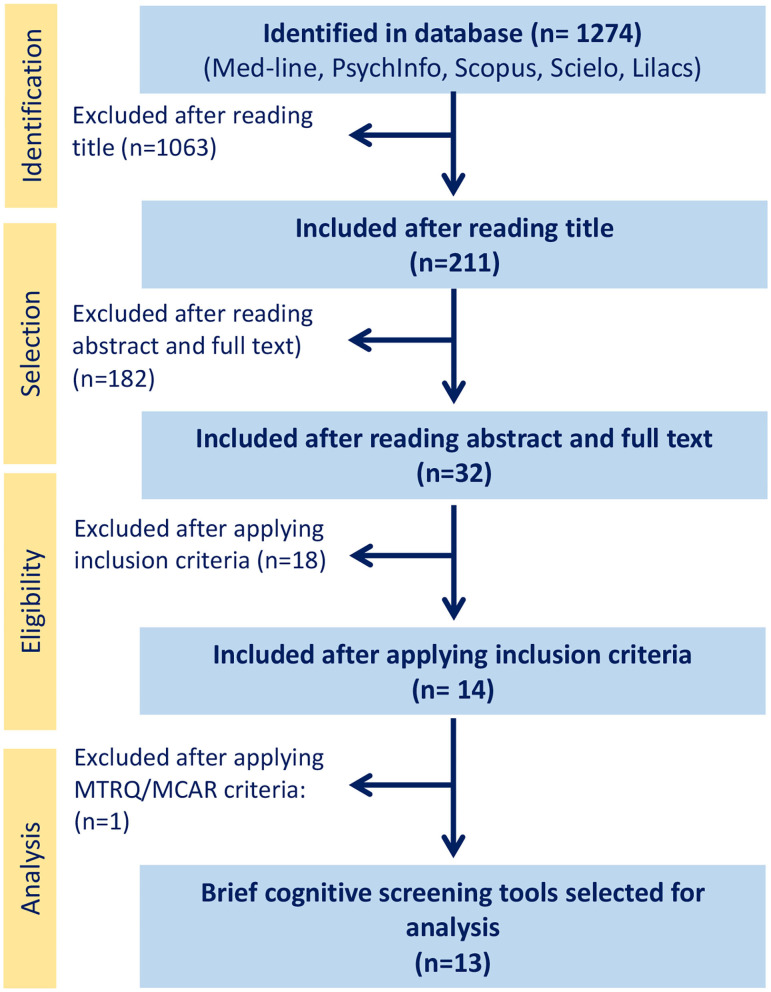
The aim of this study was to evaluate the validity of brief cognitive screening (BCS) tools designed to diagnose mild cognitive impairment (MCI) or dementia in Spanish-speaking individuals over the age of 50 years from Latin America (LA). A systematic search of titles and abstracts in Medline, Biomed Central, Embase, Scopus, Scirus, PsycINFO, LILACS, and SciELO was conducted. Inclusion criteria were papers written in English or Spanish involving samples from Spanish-speaking Latin American individuals published until 2018. Standard procedures were applied for reviewing the literature. The data related to the study sample, methodology, and procedures applied, as well as the performance obtained with the corresponding BCS, were collected and systematized. Thirteen of 211 articles met the inclusion criteria. The studies primarily involved memory clinic-based samples, with the exception of two studies from an adult day-care center, one from a primary care clinic, and one from a community-based sample. All the studies originated from five of the 20 countries of LA and all used standardized diagnostic criteria for the diagnosis of dementia and MCI; however, the diagnostic protocols applied differed. Most studies reported samples with an average of 10 years of education and only one reported a sample with an average of <5 years of education. No publication to date has included an illiterate population. Although the Montreal cognitive assessment (MoCA) is the most widely-used BCS tool in LA, it is significantly influenced by education level. Although evidence is still limited, the findings from studies on LA populations suggest that MoCA requires cultural adaptations and different cutoff points according to education level. Moreover, the diagnostic validity of the INECO frontal screening (IFS) test should be evaluated in populations with a low level of education. Given the heterogeneity that exists in the levels of education in LA, more studies involving illiterate and indigenous populations are required.
本研究的目的是评估旨在诊断来自拉丁美洲(LA)50岁以上讲西班牙语个体的轻度认知障碍(MCI)或痴呆症的简短认知筛查(BCS)工具的有效性。我们在Medline、Biomed Central、Embase、Scopus、Scirus、PsycINFO、LILACS和SciELO中对标题和摘要进行了系统检索。纳入标准是截至2018年发表的、用英语或西班牙语撰写的、涉及讲西班牙语的拉丁美洲个体样本的论文。采用标准程序对文献进行综述。收集并整理了与研究样本、方法和应用程序相关的数据,以及相应BCS所获得的性能数据。211篇文章中有13篇符合纳入标准。这些研究主要涉及基于记忆诊所的样本,不过有两项研究来自成人日托中心,一项来自初级保健诊所,一项来自社区样本。所有研究均来自LA 20个国家中的5个国家,并且都使用标准化诊断标准来诊断痴呆症和MCI;然而,所应用的诊断方案有所不同。大多数研究报告的样本平均受教育年限为10年,只有一项研究报告的样本平均受教育年限小于5年。迄今为止,没有出版物纳入文盲人群。尽管蒙特利尔认知评估(MoCA)是LA使用最广泛的BCS工具,但它受教育水平的影响很大。虽然证据仍然有限,但对LA人群的研究结果表明,MoCA需要根据教育水平进行文化调整和不同的临界值设定。此外,应在低教育水平人群中评估INECO额叶筛查(IFS)测试的诊断有效性。鉴于LA存在教育水平的异质性,需要更多涉及文盲和土著人群的研究。