Manzi Federico, Peretti Giulia, Di Dio Cinzia, Cangelosi Angelo, Itakura Shoji, Kanda Takayuki, Ishiguro Hiroshi, Massaro Davide, Marchetti Antonella
Research Unit on Theory of Mind, Department of Psychology, Università Cattolica del Sacro Cuore, Milan, Italy.
School of Computer Science, University of Manchester, Manchester, United Kingdom.
Front Psychol. 2020 Sep 30;11:2011. doi: 10.3389/fpsyg.2020.02011. eCollection 2020.
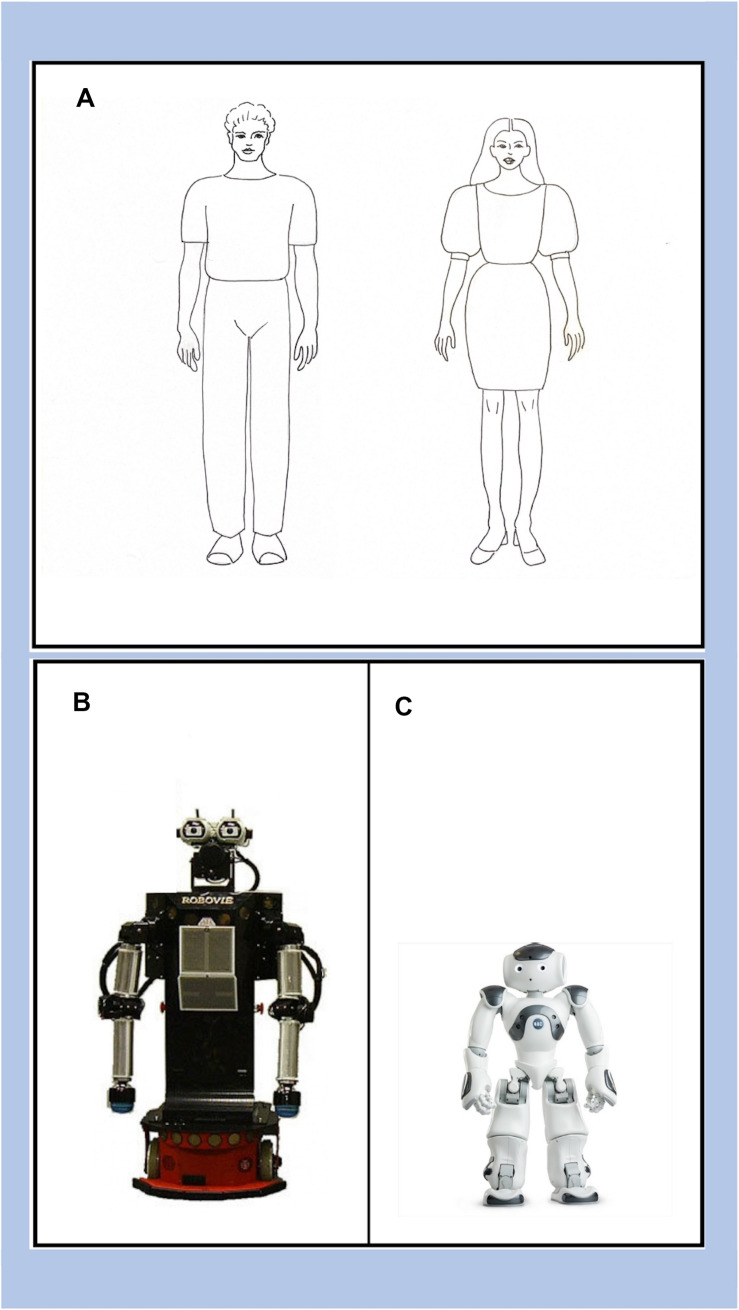
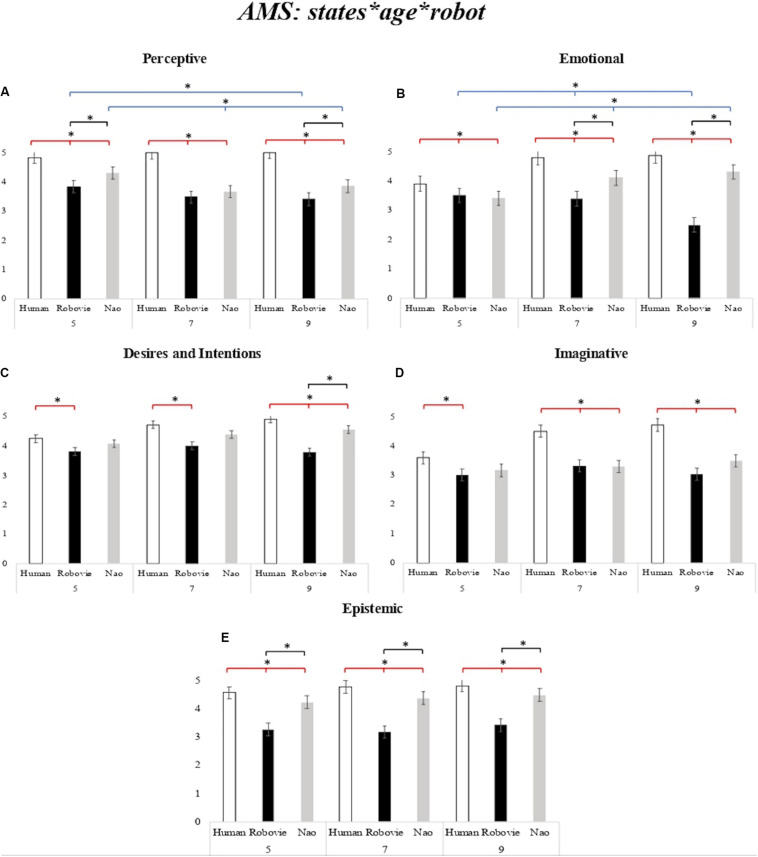
Recent technological developments in robotics has driven the design and production of different humanoid robots. Several studies have highlighted that the presence of human-like physical features could lead both adults and children to anthropomorphize the robots. In the present study we aimed to compare the attribution of mental states to two humanoid robots, NAO and Robovie, which differed in the degree of anthropomorphism. Children aged 5, 7, and 9 years were required to attribute mental states to the NAO robot, which presents more human-like characteristics compared to the Robovie robot, whose physical features look more mechanical. The results on mental state attribution as a function of children's age and robot type showed that 5-year-olds have a greater tendency to anthropomorphize robots than older children, regardless of the type of robot. Moreover, the findings revealed that, although children aged 7 and 9 years attributed a certain degree of human-like mental features to both robots, they attributed greater mental states to NAO than Robovie compared to younger children. These results generally show that children tend to anthropomorphize humanoid robots that also present some mechanical characteristics, such as Robovie. Nevertheless, age-related differences showed that they should be endowed with physical characteristics closely resembling human ones to increase older children's perception of human likeness. These findings have important implications for the design of robots, which also needs to consider the user's target age, as well as for the generalizability issue of research findings that are commonly associated with the use of specific types of robots.
机器人技术的最新发展推动了不同类人机器人的设计与生产。多项研究强调,类人身体特征的存在可能会使成年人和儿童都将机器人拟人化。在本研究中,我们旨在比较对两款拟人化程度不同的类人机器人NAO和Robovie的心理状态归因。要求5岁、7岁和9岁的儿童对NAO机器人进行心理状态归因,与身体特征看起来更具机械感的Robovie机器人相比,NAO呈现出更多类人特征。作为儿童年龄和机器人类型函数的心理状态归因结果表明,无论机器人类型如何,5岁儿童比年龄较大的儿童更倾向于将机器人拟人化。此外,研究结果显示,尽管7岁和9岁的儿童都赋予了两款机器人一定程度的类人心理特征,但与年幼儿童相比,他们赋予NAO的心理状态比Robovie更多。这些结果总体表明,儿童倾向于将具有一些机械特征的类人机器人拟人化,比如Robovie。然而,与年龄相关的差异表明,应该赋予它们与人类极为相似的身体特征,以增强年龄较大儿童对类人性的感知。这些发现对机器人设计具有重要意义,机器人设计还需要考虑用户的目标年龄,同时对于通常与特定类型机器人使用相关的研究结果的普遍性问题也具有重要意义。