D'Cruz Nicholas, Seuthe Jana, Ginis Pieter, Hulzinga Femke, Schlenstedt Christian, Nieuwboer Alice
Neurorehabilitation Research Group, Department of Rehabilitation Sciences, KU Leuven, Leuven, Belgium.
Department of Neurology, University Hospital Schleswig-Holstein, Christian-Albrechts-University (CAU) Kiel, Kiel, Germany.
Front Neurol. 2020 Sep 30;11:560084. doi: 10.3389/fneur.2020.560084. eCollection 2020.
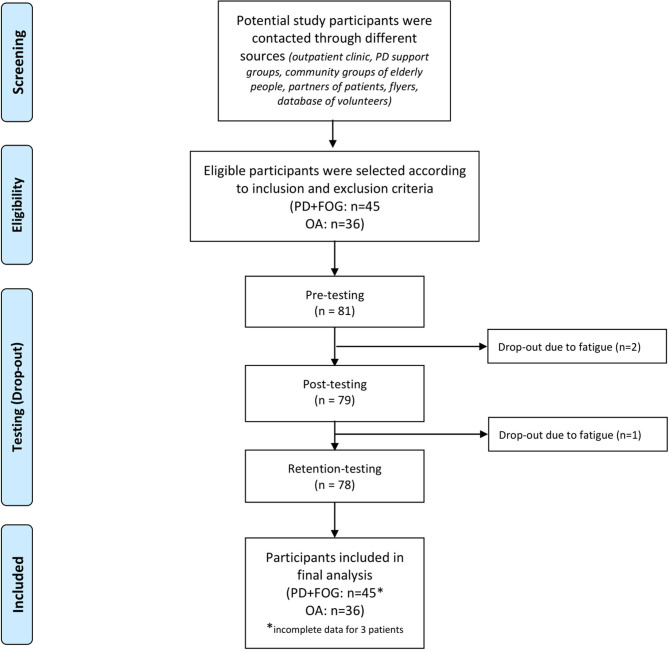
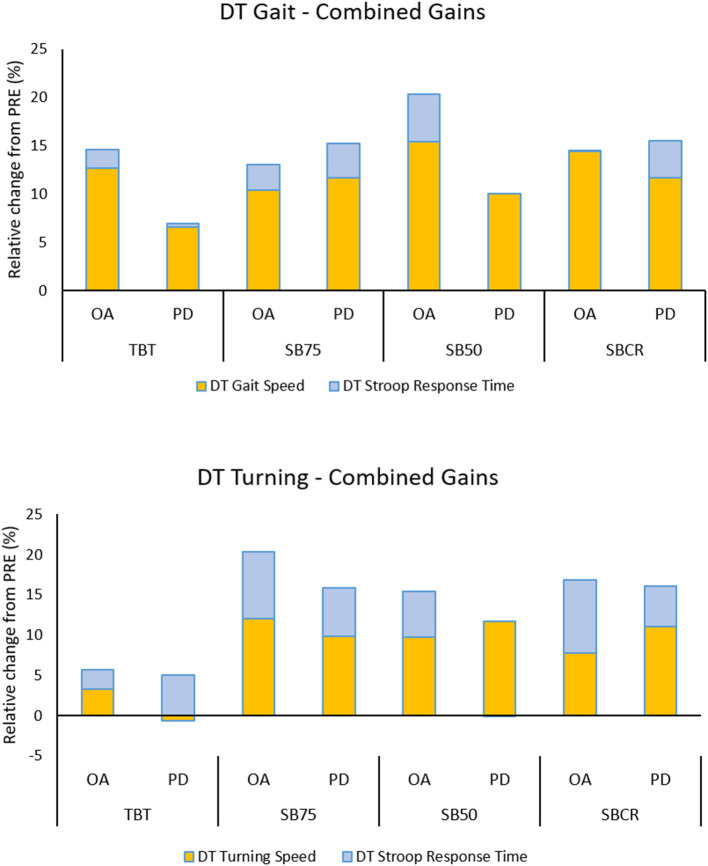
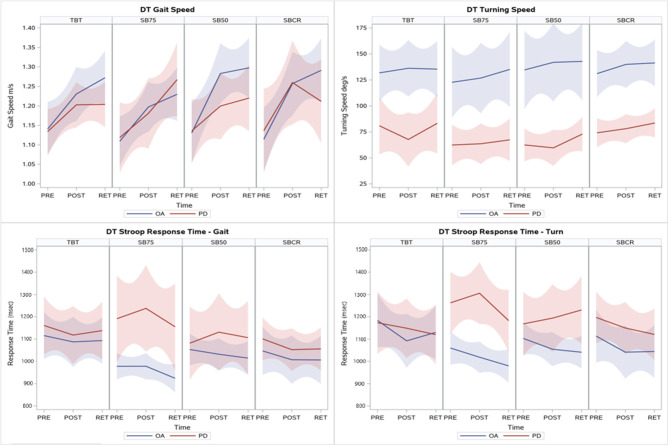
Dual-tasking is challenging for people with Parkinson's disease and freezing of gait (PD+FOG) and can exacerbate freezing episodes and falls. Split-belt treadmill training (SBT) is a novel tool to train complex gait and may improve dual-task (DT) walking and turning. To investigate the single-session effects of SBT on DT walking and DT turning performance in PD+FOG and older adults (OA), compared to regular treadmill training. Forty-five PD+FOG and 36 OA participated in a single training session (30 min). They were randomized into one of four training groups: (A) SB75-steady belt speed ratio 0.75:1; (B) SB50-steady belt speed ratio 0.5:1; (C) SBCR-changing belt speed ratios between 0.75:1 and 0.5:1; and (D) Tied-Belt (TBT). Over-ground straight-line gait and an alternating turning in place task combined with a cognitive dual-task (DT) (auditory Stroop) were assessed pre- and post-training, and the following day (retention). Constrained longitudinal data analysis was used to investigate the training effects for all participants and for PD+FOG alone. DT gait speed improved at post-training for all groups ( < 0.001). However, SBT (SB50 and SBCR) led to larger post-training improvements compared to TBT, which were still visible at retention (SB50). For mean DT turning speed and Stroop response time while walking, only SBT groups showed significant improvements at post-training or retention. DT stride length, peak DT turning speed, and Stroop performance index while walking also showed larger gains in SBT compared to TBT. Results for PD+FOG alone showed similar effects although with smaller effect sizes. A single session of SBT in PD+FOG and OA showed larger short-term effects on DT walking and turning compared to TBT. Cognitive DT performance was also improved in SBT, likely due to reduced cortical control of gait. These results illustrate the potential for SBT to improve DT during complex gait and possibly reduce fall risk in clinical and healthy populations.
对于帕金森病伴冻结步态患者(PD+FOG)而言,同时执行两项任务具有挑战性,且会加剧冻结发作和跌倒情况。分带跑步机训练(SBT)是一种训练复杂步态的新型工具,可能会改善双任务(DT)行走和转弯能力。为了研究与常规跑步机训练相比,SBT对PD+FOG患者和老年人(OA)的DT行走及DT转弯表现的单次训练效果。45名PD+FOG患者和36名OA参与了一次训练课程(30分钟)。他们被随机分为四个训练组之一:(A)SB75——稳定带速比为0.75:1;(B)SB50——稳定带速比为0.5:1;(C)SBCR——带速比在0.75:1和0.5:1之间变化;以及(D)系腰带训练(TBT)。在训练前、训练后以及第二天(保持期)评估地面直线步态、原地交替转弯任务以及与认知双任务(DT)(听觉斯特鲁普任务)相结合的情况,并使用受限纵向数据分析来研究所有参与者以及仅PD+FOG患者的训练效果。所有组在训练后DT步态速度均有所提高(<0.001)。然而,与TBT相比,SBT(SB50和SBCR)在训练后带来了更大的改善,在保持期(SB50)时这种改善仍然明显。对于平均DT转弯速度和行走时的斯特鲁普反应时间,只有SBT组在训练后或保持期显示出显著改善。与TBT相比,SBT在DT步幅长度、峰值DT转弯速度以及行走时的斯特鲁普表现指数方面也有更大提升。仅针对PD+FOG患者的结果显示出类似效果,尽管效应量较小。与TBT相比,对PD+FOG患者和OA进行一次SBT训练对DT行走和转弯的短期效果更显著。SBT中的认知DT表现也得到了改善,这可能是由于对步态的皮质控制减少所致。这些结果表明SBT在改善复杂步态中的DT能力以及可能降低临床和健康人群跌倒风险方面具有潜力。