NMI Natural and Medical Sciences Institute at the University of Tübingen, Tübingen, Germany.
Front Immunol. 2020 Sep 24;11:572634. doi: 10.3389/fimmu.2020.572634. eCollection 2020.
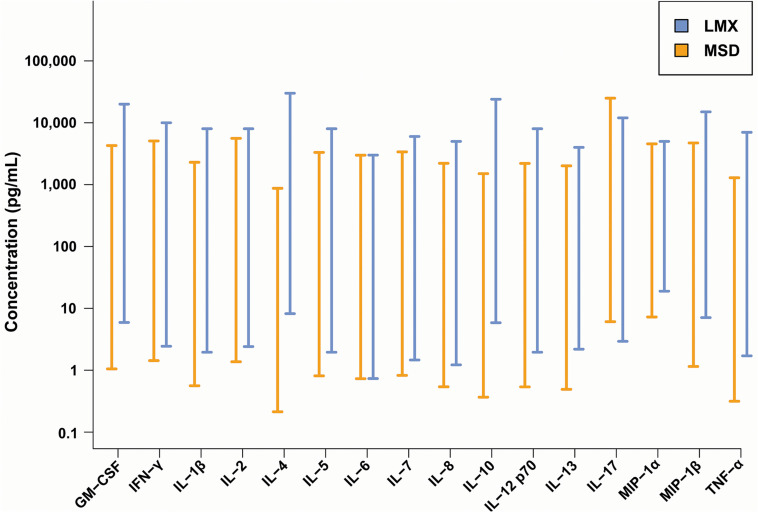
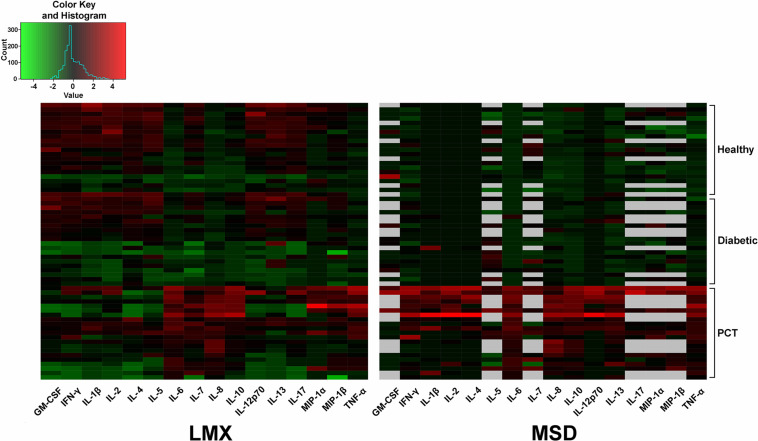
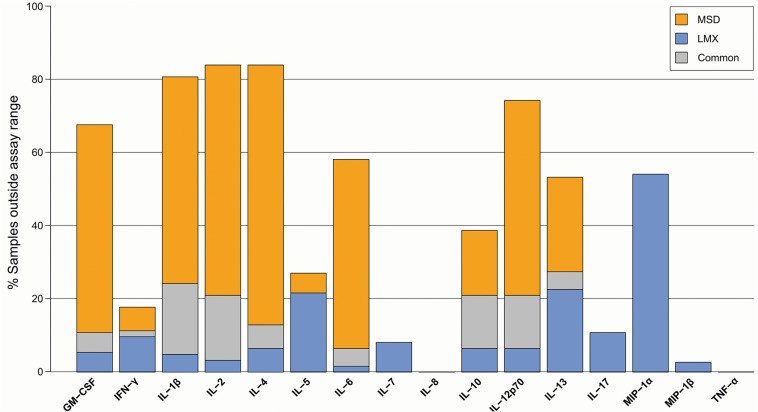
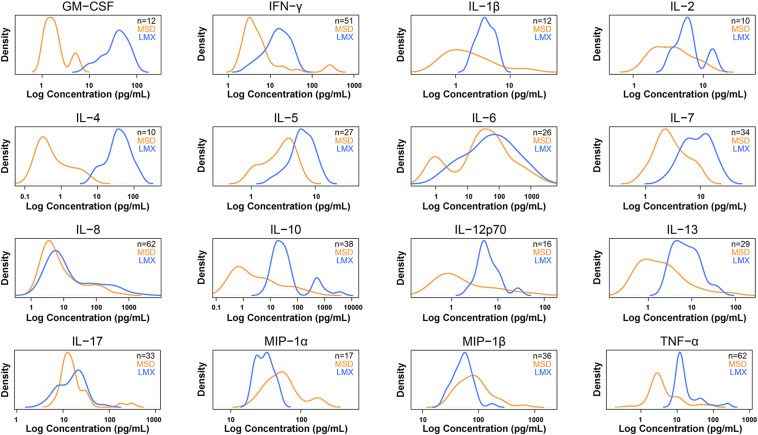
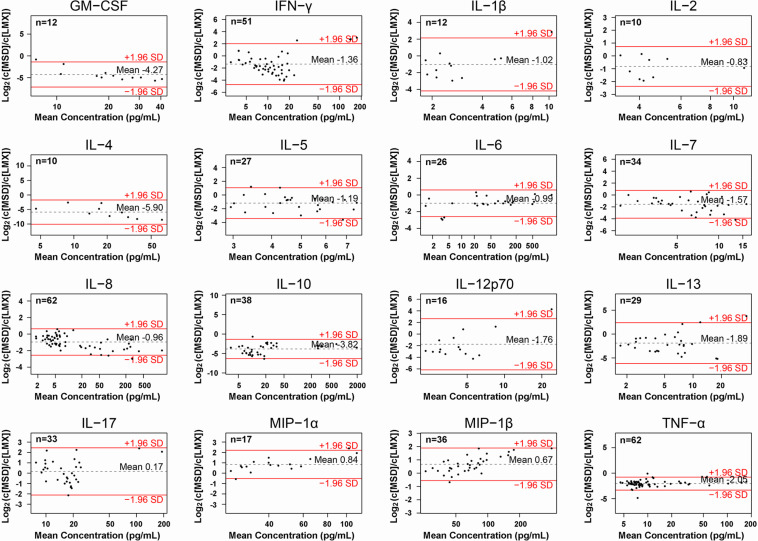
This study compared two 96-well multiplex immunoassay platforms for analytical performance in assessing cytokine concentrations in standards, quality controls and human plasma samples ( = 62), and evaluated assay time requirements. Assays included a bead-based fluorescence MILLIPLEX assay/Luminex fluorescence platform (LMX) and three kits from Meso Scale Discovery (MSD) in planar electrochemiluminescence format. The LMX kit evaluated 21 cytokines and the MSD kits evaluated 10 cytokines each, with 16 overlapping cytokines between platforms. Both assays provided good reproducibility in standard curves for all analytes. Interassay CVs of shared analytes showed average kit quality control CVs ranging 1.9-18.2% for LMX and 2.4-13.9% for MSD. The MSD platform had lower LLoQs than LMX for 14/16 shared cytokines. For IL-17, the LLoQ was lower with LMX than MSD, and the LLoQs for IL-6 were similar. Although MSD calibration curves indicated lower LLoQs for most of those analytes, many more cytokines in human plasma samples were not detected by MSD than by LMX. The ULoQs were higher in LMX versus MSD assays for 13/16 shared analytes, lower than MSD for IL-17, and equivalent between assays for IL-6 and MIP-1α. Bland-Altman plots indicated that MSD classified 13/16 shared analytes as concentrations lower than by LMX. Time and motion analysis indicated that total mean assay times were 20 h 28 m and 21 h 33 m for LMX and MSD, respectively, including an overnight (17 h) incubation. The MSD assays employed a manufacturer-approved overnight incubation instead of the standard 2-h incubation, which kit instructions suggest might increase detection sensitivity. Hands-on labor time averaged 1 h 37 m for LMX and 2 h 33 m for MSD. In summary, assay selection factors should include selection of specific markers of interest, time and cost considerations, and anticipated cytokine concentrations in prospective samples.
本研究比较了两种 96 孔多重免疫分析平台在评估标准品、质控品和人血浆样品中细胞因子浓度(=62)的分析性能,并评估了检测时间需求。检测包括基于珠的荧光 MILLIPLEX 检测/Luminex 荧光平台(LMX)和 Meso Scale Discovery(MSD)的三种试剂盒,均采用平面电化学发光格式。LMX 试剂盒评估了 21 种细胞因子,MSD 试剂盒各评估了 10 种细胞因子,两种平台共有 16 种重叠细胞因子。两种检测方法均为所有分析物提供了良好的标准曲线重现性。共享分析物的批间变异系数显示,LMX 的平均试剂盒质量控制变异系数范围为 1.9-18.2%,MSD 为 2.4-13.9%。对于 14/16 种共享细胞因子,MSD 平台的LLOQ 低于 LMX。对于 IL-17,LOQ 低于 MSD 的是 LMX,而对于 IL-6,LLOQ 相似。尽管 MSD 校准曲线表明对于大多数这些分析物,LLOQ 较低,但 MSD 检测到的人血浆样品中的细胞因子比 LMX 少。对于 13/16 种共享分析物,ULOQ 高于 LMX 与 MSD 检测,低于 MSD 的是 IL-17,而 IL-6 和 MIP-1α 的 ULOQ 在两种检测方法之间相等。Bland-Altman 图表明,MSD 将 13/16 种共享分析物归类为低于 LMX 的浓度。时间和运动分析表明,LMX 和 MSD 的总平均检测时间分别为 20 小时 28 分钟和 21 小时 33 分钟,包括 17 小时的过夜孵育。MSD 检测采用制造商批准的过夜孵育,而不是试剂盒说明书建议的标准 2 小时孵育,这可能会提高检测灵敏度。LMX 的手动操作时间平均为 1 小时 37 分钟,MSD 的为 2 小时 33 分钟。总之,检测选择因素应包括选择特定感兴趣的标志物、时间和成本考虑以及预期的前瞻性样本中的细胞因子浓度。