Zhang Jinxin, Nie Changsheng, Li Xinghua, Ning Zhonghua, Chen Yu, Jia Yaxiong, Han Jianlin, Wang Liang, Lv Xueze, Yang Weifang, Qu Lujiang
Department of Animal Genetics and Breeding, National Engineering Laboratory for Animal Breeding, College of Animal Science and Technology, China Agricultural University, Beijing, China.
Beijing Municipal General Station of Animal Science, Beijing, China.
Front Genet. 2020 Sep 25;11:543294. doi: 10.3389/fgene.2020.543294. eCollection 2020.
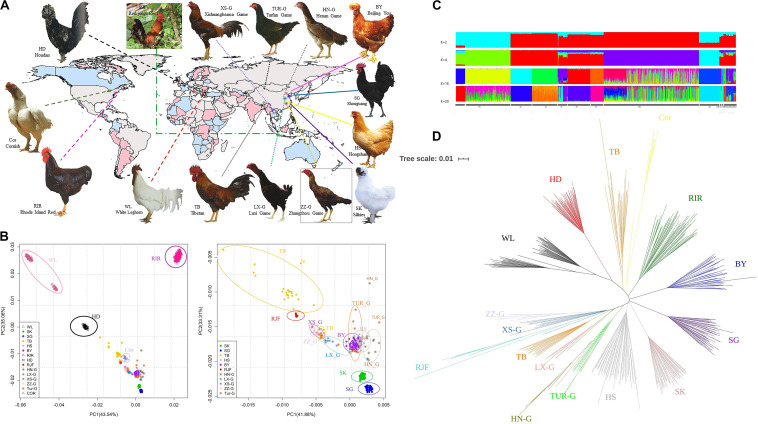
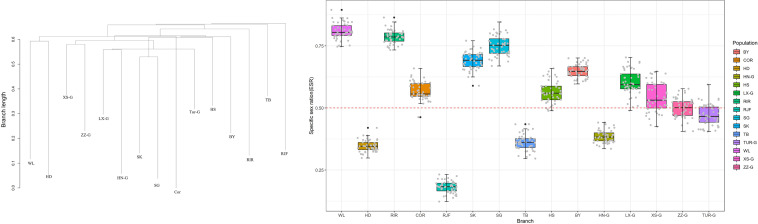
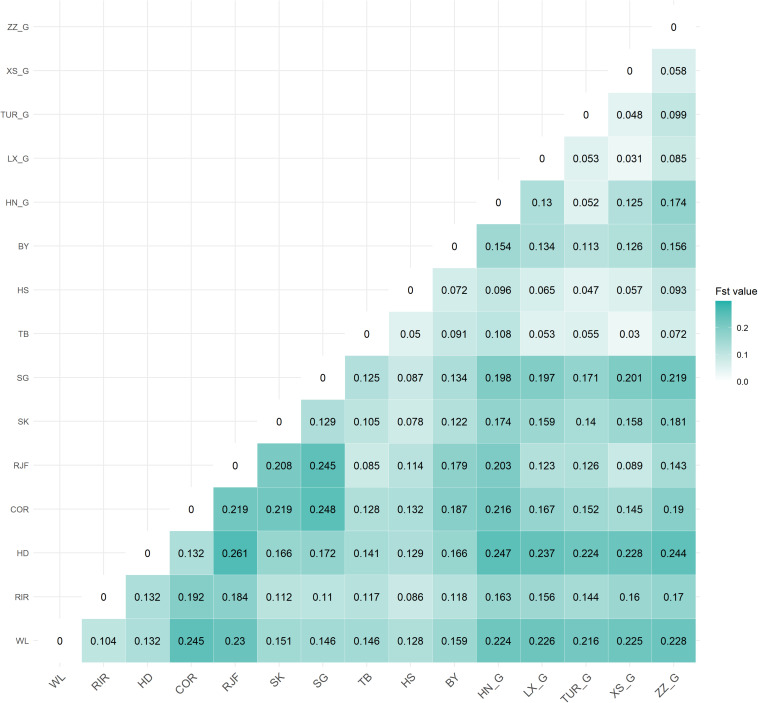
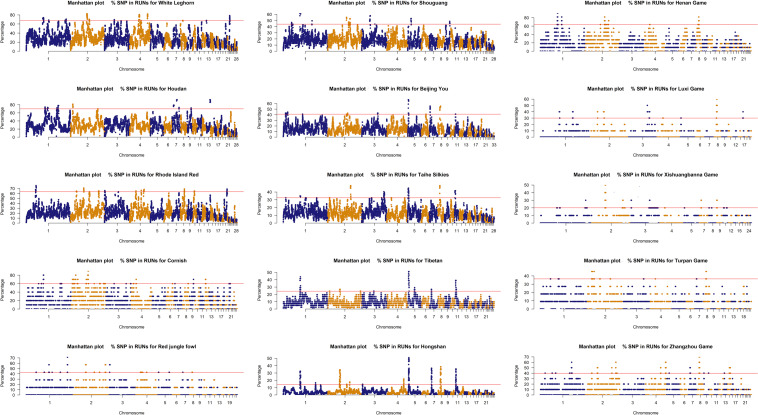
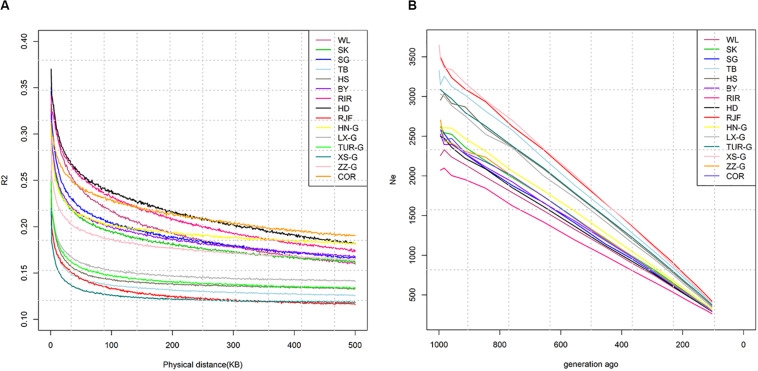
Following chicken domestication, diversified chicken breeds were developed by both natural and artificial selection, which led to the accumulation of abundant genetic and phenotypic variations, making chickens an ideal genetic research model. To better understand the genetic structure of chicken breeds under different selection pressures, we genotyped various chicken populations with specific selection targets, including indigenous, commercial, gamecock, and wild ancestral chickens, using the 600K SNP array. We analyzed the population structure, genetic relationships, run of homozygosity (ROH), effective population number (Ne), and other genetic parameters. The wild ancestral population, red junglefowl (RJF), possessed the highest diversity, in comparison with all other domesticated populations, which was supported by linkage disequilibrium decay (LD), effective population number, and ROH analyses. The gamecock breeds, which were subjected to stronger male-biased selection for fighting-related traits, also presented higher variation than the commercial and indigenous breeds. Admixture analysis also indicated that game breed is a relatively independent branch of Chinese local breeds. Following intense selection for reproductive and productive traits, the commercial lines showed the least diversity. We also observed that the European local chickens had lower genetic variation than the Chinese local breeds, which could be attributed to the shorter history of the European breed. ROH were present in a breed specific manner and 191 ROH island were detected on four groups (commercial, local, game and wild chickens). These ROH islands were involved in egg production, growth and silky feathers and other traits. Moreover, we estimated the effective sex ratio of these breeds to demonstrate the change in the ratio of the two sexes. We found that commercial chickens had a greater sex imbalance between females and males. The commercial lines showed the highest female-to-male ratios. Interestingly, RJF comprised a greater proportion of males than females. Our results show the population genetics of chickens under selection pressures, and can aid in the development of better conservation strategies for different chicken breeds.
鸡被驯化后,通过自然选择和人工选择培育出了多样化的鸡品种,这导致了丰富的遗传和表型变异的积累,使鸡成为理想的遗传研究模型。为了更好地了解不同选择压力下鸡品种的遗传结构,我们使用60万单核苷酸多态性(SNP)芯片对具有特定选择目标的各种鸡群体进行了基因分型,包括地方品种、商业品种、斗鸡和野生原鸡。我们分析了群体结构、遗传关系、纯合子连续区域(ROH)、有效种群数量(Ne)和其他遗传参数。与所有其他驯化群体相比,野生原鸡群体红原鸡(RJF)具有最高的多样性,连锁不平衡衰减(LD)、有效种群数量和ROH分析均支持这一点。由于对与打斗相关的性状进行了更强的雄性偏向选择,斗鸡品种也表现出比商业品种和地方品种更高的变异性。混合分析还表明,斗鸡品种是中国地方品种中一个相对独立的分支。在对繁殖和生产性状进行强烈选择后,商业品系的多样性最低。我们还观察到,欧洲地方鸡的遗传变异低于中国地方品种,这可能归因于欧洲品种的历史较短。ROH以品种特异性方式存在,在四个群体(商业鸡、地方鸡、斗鸡和野生鸡)中检测到191个ROH岛。这些ROH岛与产蛋、生长和丝羽等性状有关。此外,我们估计了这些品种的有效性别比,以证明两性比例的变化。我们发现,商业鸡的雌雄性别失衡更大。商业品系的雌雄比例最高。有趣的是,RJF中雄性的比例高于雌性。我们的结果展示了选择压力下鸡的群体遗传学,并有助于为不同鸡品种制定更好的保护策略。