Department of Clinical Medical Science, Walailak University School of Medicine, Nakhon Si Thammarat 80160, Thailand.
Department of Medicine, University of Arizona, Tucson, AZ 85724, USA.
J Environ Public Health. 2020 Oct 8;2020:1692930. doi: 10.1155/2020/1692930. eCollection 2020.
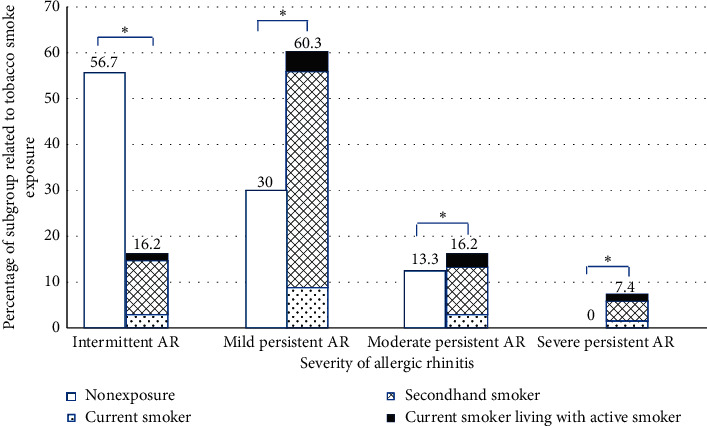
Allergic diseases, affecting a variety of organs, have continuously increased both in developed and developing countries. Tobacco smoke exposure increases prevalence of allergic rhinitis (AR) and may affect allergic sensitization. This study was designed to compare indoor-aeroallergen sensitization between those not exposed and exposed to tobacco smoke in university students and staff with allergic rhinitis. A cross-sectional descriptive study among university students and staff with allergic rhinitis was performed from February 1, 2018, to March 31, 2019. Questionnaires regarding demography, clinical symptoms, and tobacco smoke exposure were implemented. A current smoker was defined as using, at least, 1 cigarette per day for, at least, 1 month. A secondhand smoker was defined as the one who never smoked, but lived with a current smoker, at least, for 1 month. A skin prick test for eight common indoor aeroallergens, , , , cat dander, dog dander, para grass, careless weed, and spp., was performed. Sensitization was defined as positivity to, at least, 1 aeroallergen. One hundred and twenty-eight adult patients were eligible participants for the study, and 68 cases (53.10%) were classified as having tobacco smoke exposure. Among these, most of them were secondhand smokers (50 cases, 73.50%). There was no statistically significant difference between exposure and nonexposure to tobacco smoke and indoor aeroallergen sensitization, except for the antigen (=0.013). Most of those in the nonexposure group (34 cases, 56.70%) were classified as having intermittent allergic rhinitis, whereas the tobacco exposure group had significantly more prevalence of severe clinical symptoms. In conclusion, tobacco smoke exposure did not appear to have much influence on aeroallergen sensitization for 7 of the 8 antigens examined. However, for the antigen, there was a highly significant correlation with patients experiencing worsened allergic rhinitis symptoms. Overall, it was observed that allergic rhinitis patients exposed to tobacco smoke had more severe clinical symptoms. Future studies should look for other potential antigens of interest, such as mould. Implementation of public health practices reducing exposure to tobacco smoke could have benefits in allergic rhinitis patients.
变应性疾病影响多种器官,在发达国家和发展中国家的发病率均持续增高。烟草烟雾暴露可增加变应性鼻炎(AR)的患病率,并可能影响变应原致敏。本研究旨在比较大学学生和教职员工中未暴露于和暴露于烟草烟雾的变应性鼻炎患者的室内空气变应原致敏情况。2018 年 2 月 1 日至 2019 年 3 月 31 日,进行了一项变应性鼻炎的大学生和教职员工的横断面描述性研究。实施了关于人口统计学、临床症状和烟草烟雾暴露的调查问卷。目前吸烟者定义为每天至少使用 1 支香烟,至少 1 个月。二手烟暴露者定义为从不吸烟,但与目前吸烟者同住至少 1 个月的人。对 8 种常见室内空气变应原, 、 、 、猫皮屑、狗皮屑、豚草、莠草和 spp. 进行皮肤点刺试验。致敏定义为至少对 1 种变应原呈阳性。共有 128 名成年患者符合研究条件,其中 68 例(53.10%)被归类为有烟草烟雾暴露。其中,大多数是二手烟暴露者(50 例,73.50%)。暴露于和未暴露于烟草烟雾与室内空气变应原致敏之间除 抗原外无统计学差异(=0.013)。未暴露组(34 例,56.70%)大多数被归类为间歇性变应性鼻炎,而烟草暴露组严重临床症状的患病率显著更高。总之,烟草烟雾暴露似乎对所检查的 8 种抗原中的 7 种变应原致敏没有太大影响。然而,对于 抗原,与变应性鼻炎症状恶化的患者存在高度显著的相关性。总的来说,暴露于烟草烟雾的变应性鼻炎患者具有更严重的临床症状。未来的研究应该寻找其他潜在的感兴趣的抗原,如霉菌。实施减少接触烟草烟雾的公共卫生措施可能对变应性鼻炎患者有益。