Ahadi Parisa, Nasiri Jafar, Ghazavi Mohammad Reza, Mosavian Toktam, Mansouri Vahid
Department of Pediatrics, Isfahan University of Medical Sciences, Isfahan, Iran.
Child Growth and Developmental Research Center, Research Institute for Primordial Prevention of Noncommunicable Diseases, Isfahan University of Medical Sciences, Isfahan, Iran.
J Res Pharm Pract. 2020 Jun 26;9(2):68-72. doi: 10.4103/jrpp.JRPP_20_53. eCollection 2020 Apr-Jun.
This study was performed to investigate whether levetiracetam should be preferred to carbamazepine as a treatment choice for benign childhood epilepsy with centro Temporal spikes (BCECTS), the most common partial epilepsy of childhood.
This randomized clinical trial study included 92 children with rolandic epilepsy aged 4-12 years referred to the Pediatric Neurology Clinic at Imam Hossein Hospital, Isfahan, Iran, from April 2019 to January 2020. Patients were selected consecutively and randomly assigned to two study groups (levetiracetam and carbamazepine groups). Patients were followed and revisited every 2 months for 6 months after starting the medication. The frequency and duration of seizure attacks and drug side effects were recorded before treatment and in bi-monthly visits. Data were analyzed by SPSS software Version 24 using Mann-Whitney U- test and Friedman test.
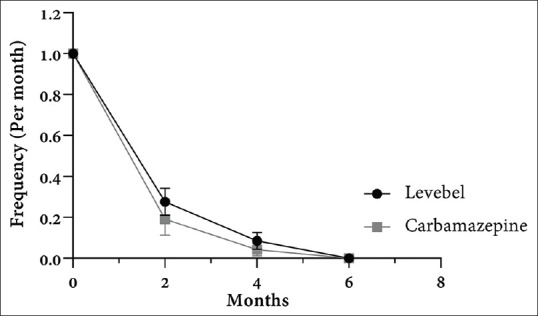
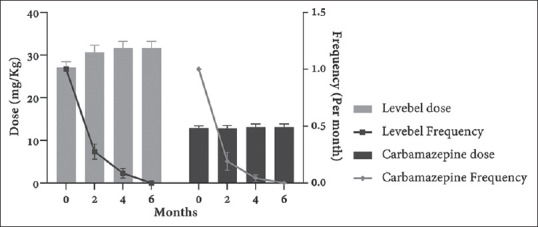
In our study, the seizure frequency decrease was not significantly different between the two groups; however, patients in both groups showed significantly lower seizure frequency in 2, 4, and 6 months of follow-up compared to starting time. After a follow-up for 6 months, one out of 47 (2.1%) patients using levetiracetam showed intolerance, resulting in changing the medication. In addition, two out of 48 (4.1%) patients in the carbamazepine group had skin rashes. No significant changes had been reported regarding the duration of seizure attacks in both groups after treatment.
This study showed encouraging results for using levetiracetam, with acceptable results and fewer side effects for the treatment of children with BCECTS in Iran.
本研究旨在探讨左乙拉西坦作为治疗儿童中央颞区棘波良性癫痫(BCECTS,儿童最常见的局灶性癫痫)的首选药物是否优于卡马西平。
这项随机临床试验研究纳入了2019年4月至2020年1月转诊至伊朗伊斯法罕伊玛目侯赛因医院儿科神经科门诊的92例4至12岁罗兰多癫痫患儿。患者连续入选并随机分为两个研究组(左乙拉西坦组和卡马西平组)。开始用药后,每2个月对患者进行随访和复诊,持续6个月。记录治疗前及每两个月复诊时癫痫发作的频率和持续时间以及药物副作用。使用SPSS 24软件通过曼-惠特尼U检验和弗里德曼检验对数据进行分析。
在我们的研究中,两组癫痫发作频率的降低无显著差异;然而,与开始治疗时相比,两组患者在随访的第2、4和6个月癫痫发作频率均显著降低。随访6个月后,47例使用左乙拉西坦的患者中有1例(2.1%)出现不耐受,导致更换药物。此外,卡马西平组48例患者中有2例(4.1%)出现皮疹。治疗后两组癫痫发作的持续时间均未报告有显著变化。
本研究显示使用左乙拉西坦治疗伊朗BCECTS患儿取得了令人鼓舞且可接受的结果,且副作用较少。