Department of Social Medicine, Division of Hygiene, Nihon University School of Medicine, Itabashi-ku, Tokyo, Japan.
Department of Electrical Engineering and Computer Science, Institute for Medical Engineering and Science, Massachusetts Institute of Technology, Cambridge, MA, USA.
J Physiol. 2021 Feb;599(4):1067-1081. doi: 10.1113/JP280318. Epub 2020 Nov 11.
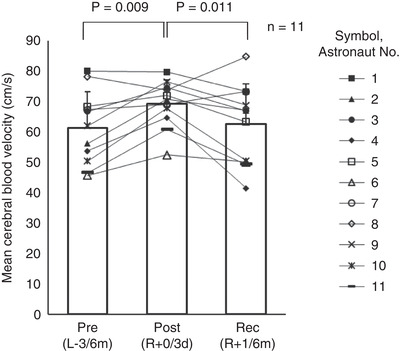
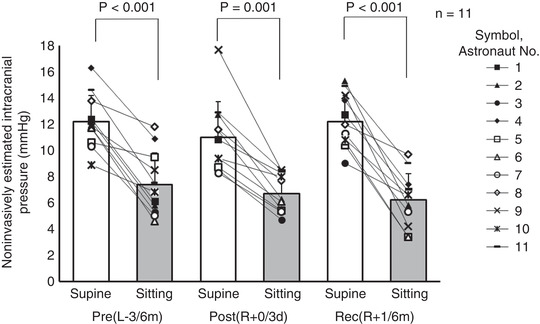
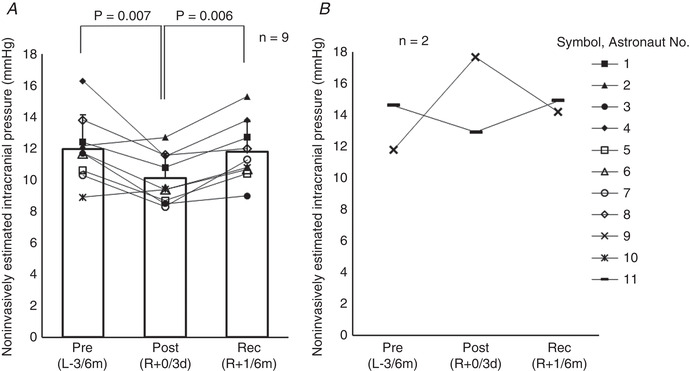
During long-duration spaceflights, some astronauts develop structural ocular changes including optic disc oedema that resemble signs of intracranial hypertension. In the present study, intracranial pressure was estimated non-invasively (nICP) using a model-based analysis of cerebral blood velocity and arterial blood pressure waveforms in 11 astronauts before and after long-duration spaceflights. Our results show that group-averaged estimates of nICP decreased significantly in nine astronauts without optic disc oedema, suggesting that the cephalad fluid shift during long-duration spaceflight rarely increased postflight intracranial pressure. The results of the two astronauts with optic disc oedema suggest that both increases and decreases in nICP are observed post-flight in astronauts with ocular alterations, arguing against a primary causal relationship between elevated ICP and spaceflight associated optical changes. Cerebral blood velocity increased independently of nICP and spaceflight-associated ocular alterations. This increase may be caused by the reduced haemoglobin concentration after long-duration spaceflight.
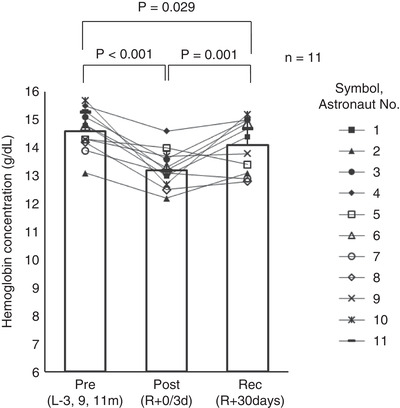
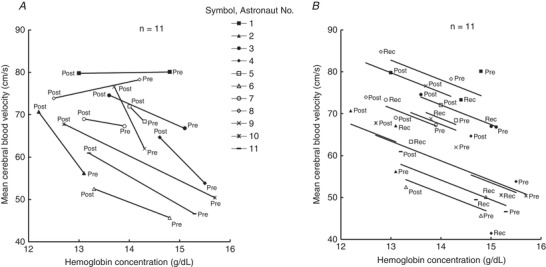
Persistently elevated intracranial pressure (ICP) above upright values is a suspected cause of optic disc oedema in astronauts. However, no systematic studies have evaluated changes in ICP from preflight. Therefore, ICP was estimated non-invasively before and after spaceflight to test whether ICP would increase after long-duration spaceflight. Cerebral blood velocity in the middle cerebral artery (MCAv) was obtained by transcranial Doppler sonography and arterial pressure in the radial artery was obtained by tonometry, in the supine and sitting positions before and after 4-12 months of spaceflight in 11 astronauts (10 males and 1 female, 46 ± 7 years old at launch). Non-invasive ICP (nICP) was computed using a validated model-based estimation method. Mean MCAv increased significantly after spaceflight (ANOVA, P = 0.007). Haemoglobin decreased significantly after spaceflight (14.6 ± 0.8 to 13.3 ± 0.7 g/dL, P < 0.001). A repeated measures correlation analysis indicated a negative correlation between haemoglobin and mean MCAv (r = -0.589, regression coefficient = -4.68). The nICP did not change significantly after spaceflight in the 11 astronauts. However, nICP decreased significantly by 15% in nine astronauts without optic disc oedema (P < 0.005). Only one astronaut increased nICP to relatively high levels after spaceflight. Contrary to our hypothesis, nICP did not increase after long-duration spaceflight in the vast majority (>90%) of astronauts, suggesting that the cephalad fluid shift during spaceflight does not systematically or consistently elevate postflight ICP in astronauts. Independently of nICP and ocular alterations, the present results of mean MCAv suggest that long-duration spaceflight may increase cerebral blood flow, possibly due to reduced haemoglobin concentration.
在长时间的太空飞行中,一些宇航员会出现眼部结构变化,包括视盘水肿,类似于颅内压升高的迹象。在本研究中,使用基于模型的大脑血液速度分析和动脉血压波形分析,在 11 名宇航员进行长时间太空飞行前后,对颅内压进行了无创估计(nICP)。我们的结果表明,在没有视盘水肿的 9 名宇航员中,nICP 的平均估计值显著下降,这表明在长时间太空飞行中,颅内液体会向头侧转移,但很少会增加飞行后的颅内压。在两名视盘水肿的宇航员中,nICP 增加和减少的结果均表明,在眼部改变的宇航员中,飞行后 nICP 会出现变化,这与颅内压升高和与太空飞行相关的光学变化之间存在因果关系相矛盾。大脑血流速度独立于 nICP 和与太空飞行相关的眼部改变而增加。这种增加可能是由于长时间太空飞行后血红蛋白浓度降低所致。
持续升高的颅内压(ICP)高于直立值,被怀疑是宇航员视盘水肿的原因。然而,目前还没有系统的研究评估飞行前的 ICP 变化。因此,我们在 11 名宇航员(10 名男性和 1 名女性,发射时年龄 46±7 岁)进行了 4-12 个月的太空飞行前后,使用经颅多普勒超声测量大脑中动脉(MCAv)的血流速度和桡动脉的动脉血压,在仰卧位和坐位下进行了测量。使用验证的基于模型的估计方法计算了无创 ICP(nICP)。飞行后 MCAv 明显增加(方差分析,P=0.007)。飞行后血红蛋白明显下降(14.6±0.8 至 13.3±0.7 g/dL,P<0.001)。重复测量相关性分析表明血红蛋白与平均 MCAv 呈负相关(r=-0.589,回归系数=-4.68)。11 名宇航员的 nICP 飞行后无明显变化。然而,9 名无视盘水肿的宇航员 nICP 显著下降 15%(P<0.005)。只有一名宇航员的 nICP 在飞行后升高到相对较高的水平。与我们的假设相反,在绝大多数(>90%)宇航员中,nICP 在长时间太空飞行后并没有增加,这表明在太空飞行中,颅内液体会向头侧转移不会系统地或持续地增加宇航员飞行后的 ICP。与 nICP 和眼部改变无关,MCAv 的平均本研究结果表明,长时间太空飞行可能会增加脑血流,可能是由于血红蛋白浓度降低所致。