
D50 疾病进展模型揭示的肌萎缩侧索硬化症白质束中的疾病侵袭特征。
Disease aggressiveness signatures of amyotrophic lateral sclerosis in white matter tracts revealed by the D50 disease progression model.
机构信息
Hans Berger Department of Neurology, Jena University Hospital, Jena, Germany.
Department of Neuroradiology, Jena University Hospital, Jena, Germany.
出版信息
Hum Brain Mapp. 2021 Feb 15;42(3):737-752. doi: 10.1002/hbm.25258. Epub 2020 Oct 26.
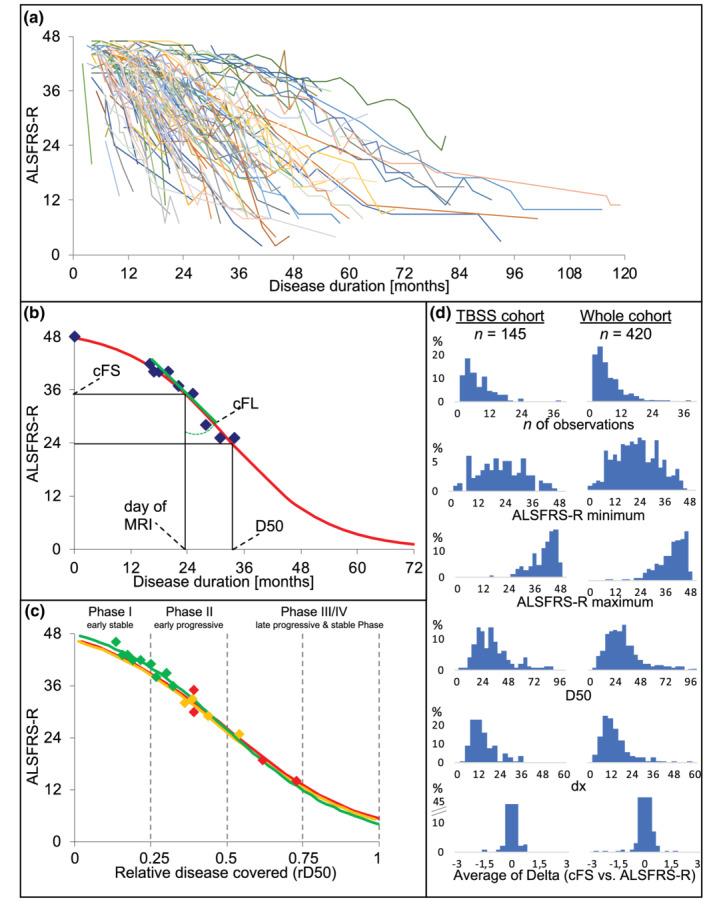
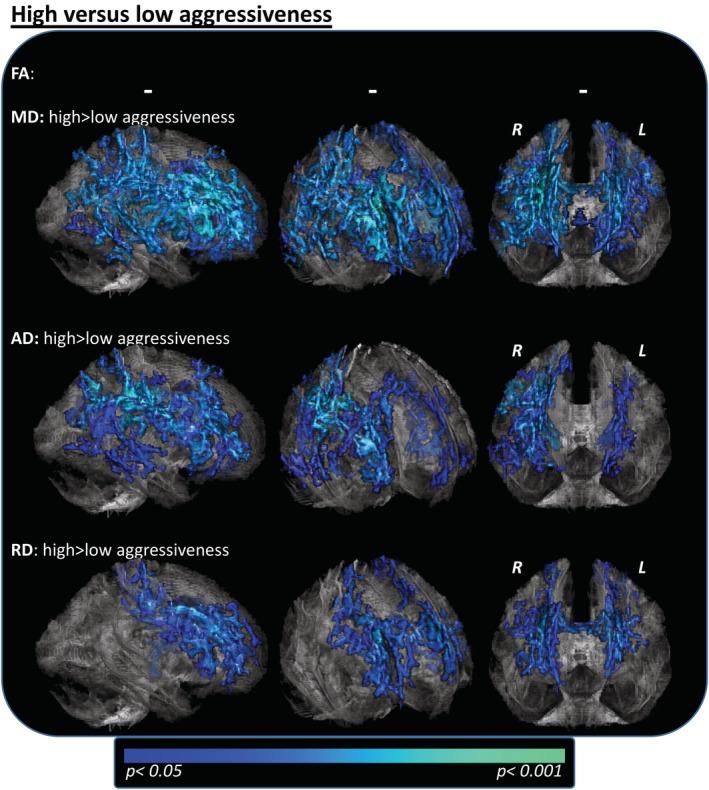
Numerous neuroimaging studies in amyotrophic lateral sclerosis (ALS) have reported links between structural changes and clinical data; however phenotypic and disease course heterogeneity have occluded robust associations. The present study used the novel D50 model, which distinguishes between disease accumulation and aggressiveness, to probe correlations with measures of diffusion tensor imaging (DTI). DTI scans of 145 ALS patients and 69 controls were analyzed using tract-based-spatial-statistics of fractional anisotropy (FA), mean- (MD), radial (RD), and axial diffusivity (AD) maps. Intergroup contrasts were calculated between patients and controls, and between ALS subgroups: based on (a) the individual disease covered (Phase I vs. II) or b) patients' disease aggressiveness (D50 value). Regression analyses were used to probe correlations with model-derived parameters. Case-control comparisons revealed widespread ALS-related white matter pathology with decreased FA and increased MD/RD. These affected pathways showed also correlations with the accumulated disease for increased MD/RD, driven by the subgroup of Phase I patients. No significant differences were noted between patients in Phase I and II for any of the contrasts. Patients with high disease aggressiveness (D50 < 30 months) displayed increased AD/MD in bifrontal and biparietal pathways, which was corroborated by significant voxel-wise regressions with D50. Application of the D50 model revealed associations between DTI measures and ALS pathology in Phase I, representing individual disease accumulation early in disease. Patients' overall disease aggressiveness correlated robustly with the extent of DTI changes. We recommend the D50 model for studies developing/validating neuroimaging or other biomarkers for ALS.
许多肌萎缩侧索硬化症(ALS)的神经影像学研究报告了结构变化与临床数据之间的联系;然而,表型和疾病过程的异质性阻碍了稳健的关联。本研究使用了新的 D50 模型,该模型区分了疾病积累和侵袭性,以探究与扩散张量成像(DTI)测量的相关性。使用基于分数各向异性(FA)、平均(MD)、径向(RD)和轴向扩散系数(AD)图的基于束的空间统计分析,对 145 名 ALS 患者和 69 名对照者的 DTI 扫描进行了分析。在患者和对照组之间、在基于个体疾病覆盖(I 期与 II 期)的 ALS 亚组之间以及在基于患者疾病侵袭性(D50 值)的 ALS 亚组之间计算了组间对比。回归分析用于探究与模型衍生参数的相关性。病例对照比较显示,广泛的 ALS 相关白质病变伴有 FA 降低和 MD/RD 增加。这些受影响的通路也与累积疾病相关,MD/RD 增加,这主要是由 I 期患者亚组驱动的。对于任何对比,I 期和 II 期患者之间均未观察到显著差异。疾病侵袭性高(D50 < 30 个月)的患者在前额和顶叶双通路中显示出 AD/MD 增加,这与 D50 的显著体素回归一致。D50 模型的应用揭示了 DTI 测量与 I 期 ALS 病理学之间的关联,代表了疾病早期的个体疾病积累。患者的整体疾病侵袭性与 DTI 变化的程度密切相关。我们建议使用 D50 模型进行开发/验证 ALS 的神经影像学或其他生物标志物的研究。




 Zotero 插件