Department of Microbiology and Immunology, Tulane University, New Orleans, LA 70118, USA.
Int J Mol Sci. 2020 Oct 22;21(21):7842. doi: 10.3390/ijms21217842.
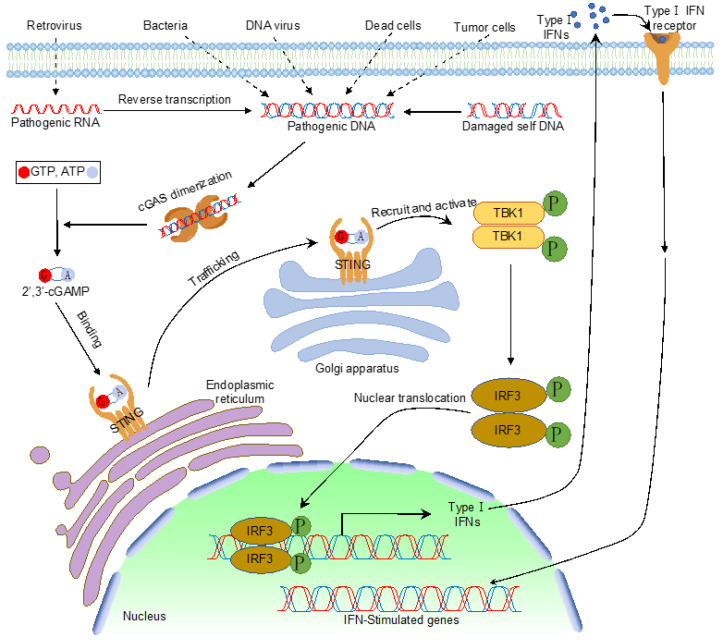
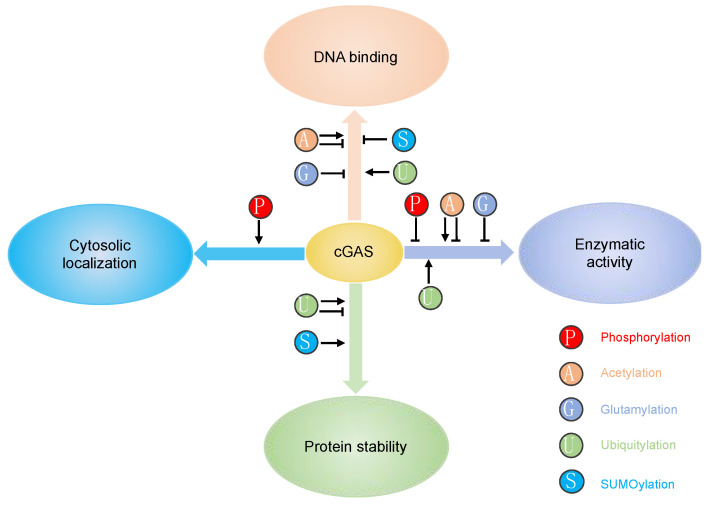
Cyclic GMP-AMP synthase (cGAS) is the synthase that generates the second messenger cyclic GMP-AMP (cGAMP) upon DNA binding. cGAS was first discovered as the cytosolic DNA sensor that detects DNA exposed in the cytoplasm either from pathogens or cellular damage. Activated cGAS instigates the signaling cascades to activate type I interferon (IFN) expression, critical for host defense and autoimmune diseases. In addition, cGAS plays a role in senescence, DNA repair, apoptosis, and tumorigenesis. Recently, various post-translational modifications (PTMs) of cGAS have been reported, such as phosphorylation, ubiquitination, acetylation, glutamylation, and sumoylation. These PTMs profoundly affect cGAS functions. Thus, here we review the recent reported PTMs of cGAS and how these PTMs regulate cGAS enzymatic activity, DNA binding, and protein stability, and discuss the potential future directions.
环鸟苷酸-腺苷酸合酶(cGAS)是一种在结合 DNA 时生成第二信使环鸟苷酸-腺苷酸(cGAMP)的合酶。cGAS 最初被发现是一种细胞质 DNA 传感器,可检测细胞质中来自病原体或细胞损伤的暴露 DNA。激活的 cGAS 引发信号级联反应,激活 I 型干扰素(IFN)的表达,这对宿主防御和自身免疫性疾病至关重要。此外,cGAS 在衰老、DNA 修复、细胞凋亡和肿瘤发生中也发挥作用。最近,已经报道了 cGAS 的各种翻译后修饰(PTM),如磷酸化、泛素化、乙酰化、谷氨酸化和 sumoylation。这些 PTM 深刻地影响了 cGAS 的功能。因此,在这里我们综述了最近报道的 cGAS 的 PTM 以及这些 PTM 如何调节 cGAS 的酶活性、DNA 结合和蛋白质稳定性,并讨论了潜在的未来方向。