Suppr超能文献

病毒 DNA 传感器和先天免疫信号转导的翻译后修饰调控

Post-translational modification control of viral DNA sensors and innate immune signaling.

机构信息

Department of Molecular Biology, Princeton University, Princeton, NJ, United States.

Department of Molecular Biology, Princeton University, Princeton, NJ, United States.

出版信息

Adv Virus Res. 2021;109:163-199. doi: 10.1016/bs.aivir.2021.03.001. Epub 2021 Apr 16.

Abstract

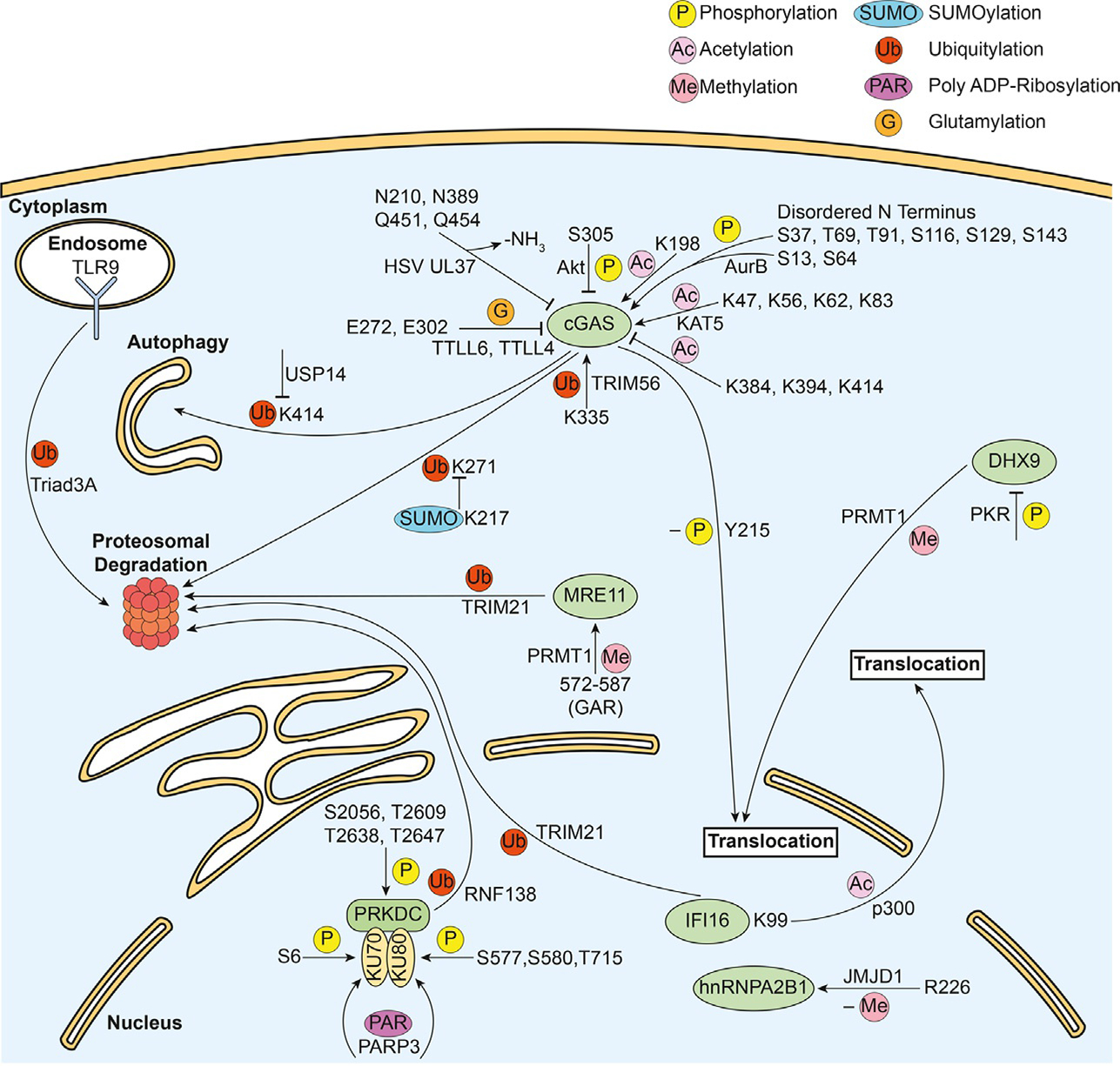
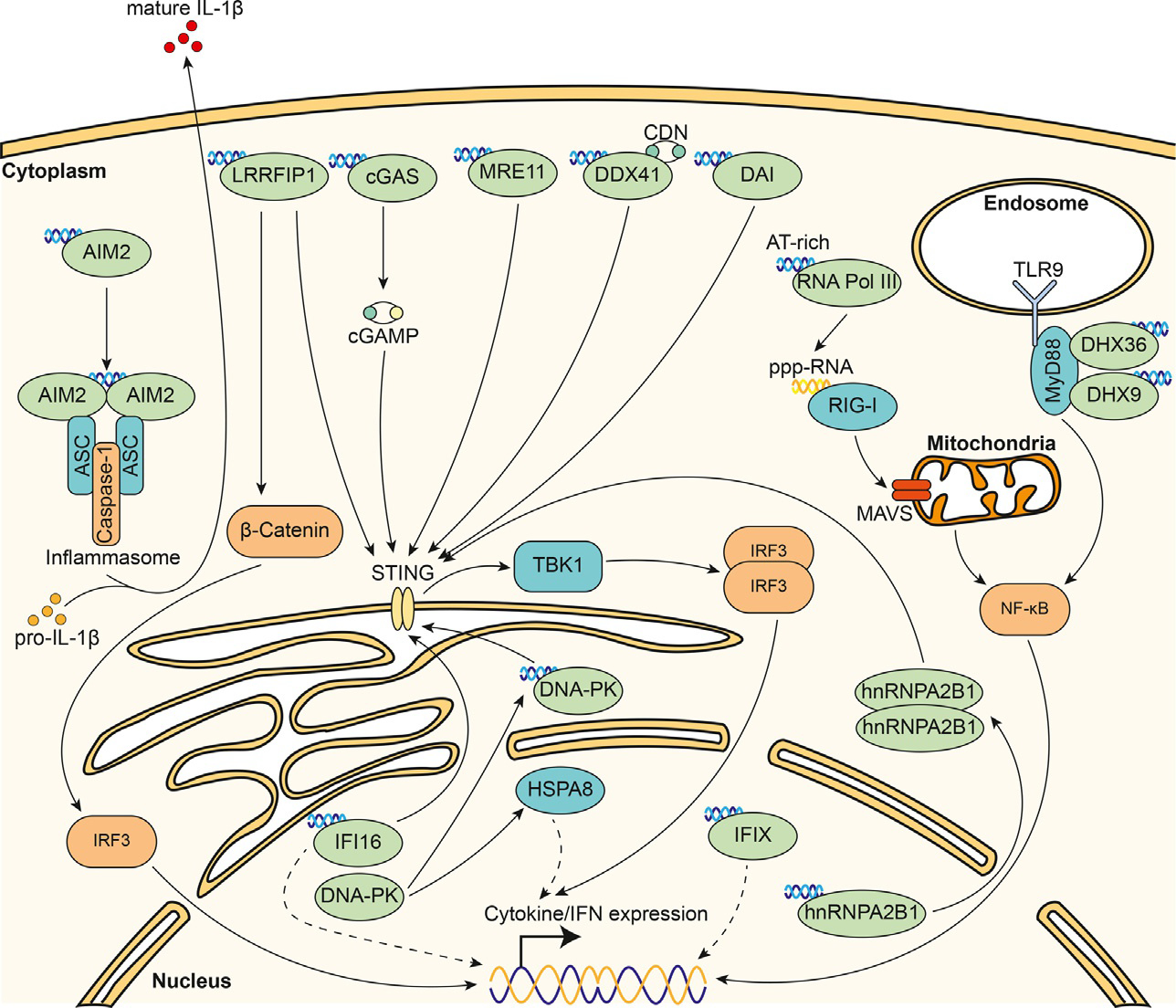
The vertebrate innate immune system confers host cells with mechanisms to protect against both evolutionarily ancient pathogens and newly emerging pathogenic strains. Innate immunity relies on the host cell's ability to distinguish between self and pathogen-derived molecules. To achieve this, the innate immune system uses germline encoded receptors called pattern recognition receptors (PRRs), which recognize various molecular signatures, including nucleic acids, proteins, lipids, glycans and glycolipids. Among these molecules, the recognition of pathogenic, mislocalized, or damaged DNA by cellular protein receptors, commonly called DNA sensors, represents a major surveillance pathway for initiating immune signaling. The ability of cells to temporally regulate DNA sensor activation and subsequent signal termination is critical for effective immune signaling. These same mechanisms are also co-opted by pathogens to promote their replication. Therefore, there is significant interest in understanding DNA sensor regulatory networks during microbial infections and autoimmune disease. One emerging aspect of DNA sensor regulation is through post-translational modifications (PTMs), including phosphorylation, acetylation, ubiquitination, ADP-ribosylation, SUMOylation, methylation, deamidation, glutamylation. In this chapter, we discuss how PTMs have been shown to positively or negatively impact DNA sensor functions via diverse mechanisms, including direct regulation of enzymatic activity, protein-protein and protein-DNA interactions, protein translocations and protein turnover. In addition, we highlight the ability of virus-induced PTMs to promote immune evasion. We also discuss the recent evidence linking PTMs on DNA sensors with human diseases and more broadly, highlight promising directions for future research on PTM-mediated regulation of DNA sensor-dependent immune signaling.

摘要

脊椎动物先天免疫系统赋予宿主细胞一系列机制,使其能够抵御古老的病原体和新兴的致病性菌株。先天免疫依赖于宿主细胞区分自身和病原体来源分子的能力。为了实现这一点,先天免疫系统使用称为模式识别受体 (PRR) 的胚系编码受体,这些受体识别各种分子特征,包括核酸、蛋白质、脂质、糖和糖脂。在这些分子中,细胞对细胞蛋白受体识别的致病性、定位错误或受损 DNA 的识别,通常称为 DNA 传感器,代表了启动免疫信号的主要监视途径。细胞临时调节 DNA 传感器激活和随后信号终止的能力对于有效的免疫信号至关重要。病原体也利用这些相同的机制来促进其复制。因此,人们对了解微生物感染和自身免疫性疾病期间 DNA 传感器调节网络非常感兴趣。DNA 传感器调节的一个新兴方面是通过翻译后修饰 (PTM),包括磷酸化、乙酰化、泛素化、ADP-核糖基化、SUMO 化、甲基化、脱酰胺化、谷氨酸化。在本章中,我们讨论了 PTM 如何通过多种机制(包括直接调节酶活性、蛋白质-蛋白质和蛋白质-DNA 相互作用、蛋白质易位和蛋白质周转率)对 DNA 传感器功能产生积极或消极影响。此外,我们强调了病毒诱导的 PTM 促进免疫逃避的能力。我们还讨论了将 PTM 与 DNA 传感器联系起来与人类疾病的最新证据,并更广泛地强调了 PTM 介导的 DNA 传感器依赖性免疫信号转导的未来研究有希望的方向。
相似文献

1
Post-translational modification control of viral DNA sensors and innate immune signaling.
Adv Virus Res. 2021;109:163-199. doi: 10.1016/bs.aivir.2021.03.001. Epub 2021 Apr 16.
2
The DNA Sensor cGAS is Decorated by Acetylation and Phosphorylation Modifications in the Context of Immune Signaling.
Mol Cell Proteomics. 2020 Jul;19(7):1193-1208. doi: 10.1074/mcp.RA120.001981. Epub 2020 Apr 28.
3
Cytoplasmic Mechanisms of Recognition and Defense of Microbial Nucleic Acids.
Annu Rev Cell Dev Biol. 2018 Oct 6;34:357-379. doi: 10.1146/annurev-cellbio-100617-062903. Epub 2018 Aug 10.
4
Viral evasion of intracellular DNA and RNA sensing.
Nat Rev Microbiol. 2016 Jun;14(6):360-73. doi: 10.1038/nrmicro.2016.45. Epub 2016 May 13.
5
Role of Post-Translational Modifications of cGAS in Innate Immunity.
Int J Mol Sci. 2020 Oct 22;21(21):7842. doi: 10.3390/ijms21217842.
6
Post-Translational Modification Control of Innate Immunity.
Immunity. 2016 Jul 19;45(1):15-30. doi: 10.1016/j.immuni.2016.06.020.
7
Post-translational regulation of antiviral innate signaling.
Eur J Immunol. 2017 Sep;47(9):1414-1426. doi: 10.1002/eji.201746959. Epub 2017 Aug 14.
8
Unconventional posttranslational modification in innate immunity.
Cell Mol Life Sci. 2024 Jul 6;81(1):290. doi: 10.1007/s00018-024-05319-8.
10
Charge-Mediated Pyrin Oligomerization Nucleates Antiviral IFI16 Sensing of Herpesvirus DNA.
mBio. 2019 Jul 23;10(4):e01428-19. doi: 10.1128/mBio.01428-19.

引用本文的文献

2
The cGAS-STING pathway in atherosclerosis.
Front Cardiovasc Med. 2025 Apr 25;12:1550930. doi: 10.3389/fcvm.2025.1550930. eCollection 2025.
3
DNA-RNA hybrids in inflammation: sources, immune response, and therapeutic implications.
J Mol Med (Berl). 2025 May;103(5):511-529. doi: 10.1007/s00109-025-02533-0. Epub 2025 Mar 25.
4
Identification and development of cGAS inhibitors and their uses to treat Alzheimer's disease.
Neurotherapeutics. 2025 Apr;22(3):e00536. doi: 10.1016/j.neurot.2025.e00536. Epub 2025 Jan 31.
5
cGAS-STING signaling in cardiovascular diseases.
Front Immunol. 2024 May 13;15:1402817. doi: 10.3389/fimmu.2024.1402817. eCollection 2024.
6
Role of protein Post-translational modifications in enterovirus infection.
Front Microbiol. 2024 Feb 26;15:1341599. doi: 10.3389/fmicb.2024.1341599. eCollection 2024.
7
The cGAS-STING pathway in viral infections: a promising link between inflammation, oxidative stress and autophagy.
Front Immunol. 2024 Feb 15;15:1352479. doi: 10.3389/fimmu.2024.1352479. eCollection 2024.
8
USP12 promotes antiviral responses by deubiquitinating and stabilizing IFI16.
PLoS Pathog. 2023 Jul 6;19(7):e1011480. doi: 10.1371/journal.ppat.1011480. eCollection 2023 Jul.
9
Viral evasion of the interferon response at a glance.
J Cell Sci. 2023 Jun 15;136(12). doi: 10.1242/jcs.260682. Epub 2023 Jun 21.
10
Link between sterile inflammation and cardiovascular diseases: Focus on cGAS-STING pathway in the pathogenesis and therapeutic prospect.
Front Cardiovasc Med. 2022 Aug 22;9:965726. doi: 10.3389/fcvm.2022.965726. eCollection 2022.

本文引用的文献

1
Spatial-proteomics reveals phospho-signaling dynamics at subcellular resolution.
Nat Commun. 2021 Dec 7;12(1):7113. doi: 10.1038/s41467-021-27398-y.
2
Phosphorylation and chromatin tethering prevent cGAS activation during mitosis.
Science. 2021 Mar 19;371(6535). doi: 10.1126/science.abc5386. Epub 2021 Feb 4.
3
KAT5 acetylates cGAS to promote innate immune response to DNA virus.
Proc Natl Acad Sci U S A. 2020 Sep 1;117(35):21568-21575. doi: 10.1073/pnas.1922330117. Epub 2020 Aug 17.
4
Approaching complexity: systems biology and ms-based techniques to address immune signaling.
Expert Rev Proteomics. 2020 May;17(5):341-354. doi: 10.1080/14789450.2020.1780920. Epub 2020 Jun 21.
5
Dynamic ADP-Ribosylome, Phosphoproteome, and Interactome in LPS-Activated Macrophages.
J Proteome Res. 2020 Sep 4;19(9):3716-3731. doi: 10.1021/acs.jproteome.0c00261. Epub 2020 Jul 1.
6
The DNA Sensor cGAS is Decorated by Acetylation and Phosphorylation Modifications in the Context of Immune Signaling.
Mol Cell Proteomics. 2020 Jul;19(7):1193-1208. doi: 10.1074/mcp.RA120.001981. Epub 2020 Apr 28.
7
Mitochondrial DNA in inflammation and immunity.
EMBO Rep. 2020 Apr 3;21(4):e49799. doi: 10.15252/embr.201949799. Epub 2020 Mar 23.
8
Profiling Cell Signaling Networks at Single-cell Resolution.
Mol Cell Proteomics. 2020 May;19(5):744-756. doi: 10.1074/mcp.R119.001790. Epub 2020 Mar 4.
10
Human DNA-PK activates a STING-independent DNA sensing pathway.
Sci Immunol. 2020 Jan 24;5(43). doi: 10.1126/sciimmunol.aba4219.

文献AI研究员

20分钟写一篇综述,助力文献阅读效率提升50倍。

立即体验

用中文搜PubMed

大模型驱动的PubMed中文搜索引擎

马上搜索

文档翻译

学术文献翻译模型,支持多种主流文档格式。

立即体验