Shanxi Key Laboratory of Otorhinolaryngology Head and Neck Cancer, First Hospital of Shanxi Medical University, 030001, Taiyuan, Shanxi, P.R. China.
Shanxi Province Clinical Medical Research Center for Precision Medicine of Head and Neck Cancer, First Hospital of Shanxi Medical University, 030001, Taiyuan, Shanxi, P.R. China.
Cell Death Dis. 2020 Oct 26;11(10):919. doi: 10.1038/s41419-020-03104-6.
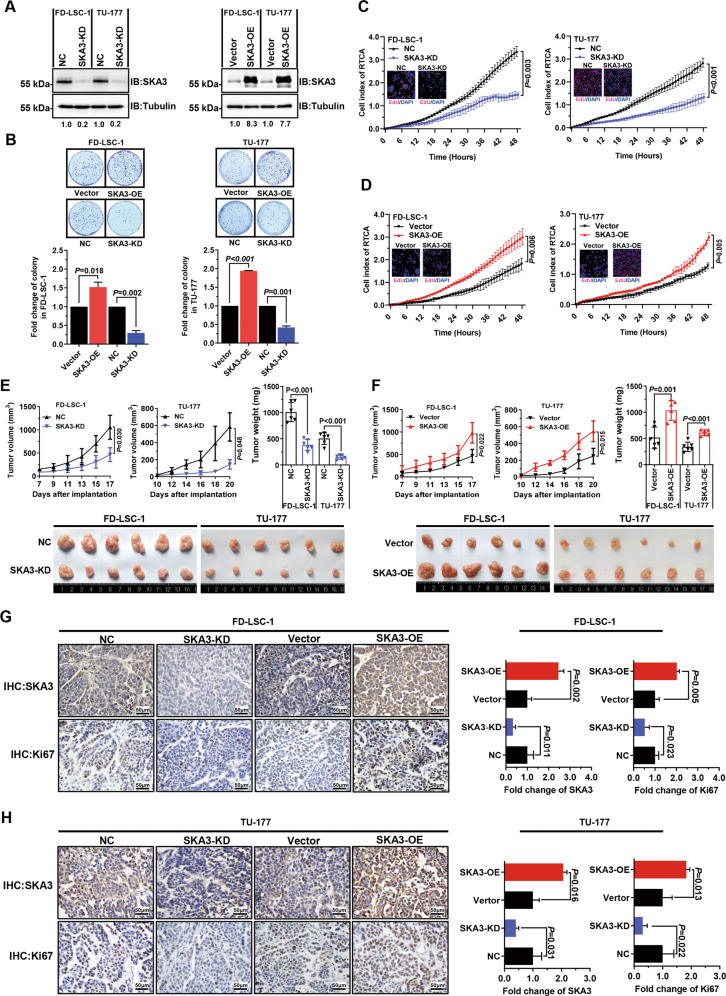
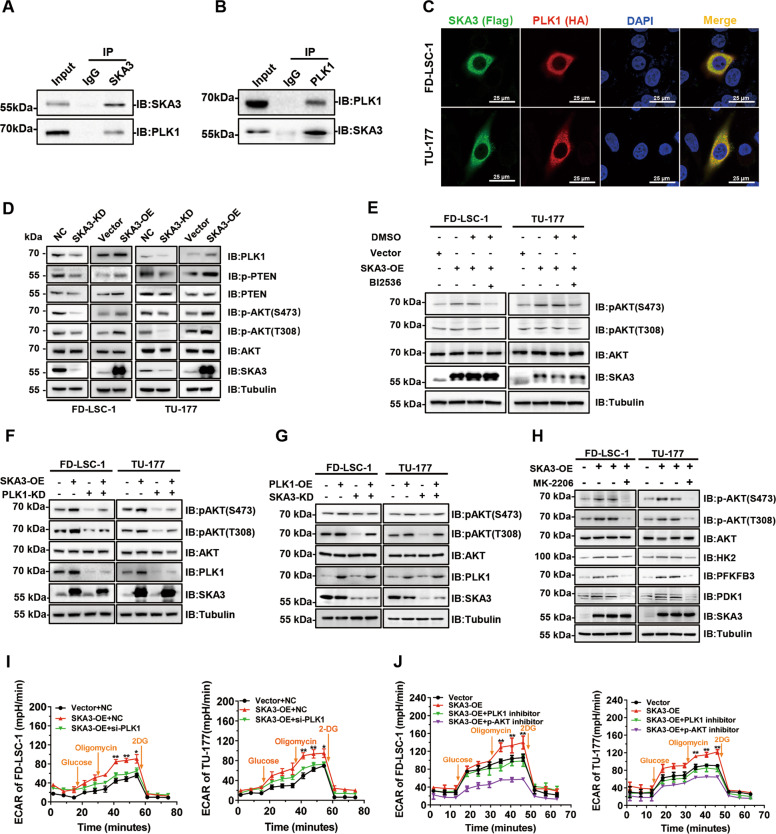
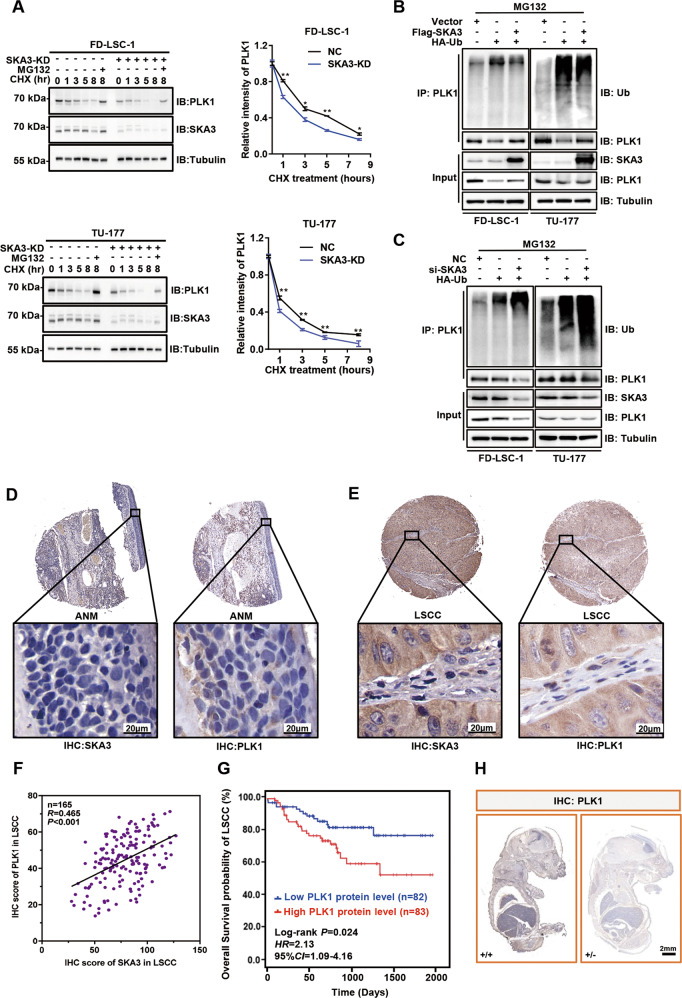
Spindle and kinetochore-associated complex subunit 3 (SKA3) is a well-known regulator of chromosome separation and cell division, which plays an important role in cell proliferation. However, the mechanism of SKA3 regulating tumor proliferation via reprogramming metabolism is unknown. Here, SKA3 is identified as an oncogene in laryngeal squamous cell carcinoma (LSCC), and high levels of SKA3 are closely associated with malignant progression and poor prognosis. In vitro and in vivo experiments demonstrate that SKA3 promotes LSCC cell proliferation and chemoresistance through a novel role of reprogramming glycolytic metabolism. Further studies reveal the downstream mechanisms of SKA3, which can bind and stabilize polo-like kinase 1 (PLK1) protein via suppressing ubiquitin-mediated degradation. The accumulation of PLK1 activates AKT and thus upregulates glycolytic enzymes HK2, PFKFB3, and PDK1, resulting in enhancement of glycolysis. Furthermore, our data reveal that phosphorylation at Thr360 of SKA3 is critical for its binding to PLK1 and the increase in glycolysis. Collectively, the novel oncogenic signal axis "SKA3-PLK1-AKT" plays a critical role in the glycolysis of LSCC. SKA3 may serve as a prognostic biomarker and therapeutic target, providing a potential strategy for proliferation inhibition and chemosensitization in tumors, especially for LSCC patients with PLK1 inhibitor resistance.
纺锤体和着丝粒相关复合物亚基 3(SKA3)是一种已知的染色体分离和细胞分裂的调节因子,在细胞增殖中起着重要作用。然而,SKA3 通过重编程代谢来调节肿瘤增殖的机制尚不清楚。在这里,SKA3 被鉴定为喉鳞状细胞癌(LSCC)中的癌基因,高水平的 SKA3 与恶性进展和预后不良密切相关。体外和体内实验表明,SKA3 通过重编程糖酵解代谢发挥新的作用促进 LSCC 细胞增殖和化疗耐药性。进一步的研究揭示了 SKA3 的下游机制,它可以通过抑制泛素介导的降解来结合和稳定 Polo 样激酶 1(PLK1)蛋白。PLK1 的积累激活 AKT,从而上调糖酵解酶 HK2、PFKFB3 和 PDK1,导致糖酵解增强。此外,我们的数据表明 SKA3 的 Thr360 磷酸化对于其与 PLK1 的结合和糖酵解的增加是至关重要的。总之,新的致癌信号轴“SKA3-PLK1-AKT”在 LSCC 的糖酵解中起着关键作用。SKA3 可以作为一种预后生物标志物和治疗靶点,为肿瘤的增殖抑制和化疗增敏提供了一种潜在的策略,特别是对于具有 PLK1 抑制剂耐药性的 LSCC 患者。