Kurniawan Tonni Agustiono, Avtar Ram, Singh Deepak, Xue Wenchao, Dzarfan Othman Mohd Hafiz, Hwang Goh Hui, Iswanto Iswanto, Albadarin Ahmad B, Kern Axel Olaf
Key Laboratory of the Coastal and Wetland Ecosystems (Xiamen University), Ministry of Education, College of the Environment and Ecology, Xiamen University, Fujian, 361102, China.
Faculty of Social Work, Health and Nursing, Ravensburg-Weingarten University of Applied Sciences, Weingarten, 88216, Germany.
J Clean Prod. 2021 Feb 15;284:124775. doi: 10.1016/j.jclepro.2020.124775. Epub 2020 Oct 22.
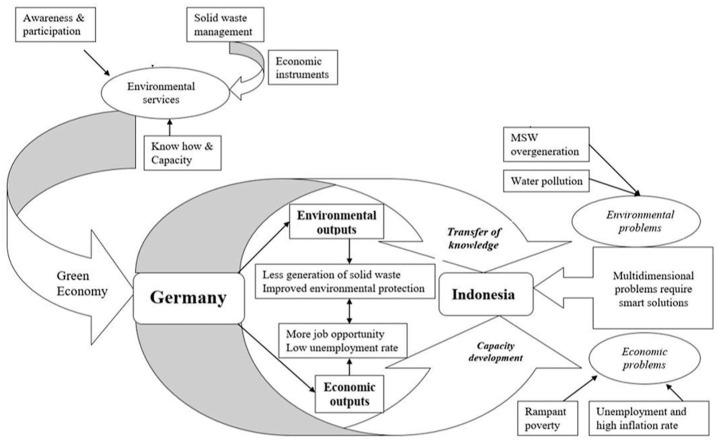
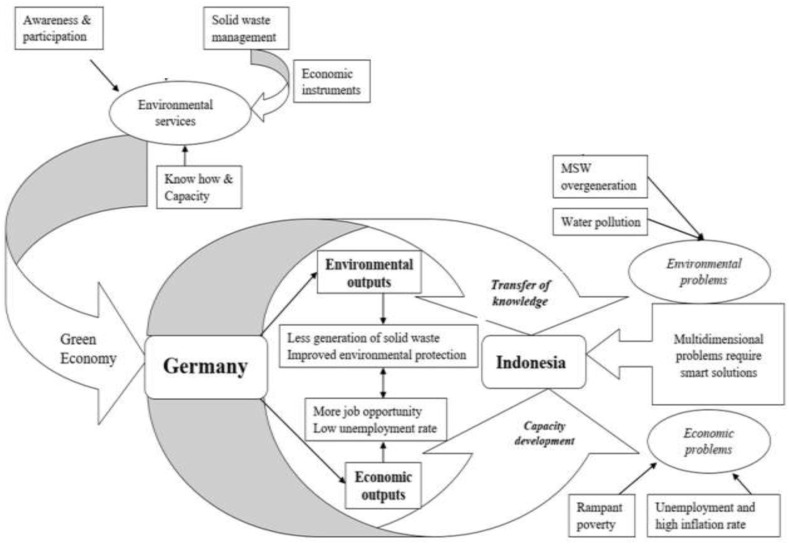
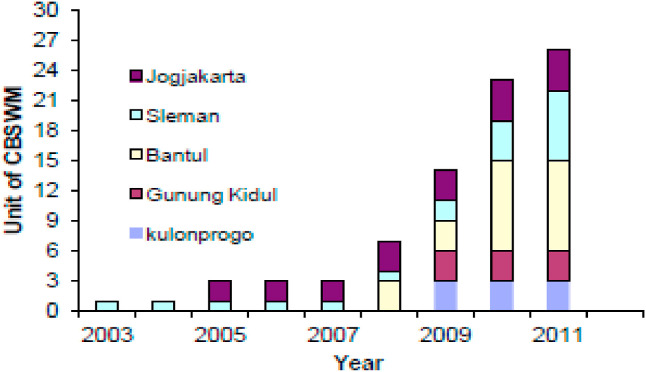
Over the past years, Indonesia, the world's fourth most populous country, has confronted environmental problems due to uncontrolled generation of municipal solid waste (MSW). While the integrated solid waste management (ISWM) represents a critical strategy for Indonesia to control its production, it is also recognized that economic approaches also need to be promoted to address the waste problem concertedly. In this case study, empirical approaches are developed to understand how a volume-based waste fee could be incorporated into MSW collection services and how to apply a zero-waste approach in Indonesia by adapting resource recovery initiatives, adapted from Germany's mature experiences in integrating the CE paradigm into the latter's MSWM practices. Currently, Sukunan village (Yogyakarta, Indonesia) promotes waste reduction at sources in the framework of community-based solid waste management (CBSWM) by mobilizing the local community for waste separation (organic and non-organic) and waste recycling. As a result, about 0.2 million Mt of CO emissions was avoided annually from local landfills. The economic benefits of recycling activities by the village's community also resulted in 30% reduction of the waste generated. This CBSWM scheme not only saves the government budget on waste collection, transport and disposal, but also extends the lifetime of local landfills as the final disposal sites. By integrating the CE paradigm into its MSWM practices through the implementation of economic instruments and adherence to the rule of law in the same way as Germany does, Indonesia could make positive changes to its environmental policy and regulation of MSW. A sound MSWM in Indonesia could play important roles in promoting the effectiveness of urban development with resource recovery approaches to facilitate its transition towards a CE nationwide in the long-term.
在过去几年里,世界第四人口大国印度尼西亚因城市固体废物(MSW)的无节制产生而面临环境问题。虽然综合固体废物管理(ISWM)是印度尼西亚控制其产生量的关键战略,但人们也认识到,还需要推广经济手段来协同解决垃圾问题。在本案例研究中,开发了实证方法,以了解如何将基于体积的垃圾费纳入城市固体废物收集服务,以及如何通过借鉴德国将循环经济(CE)范式融入其城市固体废物管理实践的成熟经验,调整资源回收举措,在印度尼西亚应用零浪费方法。目前,苏库南村(印度尼西亚日惹)在社区固体废物管理(CBSWM)框架内,通过动员当地社区进行垃圾分类(有机和无机)及垃圾回收,促进源头减量。结果,当地垃圾填埋场每年避免了约20万吨的碳排放。该村社区回收活动的经济效益还使产生的垃圾减少了30%。这种社区固体废物管理方案不仅节省了政府在垃圾收集、运输和处理方面的预算,还延长了当地作为最终处置场所的垃圾填埋场的使用寿命。通过像德国那样,通过实施经济手段并遵守法治,将循环经济范式融入其城市固体废物管理实践,印度尼西亚可以对其环境政策和城市固体废物监管做出积极改变。印度尼西亚完善的城市固体废物管理可以在通过资源回收方法促进城市发展的有效性方面发挥重要作用,以长期推动其向全国范围内的循环经济转型。