Clinic of Operative Dentistry, Periodontology and Preventive Dentistry, Saarland University, Saarland University Hospital, Kirrberger Str. 100, Building 73, 66421, Homburg/Saar, Germany.
Institute of Medical Microbiology and Hygiene, Department of Hospital Hygiene, Saarland University, Homburg, Germany.
Clin Oral Investig. 2021 May;25(5):3173-3180. doi: 10.1007/s00784-020-03645-2. Epub 2020 Oct 27.
Surgical masks are usually contaminated during dental treatment. So far it has not been investigated whether a surgical mask itself can be a source of microbial transmission. The aim of this study was therefore to investigate the microbiological contamination of surgical masks during dental treatment and the transfer of microorganisms from the mask to the hands.
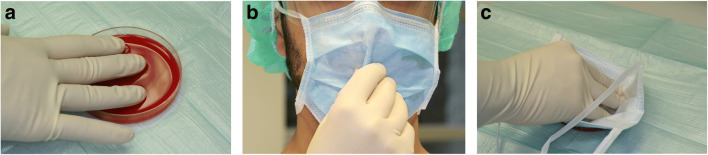
Five dental treatment modalities were studied: carious cavity preparation (P-caries, n = 10), tooth substance preparation (P-tooth, n = 10), trepanation and root canal treatment (P-endo, n = 10), supragingival ultrasonic application (US-supra, n = 10), and subgingival periodontal ultrasonic instrumentation (US-sub, n = 10). Bacterial contamination of mask and gloves worn during treatment was tested by imprinting on agar plates. Additionally, before masks were tested, their outer surface was touched with a new sterile glove. This glove was also imprinted on agar. Bacteria were identified by MALDI TOF mass spectrometry. Colony-forming units (CFU) were scored: score 0: 0 CFU, score 1: < 10 CFU, score 2: > 10 CFU, score 3: dense microbial growth.
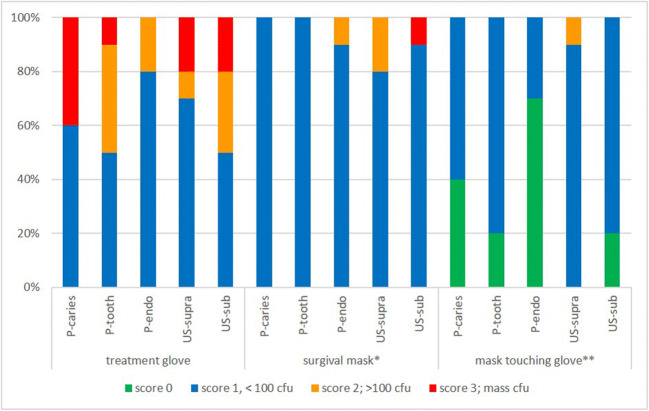
All masks and all gloves used during treatment displayed bacterial contamination (sample scores 0/1/2/3: masks 0/46/3/1 and gloves 0/31/10/9). After touching the masks with new sterile gloves, microorganisms were recovered with the following contamination scores: P-caries: 4/6/0/0, P-tooth: 2/8/0/0: P-endo: 7/3/0/0, US-supra: 0/9/1/0, US-sub: 2/8/0/0. No statistically significant differences were detected between the treatment modalities. Streptococci spp. and Staphylococci spp. representing the oral and cutaneous flora dominated.
Surgical masks are contaminated after aerosol-producing dental treatment procedures. Used masks have a potential to be a source of bacterial contamination of the hands.
Dental staff should avoid touching the outer surface of masks with their hands to prevent transmission of pathogens. It is recommendable to change the mask after each treated patient followed by hand disinfection.
手术口罩在牙科治疗过程中通常会受到污染。到目前为止,还没有研究表明手术口罩本身是否会成为微生物传播的源头。因此,本研究旨在调查牙科治疗过程中手术口罩的微生物污染情况,以及口罩上的微生物转移到手上的情况。
研究了 5 种牙科治疗方式:龋洞预备(P-caries,n=10)、牙体预备(P-tooth,n=10)、开髓和根管治疗(P-endo,n=10)、龈上超声洁牙(US-supra,n=10)和龈下牙周超声洁治(US-sub,n=10)。通过在琼脂平板上印迹法测试治疗过程中佩戴的口罩和手套的细菌污染情况。此外,在测试口罩之前,用新的无菌手套触摸口罩的外表面。这块手套也被印在琼脂上。通过 MALDI TOF 质谱法鉴定细菌。评分记录菌落形成单位(CFU):评分 0:无 CFU;评分 1:<10 CFU;评分 2:>10 CFU;评分 3:密集的微生物生长。
所有在治疗过程中使用的口罩和手套都显示出细菌污染(样本评分 0/1/2/3:口罩 0/46/3/1,手套 0/31/10/9)。用新的无菌手套触摸口罩后,以以下污染评分回收微生物:P-caries:4/6/0/0;P-tooth:2/8/0/0;P-endo:7/3/0/0;US-supra:0/9/1/0;US-sub:2/8/0/0。各治疗方式间无统计学差异。代表口腔和皮肤菌群的链球菌属和葡萄球菌属占主导地位。
在产生气溶胶的牙科治疗程序后,手术口罩受到污染。使用后的口罩有成为手部细菌污染源头的潜力。
牙科医务人员应避免用手触摸口罩的外表面,以防止病原体传播。建议在为每位治疗患者更换口罩后,对手进行消毒。