
计算研究揭示了醌衍生物抑制 SARS-CoV-2 的机制。研究了安石榴素和两种有治疗意义的化合物,即甲泼尼龙和地塞米松。
Computational studies reveal mechanism by which quinone derivatives can inhibit SARS-CoV-2. Study of embelin and two therapeutic compounds of interest, methyl prednisolone and dexamethasone.
机构信息
Vassar College, Department of Chemistry, Poughkeepsie NY 12604, USA.
Vassar College, Department of Chemistry, Poughkeepsie NY 12604, USA.
出版信息
J Infect Public Health. 2020 Dec;13(12):1868-1877. doi: 10.1016/j.jiph.2020.09.015. Epub 2020 Oct 14.
BACKGROUND
Quinones are reactive to proteins containing cysteine residues and the main protease in Covid-19 contains an active site that includes Cys145. Embelin, a quinone natural product, is known to have antiviral activity against influenza and hepatitis B. Preliminary studies by our group also indicate its ability to inhibit HSV-1 in cultured cells.
METHODS
Docking and DFT methods applied to the protease target.
RESULTS
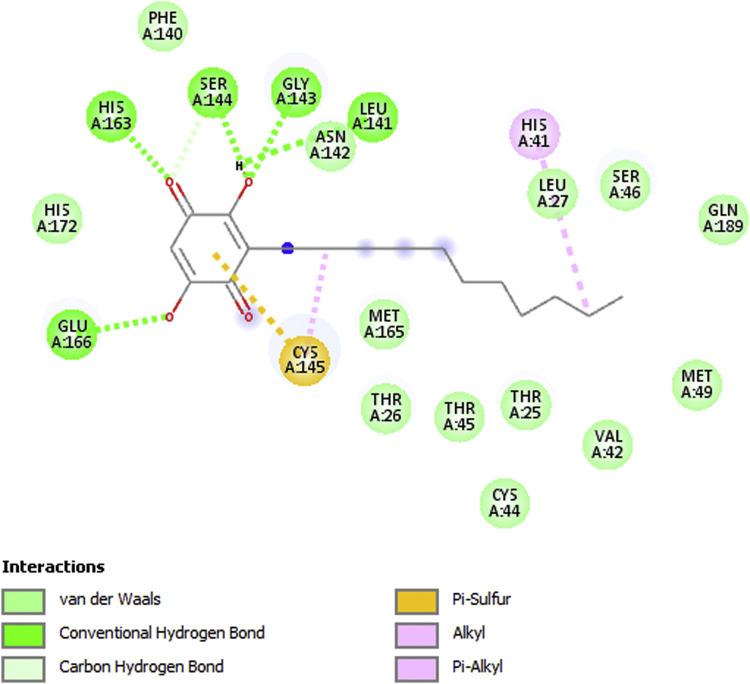
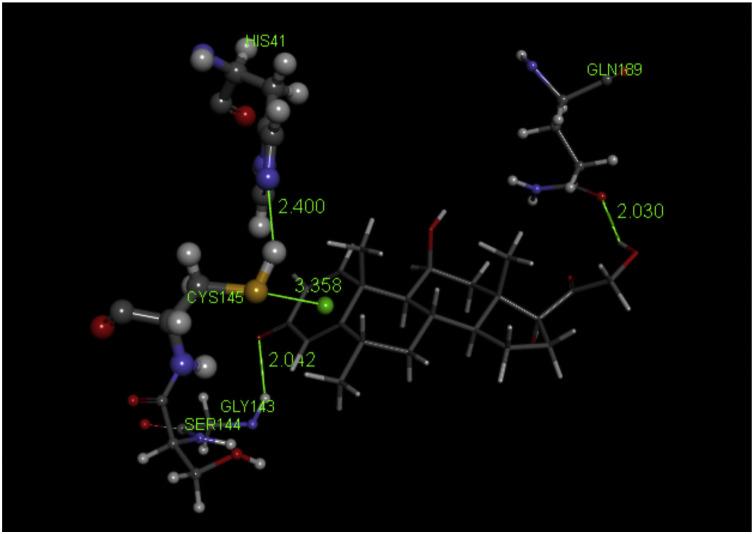
a mechanism for this inhibition of the SARS-CoV-2 Mpro protease is described, specifically due to formation of a covalent bond between S(Cys145) and an embelin C(carbonyl). This is assisted by two protein amino acids (1) N(imidazole-His41) which is able to capture H[S(Cys145)] and (2) HN(His163), which donates a proton to embelin O(carbonyl) forming an OH moiety that results in inhibition of the viral protease. A similar process is also seen with the anti-inflammatory drugs methyl prednisolone and dexamethasone, used for Covid-19 patients. Methyl prednisolone and dexamethasone are methide quinones, and possess only one carbonyl moiety, instead of two for embelin. Additional consideration was given to another natural product, emodin, recently patented against Covid-19, as well as some therapeutic quinones, vitamin K, suspected to be involved in Covid-19 action, and coenzyme Q10. All show structural similarities with embelin, dexamethasone and methyl prednisolone results.
CONCLUSIONS
Our data on embelin and related quinones indicate that these natural compounds may represent a feasible, strategic tool against Covid-19.
背景
醌类物质可与含有半胱氨酸残基的蛋白质发生反应,而新冠病毒的主要蛋白酶含有一个包含半胱氨酸残基的活性位点。天然醌类化合物 Embelin 已知具有抗流感和乙型肝炎的抗病毒活性。我们小组的初步研究还表明,它能够抑制培养细胞中的单纯疱疹病毒 1 型。
方法
对接和 DFT 方法应用于蛋白酶靶标。
结果
描述了这种抑制 SARS-CoV-2 Mpro 蛋白酶的机制,具体是由于 S(半胱氨酸 145)与 Embelin C(羰基)之间形成了共价键。这是由两个蛋白质氨基酸(1)N(咪唑-His41)辅助的,它能够捕获 H[S(半胱氨酸 145)]和(2)HN(His163),它向 Embelin O(羰基)捐赠质子,形成 OH 部分,从而抑制病毒蛋白酶。类似的过程也发生在用于治疗新冠病毒的抗炎药物甲基强的松龙和地塞米松中。甲基强的松龙和地塞米松是甲氧基醌类化合物,只含有一个羰基部分,而 Embelin 则含有两个。还考虑了另一种天然产物大黄素,它最近被专利用于治疗新冠病毒,以及一些治疗性醌类化合物、维生素 K,它们被怀疑与新冠病毒的作用有关,以及辅酶 Q10。所有这些都与大黄素、地塞米松和甲基强的松龙的结果具有结构相似性。
结论
我们关于 Embelin 和相关醌类化合物的数据表明,这些天然化合物可能是对抗新冠病毒的可行战略工具。






 Zotero 插件