Department of Epidemiology and Biostatistics, Western University, London, Ontario, Canada.
Department of Family Medicine, Western University, London, Ontario, Canada.
J Glob Health. 2020 Dec;10(2):020423. doi: 10.7189/jogh.10.020423.
The ongoing nutrition transition in sub-Saharan Africa (SSA) is exhibiting spatial heterogeneity and temporal variability leading to different forms of malnutrition burden across SSA, with some regions exhibiting the double burden of malnutrition. This study aimed to develop a predictive understanding of the malnutrition burden among women of child-bearing age.
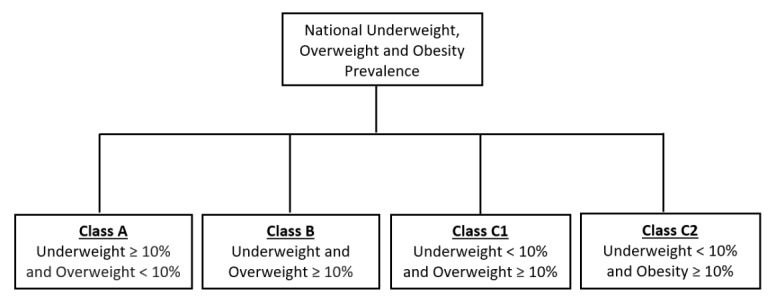
Data from 34 SSA countries were acquired from the Demographic and Health Survey, World Bank, and Swiss Federal Institute of Technology. The SSA countries were classified into malnutrition classes based on their national prevalence of underweight, overweight, and obesity using a 10% threshold. Next, random forest analysis was used to examine the association between country-level demographic variables and the national prevalence of underweight, overweight and obesity. Finally, random forest analysis and multinomial logistic regression models were utilized to investigate the association between individual-level social and demographic variables and Body Mass Index (BMI) categories of underweight, normal weight, and combined overweight and obesity.
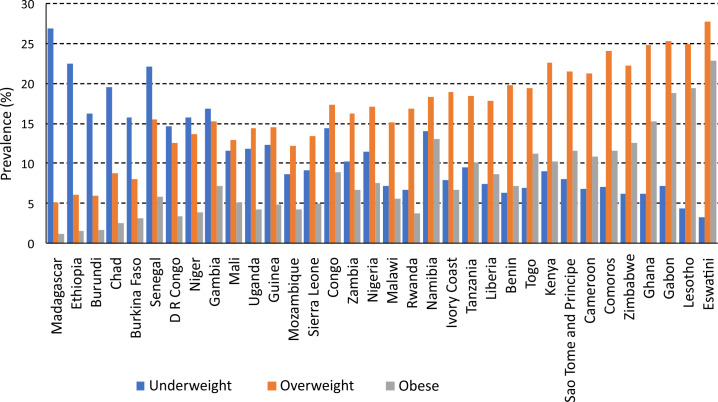
Four malnutrition classes were identified: Class A had 5 countries with ≥10% of the women underweight; Class B had 11 countries with ≥10% each of underweight and overweight; Class C1 had 7 countries with ≥10% overweight; and Class C2 had 11 countries with ≥10% obesity. At the country-level, fertility rate predicted underweight, overweight and obesity prevalence, but economic indicators were also important, including the gross domestic product per capita - a measure of economic opportunity that predicted both overweight and obesity prevalence, and the GINI coefficient - a measure of economic inequality that predicted both underweight and overweight prevalence. At the individual-level, parity was a risk factor for underweight in underweight burdened countries and a risk factor for overweight/obesity in overweight/obesity burdened countries, whereas age and wealth were protective factors for underweight but risk factors for overweight/obesity.
Beyond the effect of economic indicators, this study revealed the important role of fertility rate and parity, which may represent risk factors for both underweight and combined overweight and obesity among women of child-bearing age. Health professionals should consider combining reproductive health services with nutritional programs when addressing the challenge of malnutrition in SSA.
撒哈拉以南非洲(SSA)目前正处于营养转型过程中,这一过程表现出空间异质性和时间可变性,导致 SSA 各地的营养不良负担呈现不同形式,一些地区出现了营养不良的双重负担。本研究旨在深入了解育龄妇女的营养不良负担。
本研究从 34 个 SSA 国家获取数据,数据来源包括人口与健康调查、世界银行和瑞士联邦理工学院。根据各国体重不足、超重和肥胖的流行率,将 SSA 国家分为营养不良类别,使用 10%的阈值。接下来,使用随机森林分析检查国家层面的人口统计学变量与国家层面的体重不足、超重和肥胖流行率之间的关系。最后,使用随机森林分析和多项逻辑回归模型,研究个体层面的社会人口统计学变量与体重不足、正常体重和超重与肥胖综合 BMI 类别的关系。
确定了四类营养不良:A 类有 5 个国家,其 10%以上的女性体重不足;B 类有 11 个国家,其 10%以上的女性体重不足和超重;C1 类有 7 个国家,其 10%以上的女性超重;C2 类有 11 个国家,其 10%以上的女性肥胖。在国家层面,生育率预测了体重不足、超重和肥胖的流行率,但经济指标也很重要,包括人均国内生产总值——衡量经济机会的指标,预测了超重和肥胖的流行率,以及基尼系数——衡量经济不平等的指标,预测了体重不足和超重的流行率。在个体层面,生育力是体重不足负担国家体重不足的风险因素,也是超重/肥胖负担国家超重/肥胖的风险因素,而年龄和财富是体重不足的保护因素,但也是超重/肥胖的风险因素。
除了经济指标的影响外,本研究还揭示了生育率和生育力的重要作用,这可能是育龄妇女体重不足和超重与肥胖综合的风险因素。卫生专业人员在解决 SSA 地区的营养不良挑战时,应考虑将生殖健康服务与营养方案相结合。