Kandala Ngianga-Bakwin, Stranges Saverio
Division of Health Sciences, University of Warwick Medical School, Coventry, United Kingdom; Epidemiology and Biostatistics Division, School of Public Health, University of the Witwatersrand, Johannesburg, South Africa; University of Oxford, KEMRI-University of Oxford-Wellcome Trust Collaborative Programme, Malaria Public Health and Epidemiology Group, Centre for Geographic Medicine, Nairobi, Kenya.
Division of Health Sciences, University of Warwick Medical School, Coventry, United Kingdom.
PLoS One. 2014 Jun 30;9(6):e101103. doi: 10.1371/journal.pone.0101103. eCollection 2014.
Nutritional research in sub-Saharan Africa has primarily focused on under-nutrition. However, there is evidence of an ongoing nutritional transition in these settings. This study aimed to examine the geographic variation of overweight and obesity prevalence at the state-level among women in Nigeria, while accounting for individual-level risk factors.
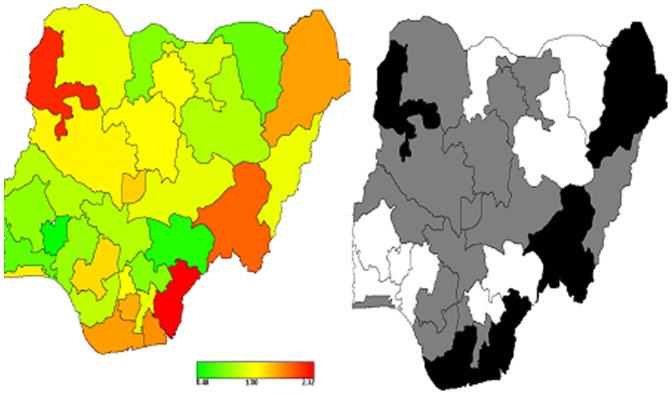
The analysis was based on the 2008 Nigerian Demographic and Health Survey (NDHS), including 27,967 women aged 15-49 years. Individual data were collected on socio-demographics, but were aggregated to the country's states. We used a Bayesian geo-additive mixed model to map the geographic distribution of overweight and obesity at the state-level, accounting for individual-level risk factors.
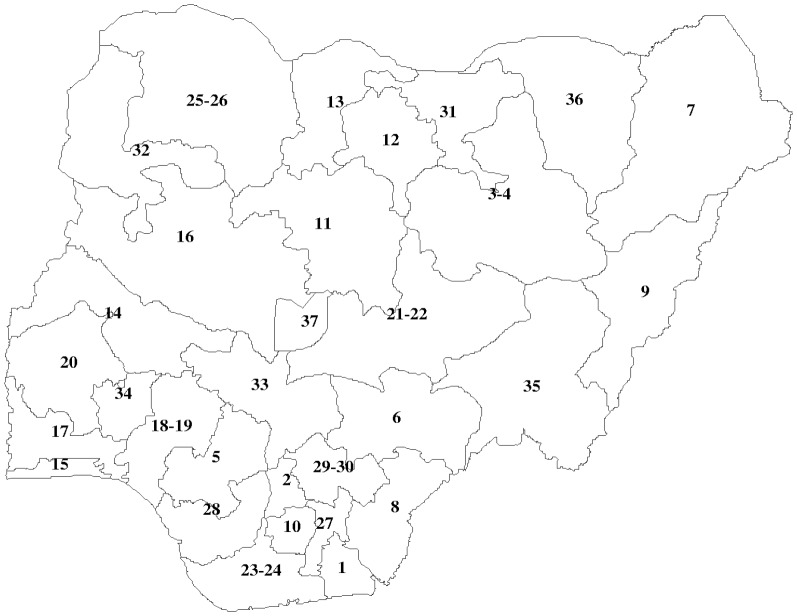
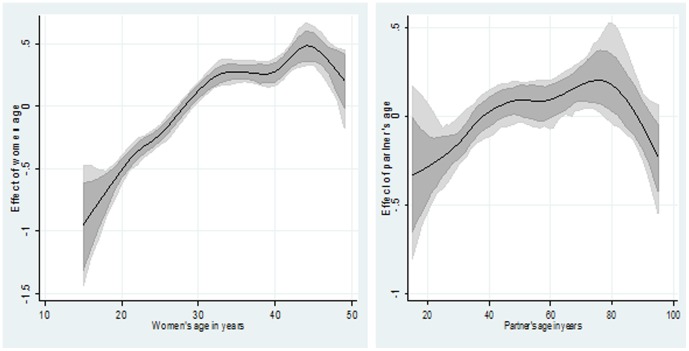
The overall prevalence of combined overweight and obesity (body mass index ≥25) was 20.9%. In multivariate Bayesian geo-additive models, higher education [odds ratio (OR) & 95% Credible Region (CR): 1.68 (1.38, 2.00)], higher wealth index [3.45 (2.98, 4.05)], living in urban settings [1.24 (1.14, 1.36)] and increasing age were all significantly associated with a higher prevalence of overweight/obesity. There was also a striking variation in overweight/obesity prevalence across ethnic groups and state of residence, the highest being in Cross River State, in south-eastern Nigeria [2.32 (1.62, 3.40)], the lowest in Osun State in south-western Nigeria [0.48 (0.36, 0.61)].
This study suggests distinct geographic patterns in the combined prevalence of overweight and obesity among Nigerian women, as well as the role of demographic, socio-economic and environmental factors in the ongoing nutritional transition in these settings.
撒哈拉以南非洲地区的营养研究主要集中在营养不良方面。然而,有证据表明这些地区正在经历营养转型。本研究旨在考察尼日利亚各州15至49岁女性超重和肥胖患病率的地理差异,并考虑个体层面的风险因素。
分析基于2008年尼日利亚人口与健康调查(NDHS),其中包括27967名15至49岁的女性。收集了关于社会人口统计学的个体数据,但汇总到该国各州。我们使用贝叶斯地理加性混合模型来绘制各州超重和肥胖的地理分布,同时考虑个体层面的风险因素。
超重和肥胖合并症(体重指数≥25)的总体患病率为20.9%。在多变量贝叶斯地理加性模型中,高等教育[优势比(OR)及95%可信区间(CR):1.68(1.38,2.00)]、较高的财富指数[3.45(2.98,4.05)]、居住在城市地区[1.24(1.14,1.36)]以及年龄增长均与超重/肥胖患病率较高显著相关。不同种族群体和居住州的超重/肥胖患病率也存在显著差异,最高的是尼日利亚东南部的克罗斯河州[2.32(1.62,3.40)],最低的是尼日利亚西南部的奥孙州[0.48(0.36,0.61)]。
本研究表明尼日利亚女性超重和肥胖合并患病率存在明显的地理模式,以及人口、社会经济和环境因素在这些地区正在进行的营养转型中的作用。