From the Department of Neurology and Alzheimer Center Erasmus MC (Jackie M. Poos, L.D.M.G., E.L.E., J.L.P., Janne M. Papma, H.S., Esther van den Berg, J.S., L.C.J.), Erasmus MC University Medical Center; Quantib B.V. (R.K.), Rotterdam; Departments of Radiology and Nuclear Medicine (Esther Bron, R.S., M.W.V.) and Epidemiology (M.W.V.), Erasmus MC University Medical Center Rotterdam; Department of Neurology (Y.A.L.P.), Alzheimer Center, Location VU University Medical Center Amsterdam Neuroscience, Amsterdam University Medical Center; Department of Radiology (S.A.R.B.R.), Leiden University Medical Center; Institute of Psychology (S.A.R.B.R.) and Leiden Institute for Brain and Cognition (S.A.R.B.R.), Leiden University, The Netherlands; and Dementia Research Centre (L.C.J.), Department of Neurodegenerative Disease, UCL Institute of Neurology, London, United Kingdom.
Neurology. 2022 Dec 12;99(24):e2661-e2671. doi: 10.1212/WNL.0000000000201292.
It is important to identify at what age brain atrophy rates in genetic frontotemporal dementia (FTD) start to accelerate and deviate from normal aging effects to find the optimal starting point for treatment. We investigated longitudinal brain atrophy rates in the presymptomatic stage of genetic FTD using normative brain volumetry software.
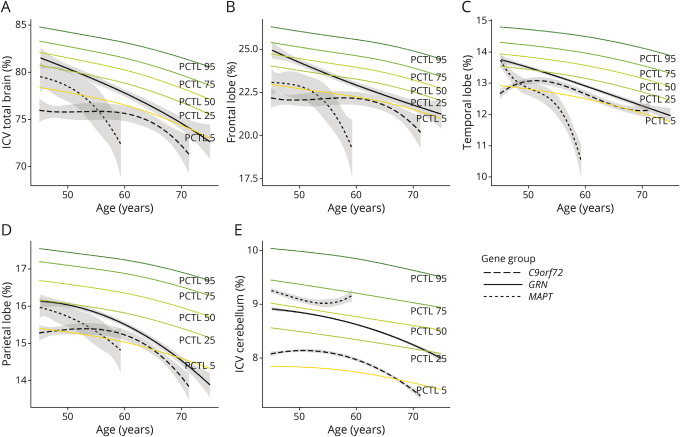
Presymptomatic , , and pathogenic variant carriers underwent longitudinal volumetric T1-weighted magnetic resonance imaging of the brain as part of a prospective cohort study. Images were automatically analyzed with Quantib® ND, which consisted of volume measurements (CSF and sum of gray and white matter) of lobes, cerebellum, and hippocampus. All volumes were compared with reference centile curves based on a large population-derived sample of nondemented individuals (n = 4,951). Mixed-effects models were fitted to analyze atrophy rates of the different gene groups as a function of age.
Thirty-four , 8 , and 14 pathogenic variant carriers were included (mean age = 52.1, standard deviation = 7.2; 66% female). The mean follow-up duration of the study was 64 ± 33 months (median = 52; range 13-108). pathogenic variant carriers showed a faster decline than the reference centile curves for all brain areas, though relative volumes remained between the 5th and 75th percentiles between the ages of 45 and 70 years. In pathogenic variant carriers, frontal lobe volume was already at the 5th percentile at age 45 years and showed a further decline between the ages 50 and 60 years. Temporal lobe volume started in the 50th percentile at age 45 years but showed fastest decline over time compared with other brain structures. Frontal, temporal, parietal, and cerebellar volume already started below the 5th percentile compared with the reference centile curves at age 45 years for pathogenic variant carriers, but there was minimal decline over time until the age of 60 years.
We provide evidence for longitudinal brain atrophy in the presymptomatic stage of genetic FTD. The affected brain areas and the age after which atrophy rates start to accelerate and diverge from normal aging slopes differed between gene groups. These results highlight the value of normative volumetry software for disease tracking and staging biomarkers in genetic FTD. These techniques could help in identifying the optimal time window for starting treatment and monitoring treatment response.
确定遗传性额颞叶痴呆(FTD)患者的脑萎缩速度从何时开始加速并偏离正常衰老效应,从而找到治疗的最佳起始点非常重要。我们使用标准脑容量测定软件研究了遗传性 FTD 患者的无症状期的纵向脑萎缩速度。
作为前瞻性队列研究的一部分,无症状的、携带致病性变异的患者接受了脑纵向容积 T1 加权磁共振成像检查。使用 Quantib® ND 自动分析图像,该软件包括基于无痴呆个体(n = 4951)的大型人群样本的脑叶、小脑和海马体的容积测量值(CSF 和灰质及白质总和)。所有体积均与参考百分位曲线进行比较。采用混合效应模型分析不同基因组的萎缩率随年龄的变化。
共纳入 34 名、8 名和 14 名携带致病性变异的患者(平均年龄 = 52.1,标准差 = 7.2;66%为女性)。研究的平均随访时间为 64 ± 33 个月(中位数 = 52;范围 13-108)。所有脑区的 携带致病性变异的患者的下降速度均快于参考百分位曲线,但在 45 至 70 岁之间,相对体积仍保持在第 5 至 75 百分位之间。在 携带致病性变异的患者中,额叶体积在 45 岁时已处于第 5 百分位,并在 50 至 60 岁之间进一步下降。颞叶体积在 45 岁时处于第 50 百分位,但与其他脑结构相比,随时间的推移下降最快。携带致病性变异的患者的额、颞、顶和小脑体积在 45 岁时已经低于参考百分位曲线的第 5 百分位,但直到 60 岁时,体积才出现最小程度的下降。
我们提供了遗传性 FTD 无症状期纵向脑萎缩的证据。受影响的脑区以及萎缩速度开始加速并偏离正常衰老斜率的年龄因基因组而异。这些结果突出了标准容量测定软件在遗传性 FTD 疾病跟踪和分期生物标志物方面的价值。这些技术可以帮助确定开始治疗的最佳时间窗口,并监测治疗反应。