Department of Medical Ethics and History of Medicine, Bursa Uludag University School of Medicine, Bursa, Turkey.
PLoS One. 2020 Oct 28;15(10):e0240713. doi: 10.1371/journal.pone.0240713. eCollection 2020.
The promotion strategies of pharmaceutical companies create many problems including irrational prescribing, diminished trust in the patient-physician relationship and unnecessary increases in pharmaceutical costs. Educating prescribers is known to be one of the few potentially effective measures to counteract those impacts. However such educational programs are limited in the literature, and their effectiveness against the effects of hidden curriculum in the long term is unknown. This study aims to evaluate the effectiveness of an education program both in the short term and the long term after the students have been exposed to informal and hidden curriculum and various pharmaceutical promotion methods.
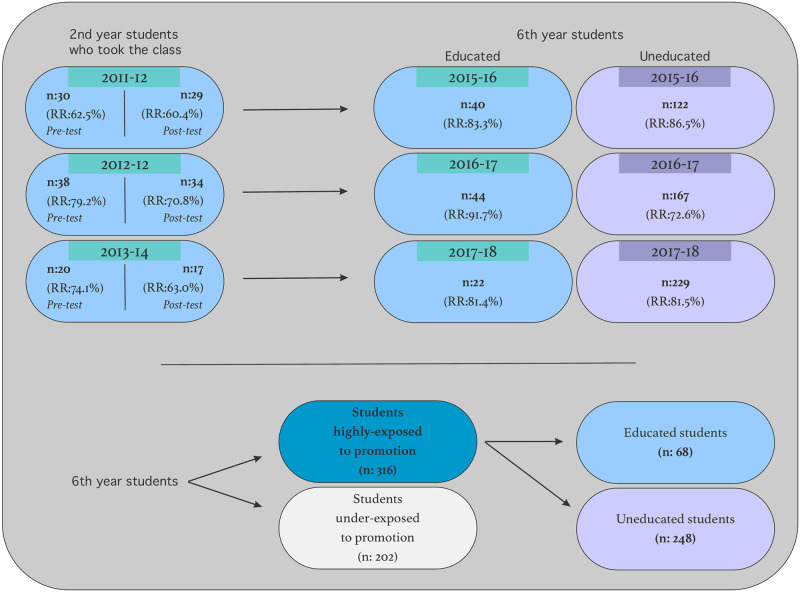
A longitudinal and controlled study was carried out in a school of medicine in Turkey where there are no restrictive policies for pharmaceutical promotion. A survey was applied to 123 students who attended the class throughout the terms of 2011-12, 2012-13, and 2013-14, evaluating the pre-educational status of students' opinions of promotion and any post-educational changes. A follow-up study four years later asked those three cohorts to fill out the same survey to see the possible effects of the clinical environment and various promotion methods. Also, the opinions of all 518 sixth-year students who had not taken the class in those three terms were compared to the educated students.
The program was significantly effective in the short term in changing students' opinions and attitudes positively towards recognizing companies' discourse and promotion strategies. But in the long term, the education lost its ability to convince students of the importance of not getting financial support for scientific activities from pharmaceutical companies (p:0.006) and carrying out research (p<0.001). In addition, although the educated students were more aware that trivial gifts could influence prescriptions compared to the uneducated 6th year students (p<0.001), the difference between them and the uneducated students generally becomes less significant when they encounter the clinical environment. The study also evaluated students highly-exposed to promotion; for this sub-group, the educated students kept their consciousness level about the influences of trivial gifts (p<0.001) while the uneducated students were confident that they were immune to the influence of trivial gifts.
The education program could be used for creating awareness of, increasing skepticism towards, and inculcating disapproval about pharmaceutical promotion practices. However, the effectiveness of the educational intervention is susceptible to erosion after exposure to the informal and hidden curriculum together with exposure to promotion. The impact of role-models, organizational culture, and institutional policies could be important aspects to be addressed for sustaining the effectiveness of such education programs.
制药公司的推广策略带来了诸多问题,包括不合理的处方、医患关系信任度降低以及药品费用不必要地增加。教育医生被认为是对抗这些影响的少数有效措施之一。然而,此类教育计划在文献中有限,其针对长期隐性课程影响的有效性尚不清楚。本研究旨在评估教育计划在学生接触非正式和隐性课程以及各种药品推广方法后短期和长期的效果。
在土耳其一所医学院进行了一项纵向对照研究,该医学院没有药品推广的限制政策。在 2011-12、2012-13 和 2013-14 学年期间,对参加课程的 123 名学生进行了一项调查,评估学生对推广的看法以及任何教育后变化的意见。四年后,对这三个队列进行了后续研究,要求他们填写相同的调查,以了解临床环境和各种推广方法的可能影响。此外,还将所有 518 名未在这三个学期修读该课程的六年级学生的意见与接受教育的学生进行了比较。
该计划在短期内显著有效地改变了学生的意见和态度,使他们能够更积极地识别公司的言论和推广策略。但长期来看,该教育计划失去了让学生认识到不从制药公司获得科学活动资金支持和开展研究的重要性(p:0.006)的说服力。此外,尽管接受教育的学生比未接受教育的六年级学生更意识到小礼物可能会影响处方(p<0.001),但当他们接触到临床环境时,他们与未接受教育的学生之间的差异变得不那么显著。该研究还评估了接触推广较多的学生;对于这一组学生,接受教育的学生保持了对小礼物影响的意识水平(p<0.001),而未接受教育的学生则相信自己不受小礼物影响的影响。
教育计划可用于提高对药品推广实践的认识、增加对其的怀疑,并灌输对其的反对态度。然而,在接触非正式和隐性课程以及接触推广后,教育干预的效果容易受到侵蚀。角色模型、组织文化和机构政策的影响可能是维持此类教育计划有效性的重要方面。
