Tesfa Ayantu, Dida Nagasa, Girma Teka, Aboma Mecha
Department of Public Health, Medicine and Health Science College, Ambo University, Ambo, Ethiopia.
Risk Manag Healthc Policy. 2020 Oct 20;13:2251-2259. doi: 10.2147/RMHP.S277310. eCollection 2020.
Intimate partner violence is a serious and widespread problem worldwide. It is a domestic violence by a spouse or partner in an intimate relationship against the other spouse or partner. Even though Ethiopia is also one of the countries where the condition has been seriously happening, there is a dearth of information in the study area.
To assess the prevalence of intimate partner violence and its sociocultural practice, and its associated factors among married women in Oromia, Central Ethiopia.
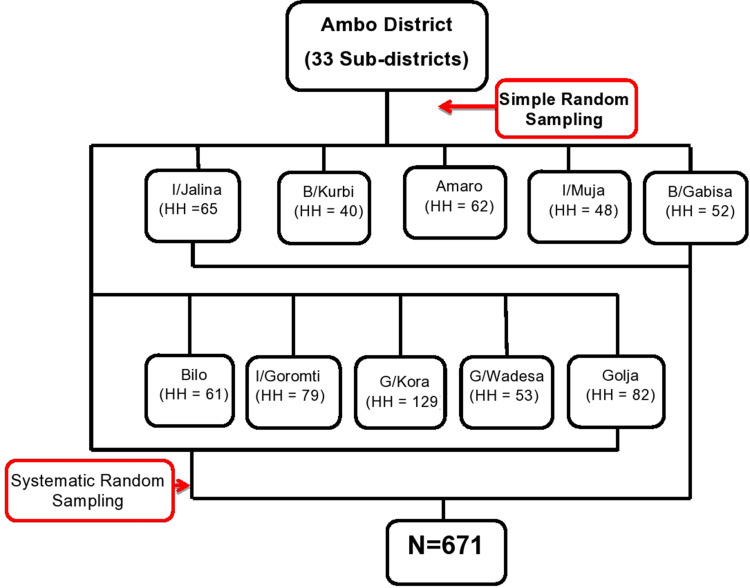
A community-based cross-sectional study was conducted on 671 women of Ambo district who were in marriage from March 1 to 30, 2018. Multistage sampling method was employed to select study participants. Data were collected using interviewer-administered WHO Multi-country Study on Women's Health and Life Experiences Questionnaire. Descriptive, bivariate, and multivariate logistic regression analyses were done using SPSS version 20.0.
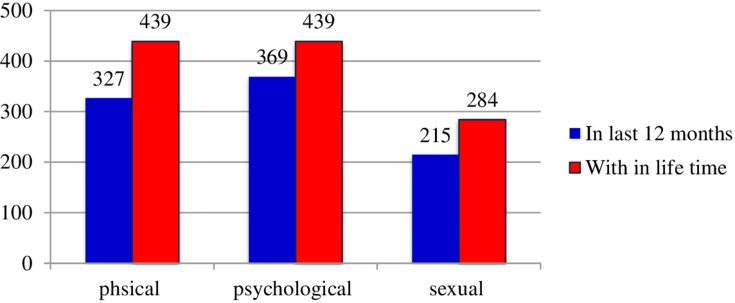
Out of 671 married women expected to participate, 657 of them participated in the study making a response rate of 98%. Overall, 77% (95% CI 73.7-80.1%), and 62.4% (95% CI, 58.6-66.1%) of the respondents reported that they have experienced intimate partner violence in their lifetime and in the last one year, respectively. Lack of formal education by husband (AOR 2.30, 95% CI 1.28-4.15), housewife occupation of respondents (AOR 2.04, 95% CI 1.02-4.06), number of children (AOR 4.37, 95% CI 1.40-13.66), perceived husband dominance (AOR 1.74, 95% CI 1.15-2.63), grow up in domestic violence (AOR 1.53, 95% CI 1.00-2.35) and partner's alcohol intake (AOR 1.77, 95% CI 1.12-2.79) were independently associated with intimate partner violence.
Intimate partner violence against women remains an important public health problem. This needs urgent attention at all levels of societal hierarchy including policymakers, stakeholders, and professionals to alleviate the situation.
亲密伴侣暴力是一个在全球范围内严重且普遍存在的问题。它是指在亲密关系中配偶或伴侣对另一方实施的家庭暴力。尽管埃塞俄比亚也是该情况严重发生的国家之一,但研究领域缺乏相关信息。
评估埃塞俄比亚中部奥罗米亚地区已婚女性中亲密伴侣暴力的患病率及其社会文化行为,以及相关因素。
对2018年3月1日至30日在安博区已婚的671名女性进行了一项基于社区的横断面研究。采用多阶段抽样方法选取研究参与者。使用由访谈员管理的世界卫生组织多国妇女健康与生活经历研究问卷收集数据。使用SPSS 20.0版本进行描述性、双变量和多变量逻辑回归分析。
在预期参与的671名已婚女性中,有657名参与了研究,回复率为98%。总体而言,分别有77%(95%可信区间73.7 - 80.1%)和62.4%(95%可信区间为58.6 - 66.1%)的受访者报告称她们在一生中以及过去一年中曾遭受过亲密伴侣暴力。丈夫未接受正规教育(调整后比值比2.30,95%可信区间1.28 - 4.15)、受访者为家庭主妇职业(调整后比值比2.04,95%可信区间1.02 - 4.06)、子女数量(调整后比值比4.37,95%可信区间1.40 - 13.66)、感知到丈夫占主导地位(调整后比值比1.74,95%可信区间1.15 - 2.63)、在家庭暴力环境中长大(调整后比值比1.53,95%可信区间1.00 - 2.35)以及伴侣饮酒(调整后比值比1.77,95%可信区间1.12 - 2.79)均与亲密伴侣暴力独立相关。
针对女性的亲密伴侣暴力仍然是一个重要的公共卫生问题。这需要包括政策制定者、利益相关者和专业人员在内的社会各阶层给予紧急关注,以缓解这种情况。