Zhang Ping, Li Ying-Xue, Zhang Zhe-Zhe, Yang Ye, Rao Ji-Xian, Xia Lan, Li Xue-Yan, Chen Gui-Hai, Wang Fang
Department of Sleep Disorders, The Affiliated Chaohu Hospital of Anhui Medical University, Hefei 238000, People's Republic of China.
Department of Neurology, The First Affiliated Hospital of Anhui Medical University, Hefei 230022, People's Republic of China.
Nat Sci Sleep. 2020 Oct 8;12:693-704. doi: 10.2147/NSS.S263528. eCollection 2020.
The objective of this study was to investigate whether the serum biomarkers S100 calcium binding protein B (S100B), glial fibrillary acidic protein (GFAP), brain-derived neurotrophic factor (BDNF), and glial cell line-derived neurotrophic factor (GDNF) change in patients with chronic insomnia disorder (CID), and if this is the case, whether the altered levels of these serum biomarkers are associated with poor sleep quality and cognitive decline in CID.
Fifty-seven CID outpatients constituted the CID group; thirty healthy controls (HC) were also enrolled. Questionnaires, polysomnography, Chinese-Beijing Version of Montreal Cognitive Assessment (MoCA-C) and Nine Box Maze Test (NBMT) were used to assess their sleep and neuropsychological function. Serum S100B, GFAP, BDNF, and GDNF were evaluated using enzyme-linked immunosorbent assay.
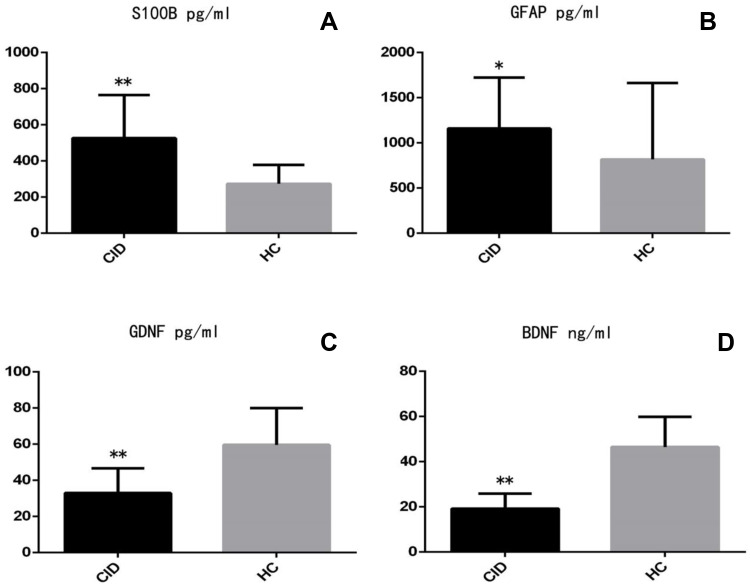
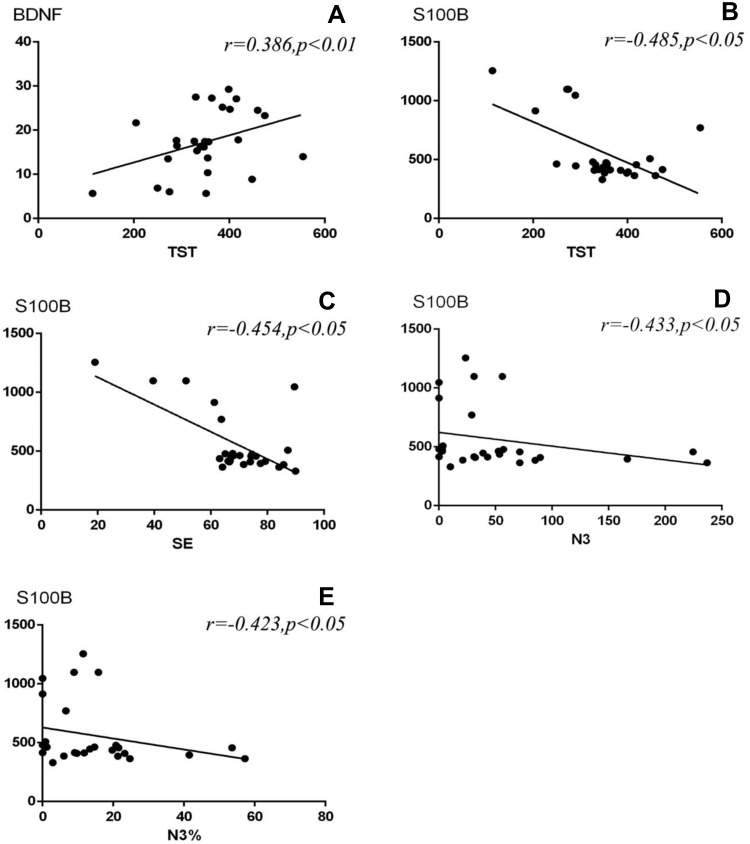
The CID group had higher levels of S100B and GFAP and lower levels of BDNF and GDNF than the HC group. Spearman correlation analysis revealed that poor sleep quality, assessed by subjective and objective measures, was positively correlated with S100B level and negatively correlated with BDNF level. GFAP level correlated positively with poor subjective sleep quality. Moreover, S100B and GFAP levels correlated negatively with general cognitive function assessed using MoCA-C. GFAP level correlated positively with poor spatial working memory (SWM) in the NBMT; BDNF level was linked to poor SWM and object recognition memory (ORcM) in the NBMT. However, principal component analysis revealed that serum S100B level was positively linked to the errors in object working memories, BDNF and GDNF concentrations were negatively linked with errors in ORcM, and GFAP concentration was positively correlated with the errors in the SWM and spatial reference memories.
Serum S100B, GFAP, BDNF, and GDNF levels were altered in patients with CID, indicating astrocyte damage, and were associated with insomnia severity or/and cognitive dysfunction.
本研究旨在调查慢性失眠障碍(CID)患者血清生物标志物S100钙结合蛋白B(S100B)、胶质纤维酸性蛋白(GFAP)、脑源性神经营养因子(BDNF)和胶质细胞系源性神经营养因子(GDNF)是否发生变化,若如此,这些血清生物标志物水平的改变是否与CID患者睡眠质量差和认知功能下降相关。
57例CID门诊患者组成CID组;还纳入了30名健康对照者(HC)。采用问卷、多导睡眠图、中文版蒙特利尔认知评估量表(MoCA-C)和九盒迷宫试验(NBMT)评估他们的睡眠和神经心理功能。采用酶联免疫吸附测定法评估血清S1OB、GFAP、BDNF和GDNF。
与HC组相比,CID组S100B和GFAP水平较高,BDNF和GDNF水平较低。Spearman相关性分析显示,通过主观和客观测量评估的睡眠质量差与S100B水平呈正相关,与BDNF水平呈负相关。GFAP水平与主观睡眠质量差呈正相关。此外,S100B和GFAP水平与使用MoCA-C评估的总体认知功能呈负相关。GFAP水平与NBMT中较差的空间工作记忆(SWM)呈正相关;BDNF水平与NBMT中较差的SWM和物体识别记忆(ORcM)相关。然而,主成分分析显示,血清S100B水平与物体工作记忆中的错误呈正相关,BDNF和GDNF浓度与ORcM中的错误呈负相关,GFAP浓度与SWM和空间参考记忆中的错误呈正相关。
CID患者血清S100B、GFAP、BDNF和GDNF水平发生改变,表明星形胶质细胞受损,且与失眠严重程度或/和认知功能障碍相关。