Bai Xue, Wang Wen-Xiao, Fu Rui-Jia, Yue Shi-Jun, Gao Huan, Chen Yan-Yan, Tang Yu-Ping
Key Laboratory of Shaanxi Administration of Traditional Chinese Medicine for TCM Compatibility, and State Key Laboratory of Research & Development of Characteristic Qin Medicine Resources (Cultivation), and Shaanxi Key Laboratory of Chinese Medicine Fundamentals and New Drugs Research, and Shaanxi Collaborative Innovation Center of Chinese Medicinal Resources Industrialization, Shaanxi University of Chinese Medicine, Xi'an, China.
Front Pharmacol. 2020 Sep 29;11:01265. doi: 10.3389/fphar.2020.01265. eCollection 2020.
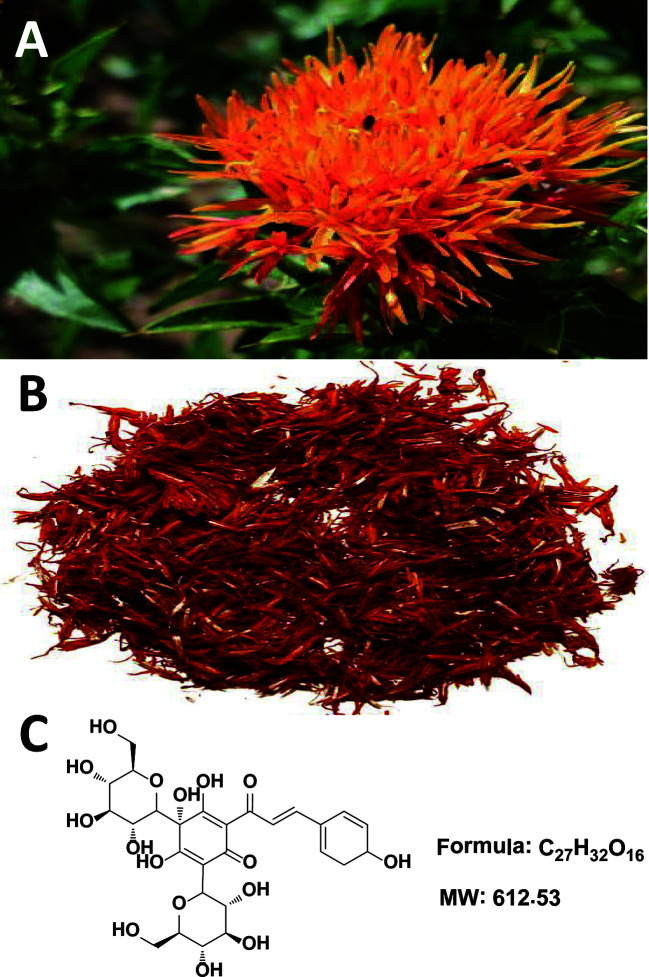
The incidence rate of cardio-cerebrovascular diseases (CCVDs) is increasing worldwide, causing an increasingly serious public health burden. The pursuit of new promising treatment options is thus becoming a pressing issue. Hydroxysafflor yellow A (HSYA) is one of the main active quinochalcone -glycosides in the florets of L., a medical and edible dual-purpose plant. HSYA has attracted much interest for its pharmacological actions in treating and/or managing CCVDs, such as myocardial and cerebral ischemia, hypertension, atherosclerosis, vascular dementia, and traumatic brain injury, in massive preclinical studies. In this review, we briefly summarized the mode and mechanism of action of HSYA on CCVDs based on these preclinical studies. The therapeutic effects of HSYA against CCVDs were presumed to reside mostly in its antioxidant, anti-inflammatory, and neuroprotective roles by acting on complex signaling pathways.
全球范围内,心脑血管疾病(CCVDs)的发病率正在上升,给公共卫生带来了日益沉重的负担。因此,寻求新的有效治疗方案已成为一个紧迫的问题。羟基红花黄色素A(HSYA)是一种药食两用植物红花小花中的主要活性喹诺查耳酮苷之一。在大量临床前研究中,HSYA因其在治疗和/或管理CCVDs方面的药理作用而备受关注,这些疾病包括心肌缺血、脑缺血、高血压、动脉粥样硬化、血管性痴呆和创伤性脑损伤。在本综述中,我们基于这些临床前研究简要总结了HSYA对CCVDs的作用方式和机制。HSYA对CCVDs的治疗作用主要推测在于其通过作用于复杂的信号通路发挥抗氧化、抗炎和神经保护作用。