Partap Mahinder, Kumar Pankaj, Kumar Anil, Joshi Robin, Kumar Dinesh, Warghat Ashish R
Cell and Tissue Engineering Laboratory, Biotechnology Division, Council of Scientific and Industrial Research (CSIR)-Institute of Himalayan Bioresource Technology, Palampur, India.
Academy of Scientific and Innovative Research, Ghaziabad, India.
Front Plant Sci. 2020 Sep 30;11:01263. doi: 10.3389/fpls.2020.01263. eCollection 2020.
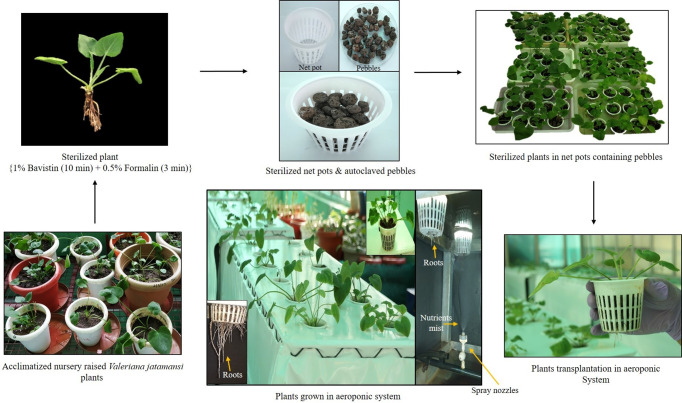
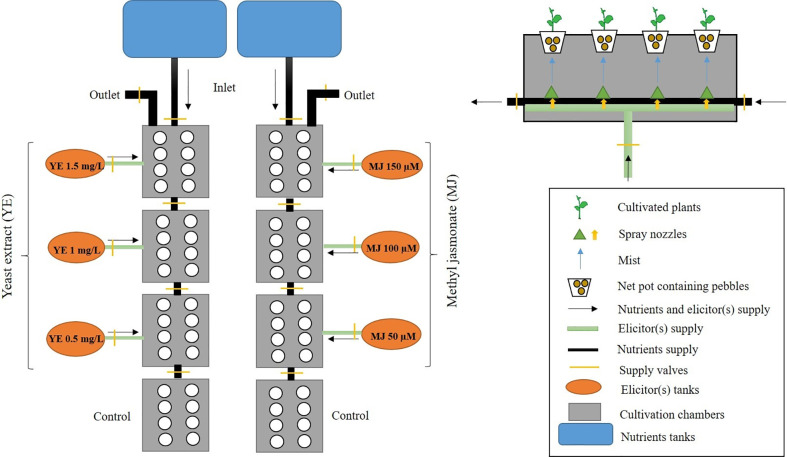
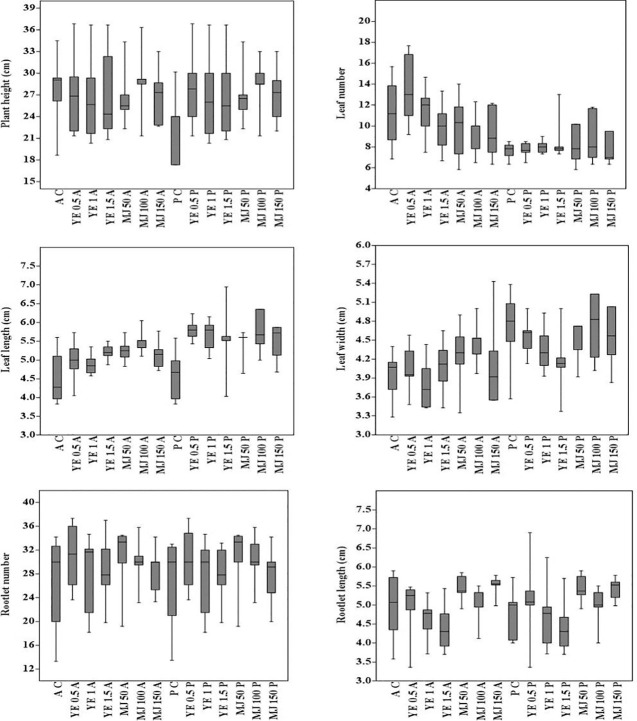
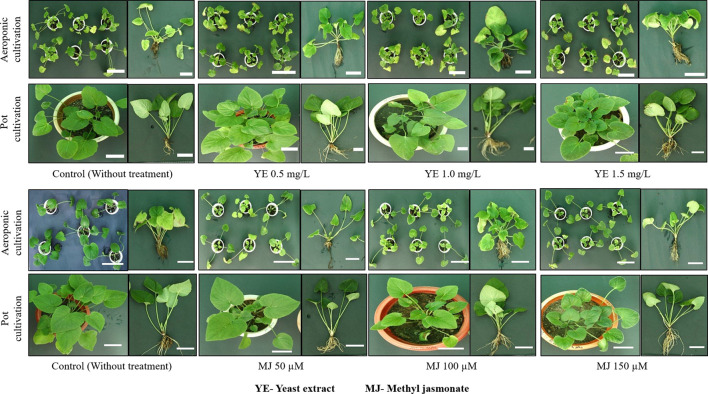
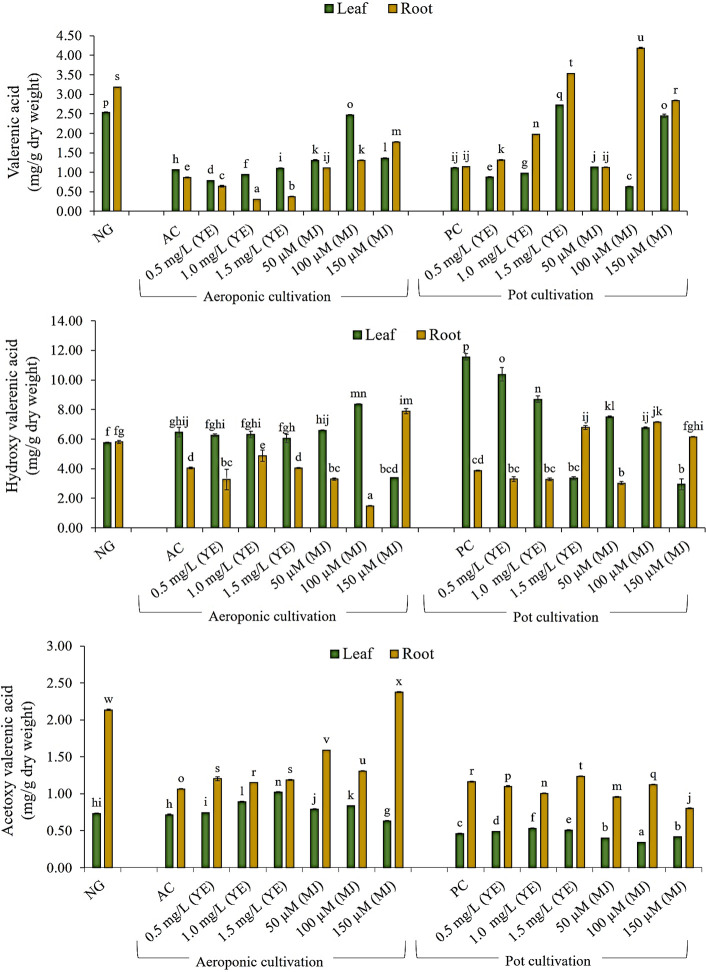
The use of new agricultural technologies such as soilless and aeroponic cultivation systems is a valuable approach to medicinal plant production. The present study investigated the prospects of enhancing yield and secondary metabolite production in under aeroponic cultivation using elicitors, such as yeast extract and methyl jasmonate. Plants were evaluated by measuring growth parameters, photosynthetic rate, and secondary metabolites contents (on a dry weight basis). Maximum plant height (36.83 cm), leaf number (17.67), rootlet number (37.33), and rootlet length (6.90 cm) were observed at 0.5 mg/L yeast extract treatment; whereas treatment levels of 1.5 mg/L yeast extract and 150 µM methyl jasmonate resulted in maximum leaf length (6.95 cm) and leaf width (5.43 cm), respectively. Maximum photosynthetic rate (5.4053 µmol ms) and stomatal conductance (0.0656 mmol ms) were recorded at treatment levels of 0.5 mg/L and 1.5 mg/L yeast extract respectively, whereas at 150 µM methyl jasmonate treatment, transpiration rate was 0.9046 mmol ms. In aeroponic cultivation, the maximum content of valerenic acid and hydroxy valerenic acid was detected in leaf (2.47 and 8.37 mg/g) and root (1.78 and 7.89 mg/g) at treatment levels of 100 µM and 150 µM methyl jasmonate, respectively. Acetoxy valerenic acid was highest in leaf (1.02 mg/g) at 1.5 mg/L yeast extract, and in the root (2.38 mg/g) at 150 µM methyl jasmonate. Gas chromatography-mass spectrometry analysis identified twenty-eight volatile compounds in roots, of which three-isovaleric acid (6.72-50.81%), patchouli alcohol (13.48-25.31%) and baldrinal (0.74-25.26%)-were the major constituents. The results revealed that, besides roots, leaves could also be utilized as a prominent alternative source for targeted secondary metabolites. In conclusion, aeroponic cultivation offers year-round quality biomass production and ease to access subsequent roots harvest in , to meet the demand of the pharmaceutical industries.
采用无土栽培和气雾栽培系统等新型农业技术是药用植物生产的一种有价值的方法。本研究调查了使用酵母提取物和茉莉酸甲酯等诱导剂在气雾栽培中提高产量和次生代谢产物产量的前景。通过测量生长参数、光合速率和次生代谢产物含量(以干重计)对植株进行评估。在0.5 mg/L酵母提取物处理下,观察到最大株高(36.83厘米)、叶片数(17.67片)、细根数(37.33条)和细根长度(6.90厘米);而1.5 mg/L酵母提取物和150 μM茉莉酸甲酯处理水平分别导致最大叶长(6.95厘米)和叶宽(5.43厘米)。分别在0.5 mg/L和1.5 mg/L酵母提取物处理水平下记录到最大光合速率(5.4053 μmol m/s)和气孔导度(0.0656 mmol m/s),而在150 μM茉莉酸甲酯处理下,蒸腾速率为0.9046 mmol m/s。在气雾栽培中,分别在100 μM和150 μM茉莉酸甲酯处理水平下,叶片(2.47和8.37毫克/克)和根(1.78和7.89毫克/克)中检测到缬草烯酸和羟基缬草烯酸的最大含量。乙酰氧基缬草烯酸在1.5 mg/L酵母提取物处理的叶片中含量最高(1.02毫克/克),在150 μM茉莉酸甲酯处理的根中含量最高(2.38毫克/克)。气相色谱-质谱分析鉴定出根中有28种挥发性化合物,其中异戊酸(6.72 - 50.81%)、广藿香醇(13.48 - 25.31%)和缬草醛(0.74 - 25.26%)为主要成分。结果表明,除了根之外,叶也可以作为目标次生代谢产物的重要替代来源。总之,气雾栽培可实现全年优质生物量生产,并且便于后续收获根部,以满足制药行业的需求。